A sun-synchronous orbit (SSO) is one of the most frequently used orbits for Earth-science and national security missions. SSOs are near-polar orbits whose ascending nodes precess at a rate that is matched to the Earth's mean orbital rate around the sun, i. e., about one degree per day.
This motion allows the maintenance of the orbit's geometry with respect to the sun such that solar lighting along the SSO satellite's ground track remains approximately the same over the mission's duration.
Thanks to the Earth's asymmetrical gravity field, a natural force is exerted on these orbits that results in precessional motion that assures a constant sun angle as each SSO satellite passes over the Earth's surface.
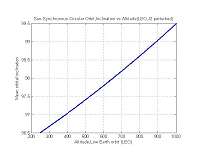
The figure illustrates the relationship between SSO inclination and altitude for circular orbits. For example, one SSO satellite at 800 km altitude would have to have an inclination of 98.6 degrees in order to maintain a constant sun angle with the orbit.
SSOs have been used for more than 50 years. One result of this is the accumulation of a large population of resident space objects (RSO) consisting of active satellites, expired satellites, discarded rocket bodies and many other debris objects.
Thus, the orbital belt between 700 and 900 km altitude is the zone of highest debris population and is becoming so congested that flight threats in this region are approaching critical levels. Without a solution to the growing population of expired satellites, old rockets and other debris, the safe use of SSOs may soon be impossible.
While SSO surveillance satellites have the advantage of photographing ground structures over and over with the same lighting conditions, and making the job of photo analysts relatively easy, SSO missions are actually obsolete. They are dinosaurs in the age of virtual reality, data analytics, high-speed data transmission and other recently developed technologies.
With these new capabilities any comprehensive Earth-coverage network of redesigned ISR satellites can collect sensor data, process this data and produce virtual results that represent critically important national security intelligence. Such constellations can avoid debris and adversarial threats, resulting in a highly resilient and hard-to-jam national security system. This is the kind of project that seems highly suitable for the new Space Development Agency.