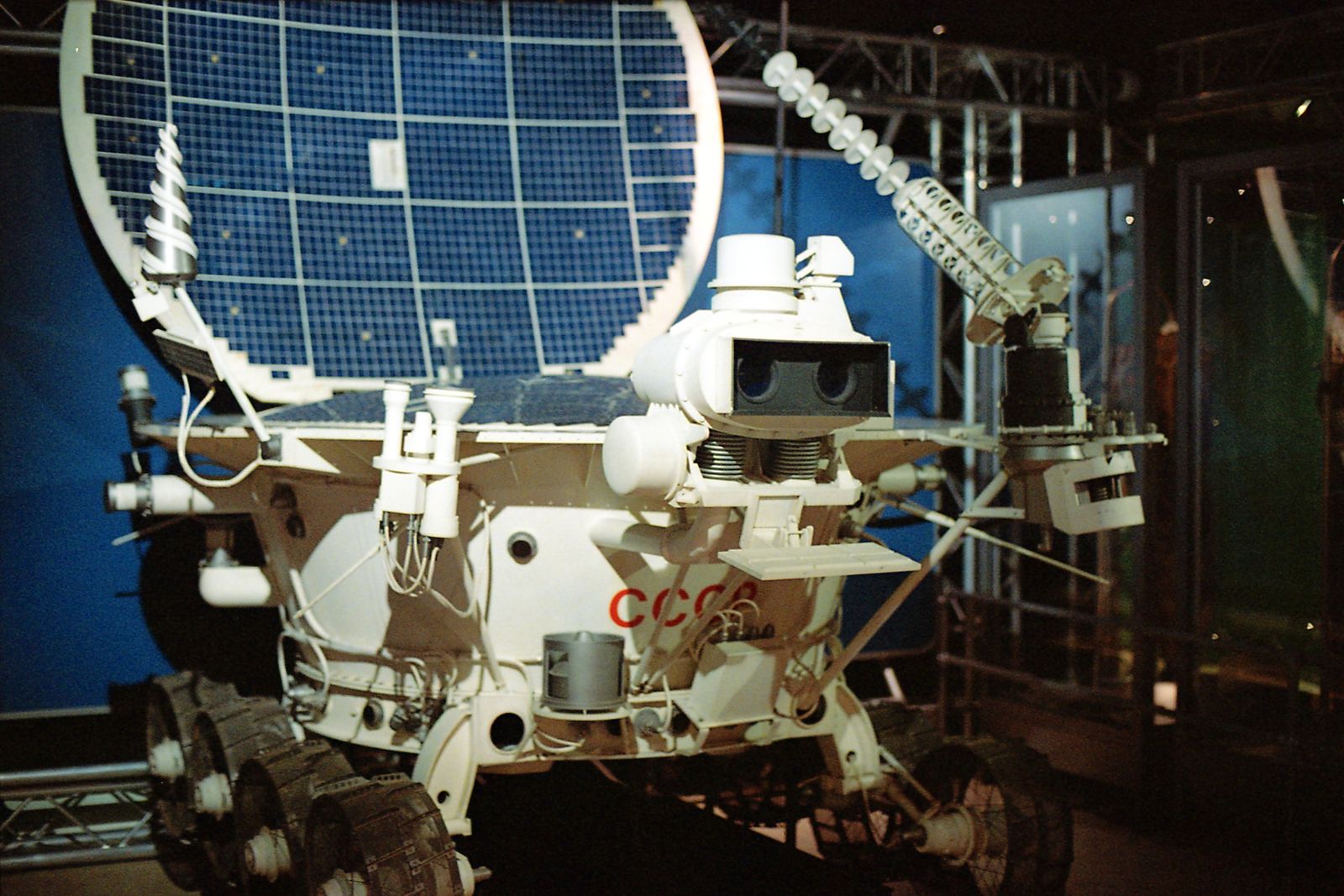
On February 18, 2021, a rover the size of a small car dropped through the Martian sky under a supersonic parachute, fired eight retrorockets, and was lowered on nylon cables into Jezero Crater. Bolted to its aft crossbeam, in plain view of its own cameras, sat three silicon chips no bigger than a fingernail. Etched into them by electron beam, in features thinner than a human hair, were 10,932,295 names — a census of Earthlings who had asked to ride along.
They are still there. They will be there long after the rover stops moving.
A phone book, written with an electron beam
The chips were produced at NASA’s Jet Propulsion Laboratory, in a facility called the Microdevices Laboratory. The tool that did the writing is an electron-beam lithography machine — the same class of instrument used to prototype the finest features on advanced semiconductors. Instead of light, it steers a focused beam of electrons across a resist-coated wafer, drawing lines that can be smaller than one micron across. A human hair, by comparison, is roughly 70 microns thick.
Each name on the Perseverance chips sits in a line of text about less than one thousandth of a millimeter high. To read one, you would need a scanning electron microscope. Stacked together, nearly eleven million of them fit on three squares of silicon you could hide under a grain of rice.
The names were gathered through NASA’s “Send Your Name to Mars” campaign, an online sign-up. Anyone with an email address could submit. Kids used their parents’ phones. Grandparents typed in their late spouses. Some people entered pets. The final tally, confirmed by NASA before launch, was 10,932,295 submissions from around the world.
The plate you can see from the mast cam
The three chips are not hidden inside the rover. They are mounted to a small anodized aluminum plate, bolted to the center of the aft crossbeam, angled to be visible to Perseverance’s mast-mounted cameras. That was deliberate. The chips are meant to be photographed on Mars, so the people whose names ride them can, in theory, see their carrier in situ.
The plate carries more than the chips. Alongside the names, engineers included the essays of finalists from NASA’s “Name the Rover” contest, a nationwide competition for K–12 students. Among them: the winning entry by Alex Mather, a seventh grader from Virginia who proposed “Perseverance,” and the entry by a student whose word “Ingenuity” was chosen for the helicopter that flew alongside the rover.
Etched into the same plate is a laser-cut graphic: Earth and Mars linked by the rays of the Sun. The design is a direct nod to the Pioneer plaques of the 1970s and to the Golden Records bolted to Voyagers 1 and 2, spacecraft that still whisper home from interstellar space on less power than a household bulb, a story SpaceMart has explored in detail.
Why silicon, why an electron beam
The Microdevices Lab at JPL normally uses its electron-beam writer to fabricate detector arrays, superconducting circuits, and the kind of precision optics that fly on space instruments. Turning it on eleven million names is a very unusual assignment for the machine.
Silicon was the natural substrate. It is dimensionally stable, resistant to the radiation environment on the Martian surface, and does not corrode in the thin, cold, carbon dioxide atmosphere. It also holds an electron-beam-drawn feature indefinitely. Once the pattern is etched, there is nothing to fade. The names on those chips will remain legible, in principle, for as long as the silicon itself survives — which on Mars, absent a rover wheel crushing it, is a geological timescale.
The names were not written one at a time in the traditional sense. The engineers rendered the full list as a single vector artwork, then let the beam sweep across the wafer, exposing the resist in the shape of each letter. Every character in every name is a set of geometric shapes, roughly under a micron in its finest dimension. The resulting text is invisible to the unaided eye, and only barely resolvable in an optical microscope.
A seven-month cruise and a seven-minute landing
Perseverance launched atop a United Launch Alliance Atlas V from Cape Canaveral on July 30, 2020, at 7:50 a.m. Eastern. The mission is NASA’s first dedicated to astrobiology — the search for direct evidence of ancient life on another world.
The cruise took just under seven months. On February 18, 2021, the spacecraft slammed into the Martian atmosphere at high speed. In roughly seven minutes it deployed a supersonic parachute, jettisoned its heat shield, ignited descent engines, and hovered above the surface while a sky crane lowered the rover on cables. The chips came through the whole sequence undisturbed, bolted to the crossbeam behind the rover’s neck.
Jezero was chosen for a specific reason. It is an ancient impact basin that once held a lake, fed by a river that carved a delta into its western rim. If microbial life ever existed on Mars, the fine-grained sediments of a lake delta are one of the best places to preserve chemical fingerprints of it. Perseverance’s job is to drill core samples, seal them in titanium tubes, and cache them for a future mission to fetch back to Earth.
A rover carrying a rover-naming essay, on a rover named by that essay
The recursion on that plate is worth pausing on. Alex Mather’s winning essay, etched in silicon and now sitting on Mars, is the essay that named the vehicle carrying it. His words, submitted through a nationwide student contest, argued that previous rovers — Curiosity, Spirit, Opportunity — were named for human qualities, and that the missing one was perseverance itself.
Mather’s essay argued that humans evolved as creatures who could learn to adapt to any situation, no matter how harsh, and that we are a species of explorers who can persevere through setbacks on the way to Mars.
Those sentences now sit, in electron-beam-drawn letters smaller than a hair’s width, on the aft crossbeam of the machine they named. The runner-up essay sits on the same plate. The helicopter that essay named would go on to make the first powered flight on another planet.
A second plate, for the pandemic
The name chips are not the only human artifact bolted to Perseverance. On the port side of the rover’s chassis sits a separate aluminum plate installed as a tribute to healthcare workers who kept working through 2020, the same year JPL engineers were finishing the rover under new lab-access rules.
Two plates, then. One carries eleven million names of ordinary people. The other carries a symbol for the people who cared for them during the year the rover was being finished. Both left Earth together.
How eleven million names fit on three fingernails
The math is easier than it looks. If each name occupies a line of text roughly one micron tall by a few hundred microns wide, a single square-centimeter chip can hold on the order of ten million lines — a full metropolitan phone book — with room around the edges for framing marks and human-readable labels. Divide 10,932,295 across three chips and the density is comfortable.
Electron-beam lithography, the technique borrowed here from JPL’s Microdevices Laboratory, is the same family of tool used to prototype photomasks for the world’s leading-edge chip fabs. On a commercial semiconductor line, features are printed in the single-digit-nanometer range. The Perseverance chips are coarser than that, but the principle is identical: focus electrons, expose resist, develop the pattern, and you have a permanent record at the scale of viruses.
Silicon on Mars will not rust. The daily temperature at Jezero swings from about minus 130 to plus 20 degrees Fahrenheit, well within the thermal tolerance of a passive silicon wafer. Dust will accumulate. Wind will scour. But the etched features are recessed into the substrate, not raised on top of it, so surface abrasion would take a very long time to erase them.
A tradition that started with a plaque and a phonograph
Sending human artifacts on robotic spacecraft is older than the shuttle program. Pioneer 10 and 11, launched in 1972 and 1973, carried gold-anodized aluminum plaques showing a naked man and woman, a solar system map, and a diagram of hydrogen’s spin-flip transition. Voyager 1 and 2, launched in 1977, carried gold-plated copper phonograph records with greetings in 55 languages, whale song, Bach, and Chuck Berry.
The Perseverance chips update that tradition for the mass-participation internet. Instead of a curated committee choosing what humanity should say, eleven million people typed their own names into a form. The message is the roll call itself.
NASA has continued the practice on later missions. The Europa Clipper spacecraft, one of the recent primary missions to fly on a SpaceX Falcon Heavy from Kennedy Space Center — SpaceMart tracked the sequence including IXPE, Psyche, GOES-U and IMAP — carries its own etched microchip with names and a hand-written poem. The technique has become a standard payload accessory.
What the chips will outlast
Perseverance’s plutonium power source, a multi-mission radioisotope thermoelectric generator, is warranted for at least 14 Earth years of operation. Its wheels — aluminum, not the shape-memory-alloy tires NASA engineers have prototyped for future missions — will eventually accumulate punctures from the Jezero rock field. The onboard electronics will fail. Motors will seize.
The silicon chips will not. Bolted to a stationary chassis on a planet with no liquid water, no oxygen weathering to speak of, and no biological activity, they will remain readable, in principle, for millions of years. If a future mission — human or robotic — ever pulls that aft crossbeam plate off Perseverance and puts one of those chips under an electron microscope, the names will resolve, letter by letter, exactly as they were written in the JPL cleanroom.
Somewhere on one of them is the name of a child who signed up at age seven and will be in their thirties before humans set foot on Mars. Somewhere is the name of a person who has since died. Somewhere is a joke entry, a cat, a fake identity, a grandmother’s maiden name typed by a grandchild. All of them are on the fourth planet from the Sun, sitting in a crater that used to be a lake, waiting for someone to look.