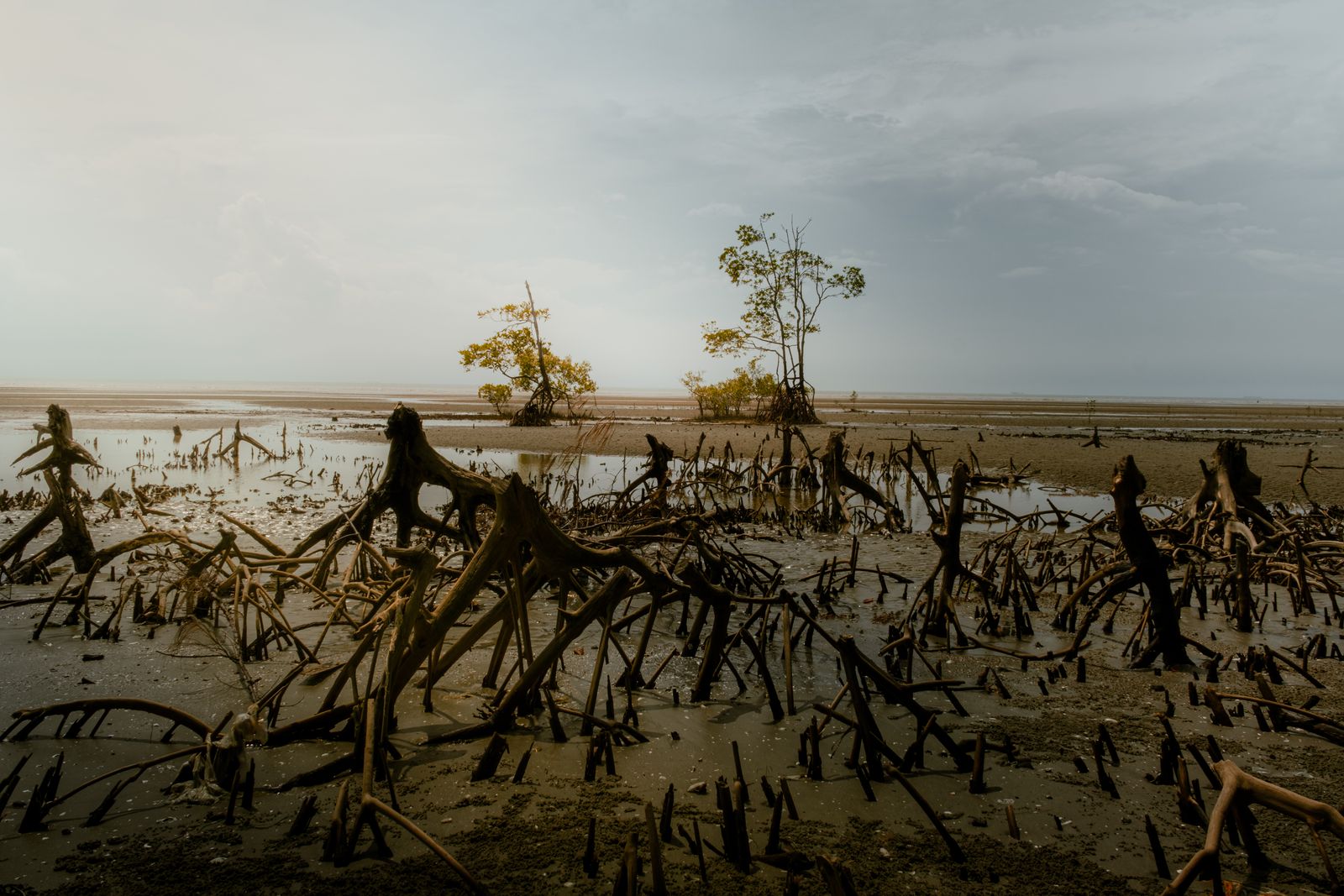
Mangroves are the strangest carbon vaults on Earth. A single hectare of tangled coastal mangrove forest — the kind that grows on stilts in the brackish seams where rivers hit the ocean, from Sundarbans mud to Florida’s Ten Thousand Islands — locks away between 500 and 1,000 tonnes of carbon, roughly three to four times what a hectare of Amazon or Congo rainforest holds. And the trees themselves are only part of it. Most of that carbon sits underneath, buried in waterlogged peat that can run six metres deep.
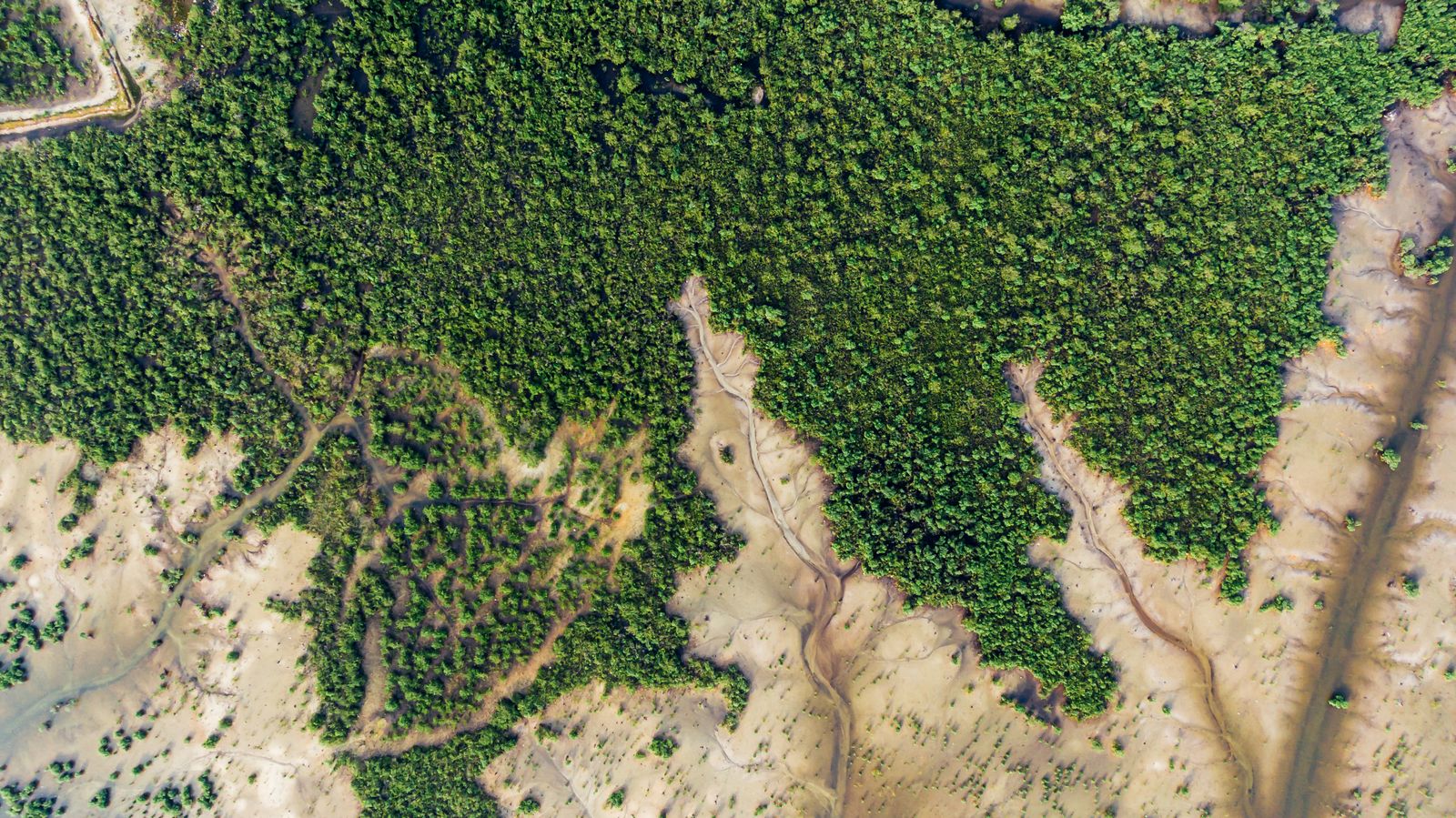
Mangroves cover about 147,000 square kilometres worldwide, a sliver of tropical forest area. Yet the coastal band they occupy holds somewhere between 4 and 20 billion tonnes of carbon, much of it in soil that has been accumulating, undisturbed, since the last ice age. The reason a five-metre tree can out-store a 60-metre rainforest giant comes down to one unglamorous variable: mud that never lets oxygen in.
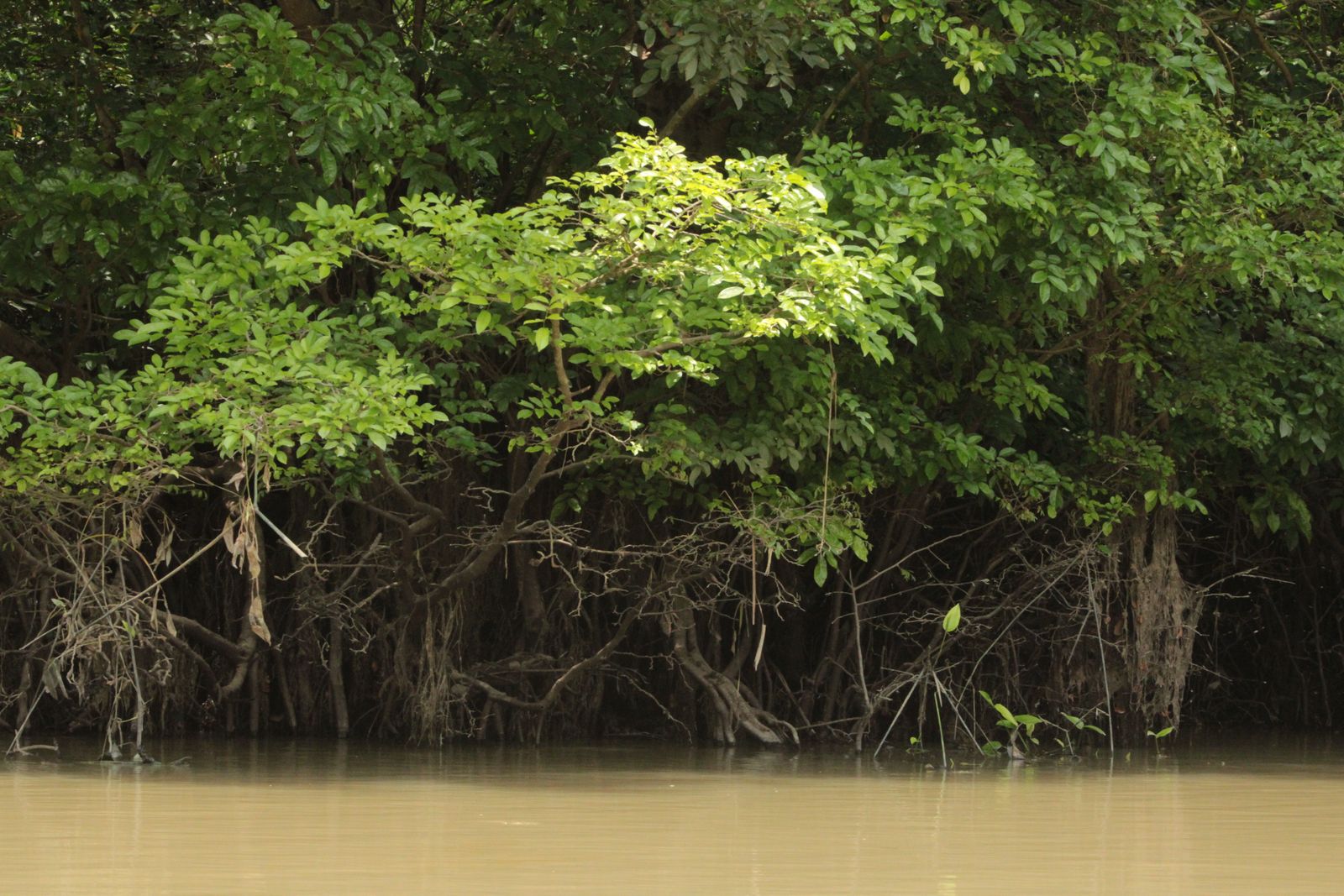
The trick is not the tree. It is the mud.
Inland rainforests store carbon mostly above ground — in trunks, branches, canopy. When a kapok tree dies in the Amazon, microbes and fungi in warm, oxygen-rich soil break the wood down in years. The carbon that took a century to lock into cellulose exhales back into the atmosphere as CO₂ within a decade or two. It is a fast conveyor belt: pull carbon down, push it back up.
Mangroves run a different system. Their roots sit in salt water that floods and drains twice a day, and the sediment they trap is anaerobic — starved of oxygen almost from the moment it settles. Leaf litter, dead root mass, propagules that never sprouted, all of it drops into that mud and stays there. Decomposition slows to a crawl. What would rot in a decade in Borneo can persist for millennia under a Sundarbans mangrove.
The carbon accumulates in layers, year after year, tide after tide. Sediment cores drilled through mangrove peat regularly turn up wood fragments dated to 6,000 or 8,000 years old, still intact enough to identify the species.
Why the ratio comes out four to one
A standing tropical rainforest holds most of its carbon in living biomass, with the rest in soil to a depth of about a metre. A mangrove forest inverts that ratio. Below-ground stocks in mangrove peat often make up the majority of total carbon, and the peat can extend three, five, sometimes eight metres down before hitting sterile clay or bedrock.
Stack a three-metre peat column against a one-metre rainforest soil layer, add the fact that mangrove peat carries roughly double the organic carbon density per cubic metre, and the four-to-one figure stops seeming remarkable. It seems structural. The chemistry of tidal mud is doing the work that the trees, on their own, could never manage.
Similar dynamics show up in other coastal systems. A 2026 field study of coastal British Columbia found that peatlands along the temperate rainforest coast store roughly three to five times more carbon per unit area than the towering old-growth spruce and cedar behind them, for the same reason. Waterlogged ground, low oxygen, slow decay.
Blue carbon: the term coined for what mangroves do
Marine scientists started calling this coastal storage “blue carbon” to separate it from the “green carbon” held in terrestrial forests. Blue carbon systems — mangroves, salt marshes, seagrass meadows — occupy a small fraction of the ocean surface but account for a disproportionate share of carbon buried in marine sediments.
Mangroves bury carbon at rates several times faster than a mature Amazon plot. The Amazon is a bigger reservoir in absolute terms, because it covers millions of square kilometres. But per hectare, per year, mangroves are the sharper pencil.
The distinction matters because inland rainforest sinks are showing strain. A recent Cary Institute study led by forest ecologist Evan Gora found that thunderstorms are responsible for 30 to 60 percent of tropical tree mortality, and storm activity is increasing by 5 to 25 percent per decade in the tropics. Trees that took 200 years to grow are being toppled in an afternoon, and the carbon they held returns to the sky within a decade of falling.
Inland tropical forests are not slouching. The Congo Basin, the second-largest rainforest on Earth, has held up better than most. A landmark 2020 study in Nature found that intact African tropical forests stayed a stable carbon sink for three decades, absorbing about 0.66 tonnes of carbon per hectare each year even as the Amazon’s uptake faltered. But that sink is an above-ground one, and it is weakening: the same work found the overall pull of intact tropical forests peaked in the 1990s and had fallen by roughly a third by the 2010s as heat and drought killed trees faster.
The Congo also runs its own climate feedback: its trees pump so much moisture into the atmosphere that the forest helps generate its own rainfall, and clearing it measurably cuts local precipitation. It is an elegant system, but it is still an above-ground one. When the trees go, the carbon and the rain go with them. Mangrove peat, buried under salt water, is harder to lose in a single fire season.
What happens when the mud gets dug up
The flip side of storing centuries of carbon in wet sediment is that when someone drains that sediment, all of it comes out at once. Convert a hectare of Indonesian mangrove into a shrimp pond — as has happened across much of Southeast Asian mangrove range in recent decades — and the exposed peat oxidises rapidly, releasing large quantities of CO₂ over the following decade or two.
That is more than clearing a hectare of upland rainforest releases, because the rainforest’s carbon was above ground and partly recyclable through regrowth; the mangrove’s carbon was ancient, and once ventilated, it is gone.
The math has finally caught the attention of carbon markets. Mangrove restoration credits now trade at premiums to reforestation credits, precisely because the below-ground storage is so durable — provided the restored trees actually take, and the peat stays wet.
A comeback, quietly
After decades of retreat, mangroves may be gaining ground for the first time since satellite records began. A Tulane University study published in the journal Science in 2026 analysed four decades of satellite imagery and found that global mangrove cover is no longer in net decline, with losses now offset largely by natural regeneration and by the forests expanding into newly formed coastal ground.
The recovery is fragile. Sea-level rise is a friend to mangroves only if the trees can migrate inland faster than the ocean drowns them, and only if there is land available — not seawalls, not shrimp farms, not resorts. In Florida and the Gulf of Mexico, researchers tracking ghost forests — stands of dead trees killed by saltwater intrusion — have found that mangroves often colonise the same ground within a decade or two, effectively replacing drowned pine and cypress. The forest changes species. The coast keeps its trees. The carbon economy of the shore reboots.
The ceiling everyone is worried about
The concern hovering over all of this is capacity. A joint report by Future Earth, The Earth League, and the World Climate Research Programme warned in late 2025 that the world’s forests and soils are approaching critical limits on how much carbon they can naturally absorb. According to Forbes, Sabine Fuss of the Potsdam Institute for Climate Impact Research has noted that natural carbon sinks that humanity has long depended upon are weakening under record-breaking temperatures.
Mongabay reported in December 2025 that tropical forests in northern Australia have flipped from net carbon sink to net carbon source, releasing more CO₂ than they absorb — a threshold once considered decades away.
Mangroves are not immune to any of this. Warmer seas bleach the reefs that shelter mangrove coasts from wave action. Stronger cyclones flatten decades-old stands in hours. Drought at the freshwater end of the tidal gradient stresses trees that evolved for exactly the salinity mix they no longer get.
But the peat itself, three metres down, cool and anoxic, is the last part of the system to unravel. That is the layer doing the four-to-one lifting. And it is the layer that, if left alone in wet sediment under tidal water, will still be there long after the trees above it have been replaced by a new generation, and the generation after that.
A wood fragment sampled from Sundarbans peat and radiocarbon-dated returned an age of roughly 7,200 years. It was buried before the first cities rose in Mesopotamia, before writing, before the wheel, and it still had not finished decomposing when the corer pulled it up.