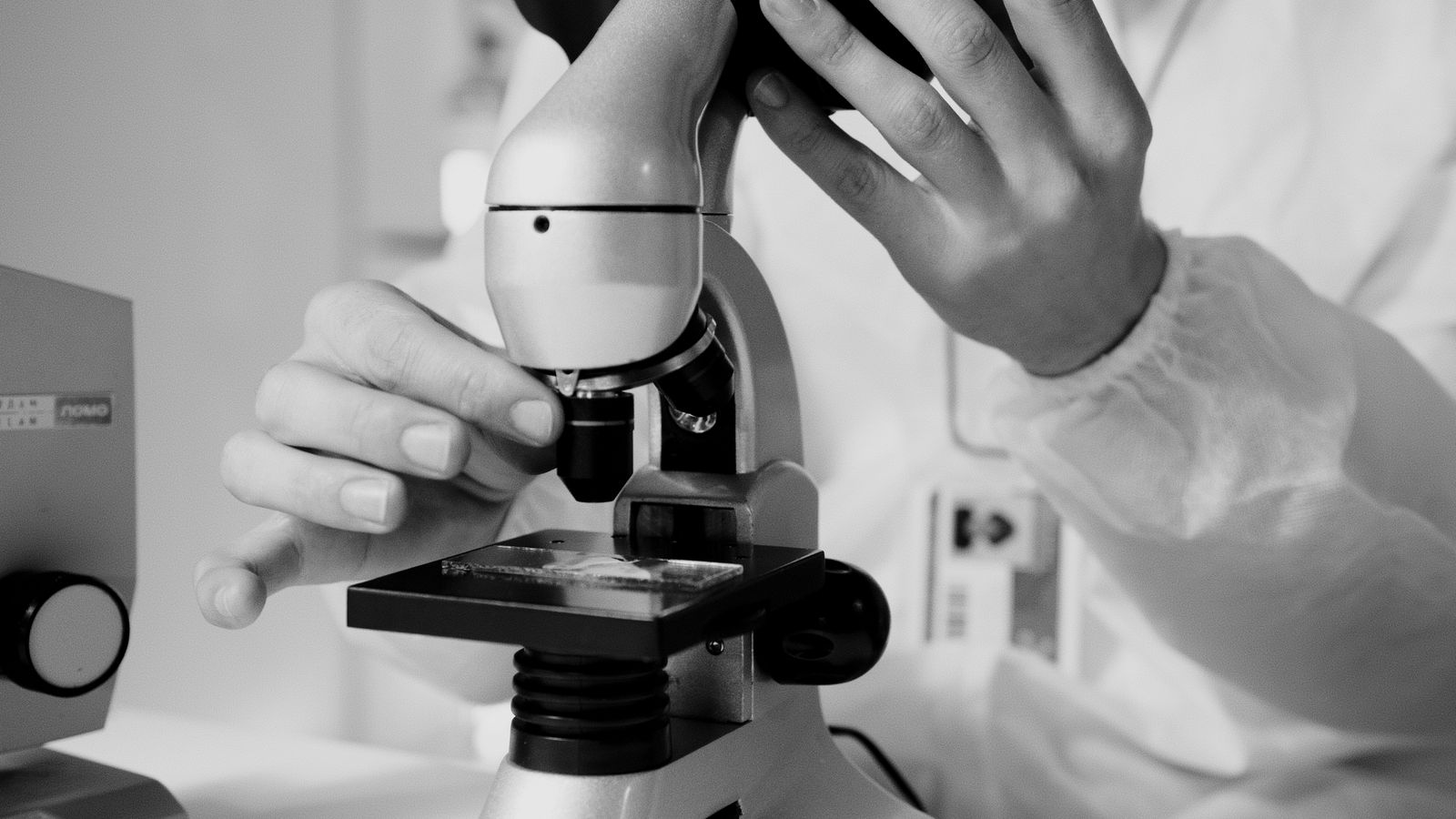
In the winter of 1868, a 24-year-old Swiss physician named Friedrich Miescher walked into a converted castle kitchen in Tübingen, Germany, opened a bucket of pus-soaked bandages collected from a nearby surgical clinic, and began scraping the yellow-white residue into glassware. Within a year, he had isolated a phosphorus-rich substance from inside the cell nuclei that he could not identify, could not name, and could not classify against any of the three known biomolecules of his era. He called it nuclein. He was holding purified DNA, 84 years before James Watson and Francis Crick would publish the double helix model in 1953.
He died in 1895, aged 51, believing he had failed.
A physician who couldn’t hear his patients
Miescher was born in Basel in 1844 into a family of well-known doctors. Medicine was the family trade. He studied for it dutifully. But severe hearing loss from illness had left him struggling with clinical work, and by his early twenties he had concluded — reasonably enough — that a physician who could not hear a patient’s chest through a stethoscope was going to be a poor physician. According to molecular biologist Kersten Hall, that anxiety pushed him toward the laboratory rather than the ward.
In 1868 he moved to Tübingen to work under Felix Hoppe-Seyler, the German chemist who is generally credited with founding biochemistry as a discipline. Hoppe-Seyler had set up his laboratory inside Hohentübingen Castle, in rooms that had been the royal kitchens. The conversion was minimal. Beakers replaced pots. Distillation alembics replaced stew pans. Miescher later compared the setup to the workshop of a medieval alchemist.
His ambition, though, was thoroughly modern. He wanted to understand life at the chemical level — to work out what molecules cells were actually made of.
Why pus, of all things
White blood cells were the ideal starting material. They were not embedded in tough tissue. They did not have to be sliced or ground. They floated freely, and they were abundant in one very reliable 19th-century commodity: infected wound drainage. Antiseptic surgery, championed by Joseph Lister, was still spreading through Europe, and most surgical wounds got infected as a matter of routine. The Tübingen surgical clinic threw out bloodied, pus-heavy bandages by the basketful.
Miescher collected them. He scraped the yellow crust into saline, filtered the cells, and set to work. The task was as unglamorous as science gets. According to Hall and Ralf Dahm writing in The Conversation, the smell alone made the work punishing, and the samples had to be processed cold to stop the cells from breaking down before he could get inside them.
He was looking for the three biomolecules the field already knew: lipids, carbohydrates, proteins. He found them. Then he found something else.
The substance that refused to behave
The unknown material was concentrated inside the nucleus of the cell — the small dense body at the centre that biologists at the time suspected was important but could not explain. When Miescher tried to break it down with pepsin, the enzyme that digests proteins, it refused. When he stained it with iodine to test for carbohydrates, no reaction. When he washed it with alcohol and ether to dissolve lipids, it stayed intact.
And it contained phosphorus. A lot of phosphorus. Proteins do not. That single elemental signature told Miescher he was looking at a substance nobody had described before. He named it after the place it came from — the nucleus — and called it nuclein.
The word survives inside the modern term deoxyribonucleic acid.
A discovery buried on page 19
Hoppe-Seyler, cautious after a previous student had claimed a false discovery, held Miescher’s paper for two years to verify the chemistry himself. When the paper finally appeared in 1871, its title was not the sort of thing that made contemporaries lean forward. The significance of nuclein was buried deep in the manuscript, behind dense chemical tables of cell fractions almost nobody wanted to read.
The delay cost him. In the years between his experiment and his publication, other laboratories in Germany were catching up on cell chemistry. When the paper came out, it did not detonate. It sat there.
There was another problem, and it was aesthetic. Miescher had no picture to show. Nuclein was a white powder in a vial. It had no shape anyone could photograph, no structure anyone could draw. Watson and Crick, decades later, would have the enormous advantage of a diagram — a spiral staircase that a school child could redraw on a napkin. Miescher had a precipitate.
Salmon on the Rhine
In 1872 Miescher returned home to Basel and took a professorship at the university. The pus-and-bandages phase of his career was over. He needed a cleaner, more concentrated source of nuclein, and the Rhine provided one.
Every autumn and winter, salmon swam up the Rhine from the North Sea to spawn. The males’ testes ballooned in the run-up to mating and became, gram for gram, one of the richest natural sources of DNA in the animal kingdom — sperm cells are almost nothing but tightly packed nuclei. Miescher would rise before dawn, walk down to the river bank in the cold, buy salmon straight from the fishermen, and carry them back to his laboratory to extract nuclein from the milt.
He worked on those extracts for the rest of his life. He characterised nuclein’s acidic behaviour, its resistance to protein-digesting enzymes, and the extraordinary consistency of its phosphorus content. His student Richard Altmann later coined the term nucleic acid to describe the substance. Altmann’s rebranding effectively took ownership of the discovery away from his mentor. The word stuck. Miescher’s original name did not.
The insight he almost had
What is most poignant about Miescher’s story is how close he came to the second, larger idea. In the final years of his life, while ill with tuberculosis, he sat with Darwin’s writings on heredity and worked through a startling line of thought.
He proposed that the variation in biological traits between organisms — the differences that Darwin’s natural selection acted on — might be carried by variation in the physical structure of a single, large molecule inside cells. According to Hall, this was very likely the first time anyone had articulated that idea in print. It anticipates by half a century the argument the physicist Erwin Schrödinger would make famous in his 1944 book What Is Life?, the book that pushed a generation of physicists into biology and helped set Watson and Crick on their path.
Miescher had the right insight. He also had the wrong molecule. He assumed the hereditary carrier had to be a protein — proteins were complex, structurally varied, chemically rich, and clearly capable of enormous diversity. Nuclein, by comparison, seemed monotonous, made of just a handful of repeating chemical units. He never made the connection between his own discovery and his own theory. The two ideas sat in the same notebook and never touched.
Sisyphus at the bench
The Miescher who emerges from his letters is exhausted. He compared himself to Sisyphus, forever pushing a boulder up a hill, and he wrote to a colleague that he went to bed each night feeling like a schoolboy who had not done his homework. His duties multiplied. He ran nutrition studies for Swiss prisons. He advised the fishing industry on salmon biology. He built up Basel’s first institute of anatomy and physiology from scratch and then had to administer it. There was always less time for nuclein than he wanted.
His students remembered a man of unnerving intensity. On Miescher’s own wedding day, friends had to physically pull him away from his laboratory bench so he would not be late to the church.
He caught tuberculosis in 1890 and spent much of his remaining life in the Alps. He died in 1895. According to historical accounts, Miescher’s mentor Carl Ludwig recognized his student’s groundbreaking work near the end of Miescher’s life, predicting that future researchers would remember his contributions to cell research. That prediction turned out to be half right. The cells got studied. The descendants mostly forgot.
Eighty-four years to the helix
The line from Miescher’s phosphorus-rich white powder to the double helix runs through a series of quieter figures who kept nucleic acid research alive when almost nobody thought it mattered. Phoebus Levene worked out the sugar and base chemistry in the early 20th century. Oswald Avery, Colin MacLeod and Maclyn McCarty demonstrated in 1944 that DNA — not protein — was the substance that carried hereditary information in bacteria, finally correcting the assumption Miescher himself had made.
Then came the X-ray crystallographers. Rosalind Franklin’s Photo 51 in 1952 — a 60-hour X-ray exposure of a hydrated DNA fibre in a King’s College basement — produced a diffraction pattern so clean that the helical structure was visible in the image itself, before any model was built. Watson and Crick published their double-helix paper in Nature the following spring. Watson, who died in November 2025 at the age of 97, would spend the rest of his life associated with that single diagram.
The gap between Miescher pipetting salmon milt in Basel and Watson pointing at a wire model in Cambridge is 84 years. In that stretch of time the world learned to fly, split the atom, and picked up the telephone. Nuclein sat in labs across Europe and America the whole time, waiting to be recognised for what it was.
The forgotten castle
Hohentübingen Castle still stands above the town, and one of its ground-floor rooms — the one where Miescher scraped his bandages — is now a small museum. The pots and pans are long gone, and so are the alembics. A plaque marks the space as the birthplace of DNA research. Compared to the pilgrimage sites of modern biology, it gets few visitors. The town produced an outsized share of the chemistry that shaped the 20th century, from Miescher’s nuclein to Fritz Haber’s later work on ammonia synthesis a short train ride away.
Every strand of DNA in every cell of every living organism on Earth is a descendant, in a sense, of the substance Miescher first held up to a lamp in that castle kitchen in the winter of 1868. Roughly two metres of it are coiled inside almost every one of your cells right now. It carries three billion base pairs. It is copied, on average, once every time one of your cells divides — which, in an adult human body, is somewhere around 50 million times a second.
Miescher never saw a base pair. He never saw a helix. He never even saw a photograph of what he had discovered. He saw a white powder rich in phosphorus, wrote it up deep in a paper nobody read, and went to bed feeling like he had not done enough. The salmon still swim up the Rhine each winter, past the banks where he used to wait for them in the dark.