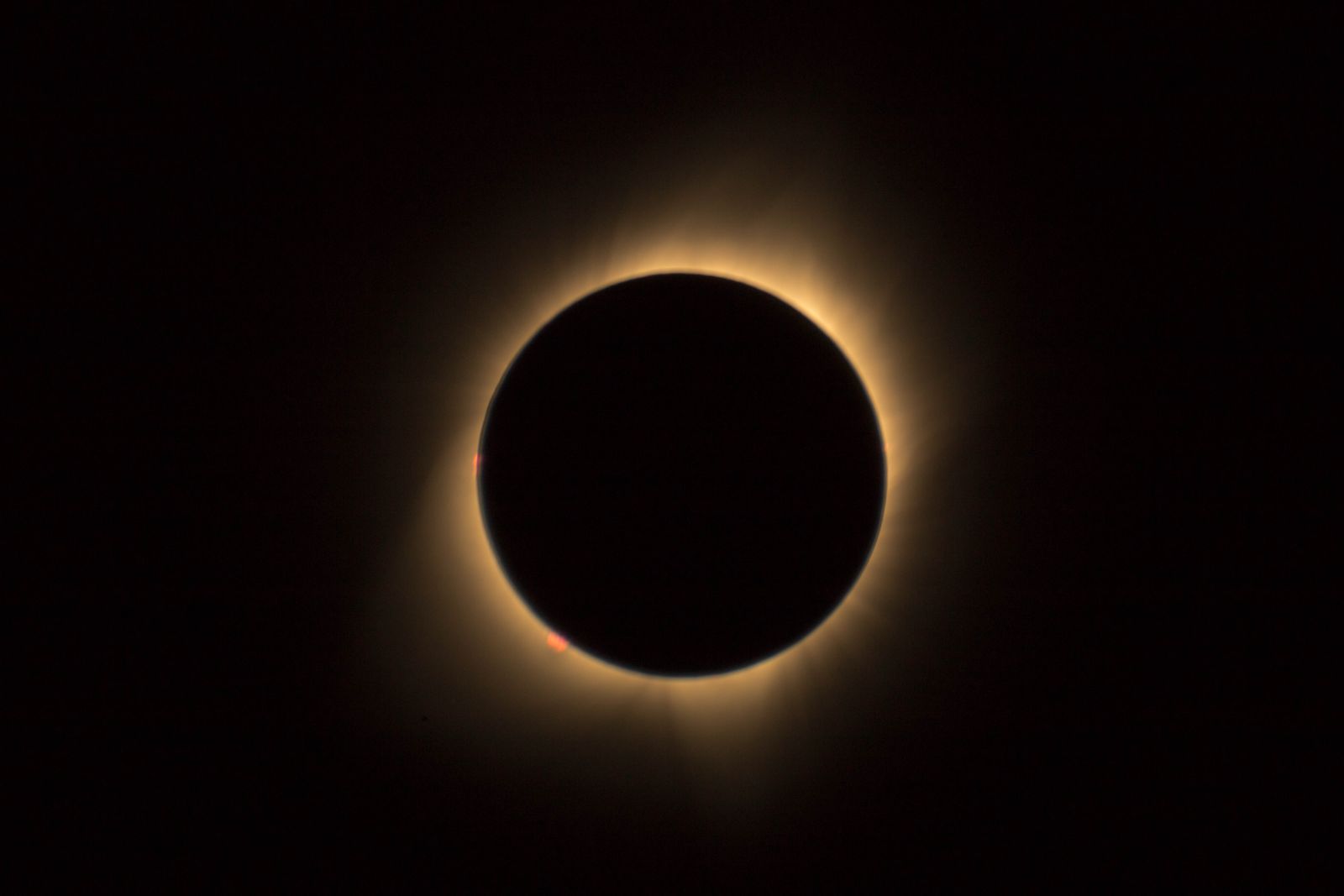
On the morning of 18 August 1868, a French astronomer named Pierre Janssen stood in the coastal town of Guntur, in what is now Andhra Pradesh, waiting for the Moon to swallow the Sun. When totality came, he swung a spectroscope toward the flaming prominences leaping off the solar limb and saw something impossible: a bright yellow line that belonged to no element then known on Earth. That line was helium. For the next 27 years, the second most abundant element in the universe existed, as far as chemistry was concerned, only in the Sun.
Helium is the only element in the periodic table that was discovered on another world before it was found on this one. Every other entry in the table — from hydrogen to oganesson — was first isolated in a terrestrial laboratory, a mine, a mineral, or a beaker. Helium was read off the atmosphere of a star.
A fishing town, a spectroscope, and 90 seconds of darkness
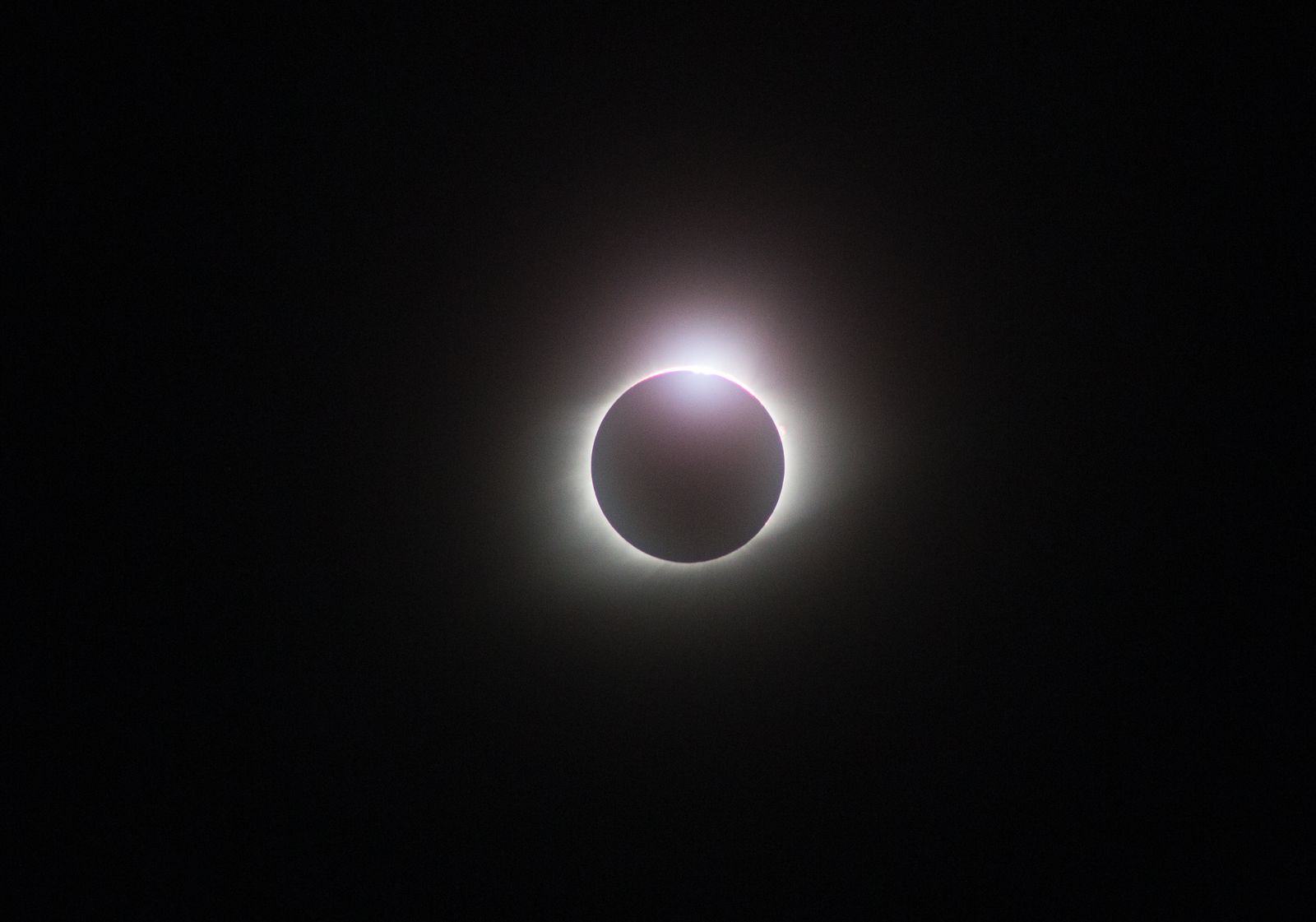
Guntur was one of the best places on the planet to be that day. The path of totality on 18 August 1868 cut across the Indian subcontinent, and European observatories had shipped instruments halfway around the world to catch it. The Andhra coast offered clear skies and a long totality — a luxury by eclipse standards.
Janssen had come to test a new technique. Spectroscopy — splitting light into its constituent wavelengths through a prism and reading the dark and bright lines that appear — had recently emerged as an astronomical tool. Each chemical element emits and absorbs light at a signature set of wavelengths, a kind of atomic barcode. Sodium burned yellow at a very specific pair of lines. Hydrogen glowed red and blue-green at its own. The Sun, scientists had already shown, contained many of the same elements found on Earth.
What Janssen wanted to look at was not the Sun’s surface but its prominences — the pink, arching plumes of gas that leap from the limb and are visible only during totality. As The Better India recounts, Janssen set up his equipment in the fishing hamlet of Machilipatnam and Guntur, working under a French expedition to catch the prominences’ spectrum for the first time.
The line that did not belong
When totality struck, Janssen pointed his spectroscope at a prominence and saw a set of familiar lines — hydrogen, mostly. But there was a bright, unaccounted-for yellow line sitting close to, but distinctly separate from, the two known sodium D lines. It was labelled D3. Nothing in any terrestrial laboratory had ever produced a line at that exact wavelength.
The observation was striking enough that Janssen realised the prominence spectrum was so bright he did not need an eclipse to see it. He devised a method to observe prominences the next day, in full sunlight, by using a narrow spectroscope slit. A British astronomer, Norman Lockyer, working independently in London, hit on the same trick shortly thereafter. Both men presented their results to the French Academy of Sciences in October 1868, and the Academy struck a commemorative medal with both their portraits on it.
Lockyer, working with chemist Edward Frankland, concluded the yellow line came from a previously unknown element. He named it helium, from the Greek helios — Sun. Science Friday traces the etymology back to that decision: an element named for the star it was first read from, before anyone had ever held a sample of it.
Twenty-seven years of a solar ghost
For nearly three decades, helium was a chemical rumour. Most European chemists were sceptical. An element that existed only on the Sun was, to a Victorian laboratory scientist, a kind of astronomical fantasy — plausible in principle, impossible to weigh.
The proof came in 1895. William Ramsay, a Scottish chemist in London, was working with a uranium-bearing mineral called cleveite. He heated it in acid, collected the gas that came off, and expected to find nitrogen. When he passed the gas through a spectroscope, the yellow D3 line stared back at him. Helium, the solar ghost, had been sitting inside a rock in Norway the whole time. Ramsay confirmed the identification by sending a sample to Lockyer, who recognised his own line instantly.
The 27-year gap between Janssen’s eclipse and Ramsay’s cleveite is what makes helium unique. As The Times of India notes, no other element on the periodic table was catalogued in the cosmos before it was catalogued on Earth. Other elements were first synthesised in laboratories, and though some are now known to exist in the atmospheres of certain stars, humans made them first. Francium, astatine, all the transuranics — every last one was a terrestrial discovery.
Why the Sun was hiding so much of it
The Sun is roughly three-quarters hydrogen and nearly a quarter helium by mass. Together those two elements account for around 98% of the star. Helium is produced continuously in the solar core, where hydrogen nuclei fuse into helium nuclei, releasing the energy that lights the daytime sky.
On Earth, the situation is inverted. Helium is the second most abundant element in the observable universe but one of the rarest gases in Earth’s atmosphere. The reason is gravity. Helium atoms are light enough and inert enough that any helium in the early atmosphere drifted upward and leaked into space over geological time. What remains on Earth is almost entirely radiogenic — alpha particles emitted by uranium and thorium decay, trapped in porous rock alongside natural gas. That is why Ramsay found it in cleveite, a uranium mineral, and why the world’s commercial helium today comes from natural gas fields, mostly in the United States, Qatar, Algeria and Russia.
The element that made astrophysics a field
The 1868 eclipse is often described as the founding event of astrophysics as a distinct discipline. Before Janssen and Lockyer, astronomy was largely about positions — where things were, when they moved, how they orbited. Spectroscopy turned starlight into chemistry. Suddenly astronomers could ask what a star was made of, not just where it sat.
The Indian Institute of Astrophysics traces its lineage back to that day, and Forbes has noted that the 1868 event sits in a long chain of scientifically productive total eclipses — the same category of event that let Arthur Eddington test general relativity in 1919 by measuring starlight bending around the Sun. Totality is one of the few natural experiments in which the solar corona and chromosphere become visible from the ground, and until orbital coronagraphs came along in the 20th century, it was the only way to do the kind of spectroscopy Janssen did.
A cosmic element with a very earthly shortage
What happens to helium after you use it on Earth is a strange coda to the discovery. Helium is non-renewable on any human timescale. Once released into the atmosphere — from a leaky MRI magnet, a burst party balloon, a rocket purge — it eventually drifts to the top of the atmosphere and escapes Earth’s gravity entirely. The universe is drenched in the stuff, but the accessible terrestrial supply is finite.
That is why the helium shortage of the last decade has been treated as a serious industrial problem. Superconducting magnets in MRI scanners need liquid helium at extremely low temperatures. Semiconductor fabs use it as a purge gas. Rocket propellant tanks are pressurised with it — a single large launch can vent substantial quantities. Discover Magazine has covered the recurring shortages of helium, an element whose supply chain runs through a handful of gas fields and a US federal reserve that has been winding down for years.
The commercial space and satellite industries have felt this directly. Every cryogenic upper stage, every ion-thruster testbed, every large-aperture space telescope with cooled optics depends on a gas that Earth is slowly losing to the sky it came from.
A yellow line, still visible
You can still see the D3 line today. Point a good amateur spectroscope at the Sun during totality, or through a hydrogen-alpha filter at a prominence on a clear afternoon, and the yellow signature Janssen caught in 1868 sits there in the spectrum, exactly where he recorded it. The wavelength has not moved. The element is the same. The physics that produces the line — an electron dropping between specific energy levels in a neutral helium atom — has been going on inside the Sun for 4.6 billion years and will go on for another five billion or so.
The SpaceMart editorial desk has written before about instruments that read the universe on a shoestring of power — a recent piece on Voyager 1 looked at how a 22-watt transmitter still speaks to Earth from beyond the heliosphere. Janssen’s spectroscope was a similar kind of instrument: small, portable, absurdly outmatched by the object it was pointed at, and yet capable of pulling a piece of information out of the sky that changed the map of matter.
The next great Indian total solar eclipse over Guntur will not happen for centuries. But every night the Sun sets, D3 is still leaving the star at 300,000 kilometres per second. Some of it, right now, is passing through the room you are sitting in. It took 27 years to find a bottle for it on Earth. The Sun has been sending samples the entire time.