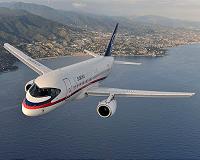
Lightning knocked out the autopilot on a Sukhoi Superjet plane that crash-landed and caught fire in Moscow last month killing 41 people, Russian investigators said Friday.
Planes are designed to be able to fly even if hit by lightning and without autopilot, suggesting human error played a role in the disaster.
The investigators, who examined the black boxes of the Aeroflot jet built in 2017, said they found burn marks on the outside of the plane typical of a lightning strike.
The investigators did not name other technical problems to explain the catastrophic accident.
They said they heard a "sound effect" as the autopilot went off 15 minutes into the flight and an "emotional exclamation" from a crew member.
Witnesses had already described lightning hitting the plane.
The accident on May 5 took place almost half an hour after takeoff from Moscow's Sheremetyevo airport on a flight bound for the Arctic city of Murmansk.
The plane burst into flames during an emergency landing and most of the passengers sitting at the back of the plane died. Thirty-seven people survived the crash.
The accident focused attention on Russia's showcase Sukhoi Superjet-100, its first new post-Soviet airliner, which has suffered numerous glitches and has not been widely adopted by international airlines.
The Moscow-based Interstate Aviation Committee (MAK) issued a preliminary report on the accident. The report is not intended to assign blame.
However, Trade and Industry Minister Denis Manturov suggested after the report's release that the pilots took the wrong decision.
"As far as the technology goes, the systems worked normally except for the moment when ball lightning hit the plane when the autopilot switched off," he said, Interfax news agency reported.
After the autopilot went off, pilots began to receive automated voice commands telling them what to do. The pilots opted to abort the flight and land back in Moscow.
At this point the pilots could have continued the flight or circled to burn off fuel before landing, Manturov said.
"It's always the pilot's decision."
The plane made an attempted landing, hitting the runway twice, before making another attempt minutes later, MAK investigators said.
By this time, the plane's chassis was already "partially damaged."
On the final rough landing, there was "further disintegration of the plane's construction with fuel leaking and a fire."
Russian criminal investigators are looking into possible air safety breaches.
The Investigative Committee has said that one of its lines of inquiry is whether pilots and air traffic control staff lacked the requisite skills and experience.