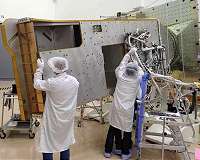
Last month, as satellites fed a steady stream of data into models tracking the paths of Hurricane Florence and Typhoon Mangkhut, the next in a fleet of satellites designed to monitor weather and climate cleared its critical design review, or CDR.
JPSS-2, or Joint Polar Satellite System-2, will join NOAA-20 in a series of polar-orbiting satellites to monitor the Earth's atmosphere, land and oceans. NASA builds the JPSS series of satellites, and NOAA will operate them.
"It will measure the temperature and moisture of our atmosphere, and the knowledge of that is really what drives the accuracy of our weather forecasts," said Greg Mandt, NOAA director of the Joint Polar Satellite System program at NASA's Goddard Space Flight Center, Greenbelt, Md.
Passing the CDR, a technical review, means that design and analysis of the satellite system, which includes its ground system and flight plan, is complete, and that the project is ready to continue in its next phases: fabrication, assembly, integration and testing.
The CDR was conducted by a standing review board of 16 members, who are independent of the program and experts in various fields, including electrical and mechanical engineering, weather forecasting and science, ground systems, ground stations, and budgeting and schedule.
Like its polar-orbiting cousins, JPSS-2 will scan our planet as it orbits from pole to pole, crossing the equator 14 times a day. In the process, its onboard instruments will snap pictures and capture data that will inform seven-day weather forecasts and extreme weather events.
Polar sounders provide roughly 85 percent of the data used in forecast models. But weather is only part of the picture. The spacecraft's instruments will also tell us about wildfires, volcanoes, atmospheric ozone, ice loss and sea surface temperatures.
"In our ground segment design for JPSS-2, we have shown that we understand what changes are needed, and we are well prepared to go to implementation," said Heather Kilcoyne, the NOAA ground segment project manager for JPSS at NASA Goddard.
"It's not enough to just have a satellite up there. Our design covers the changes needed end to end to ensure our products actually get used by forecasters and researchers."
The newest spacecraft will be nearly identical to its predecessor, NOAA-20. But, Mandt points out, the science the data feeds are always advancing.
"Every year, there will be new applications discovered," he said. "Even if the instruments are the same, the use of the data will continue to expand, and we'll find new ways to use it to solve problems."