On March 14, 2012, a camera orbiting Mars caught a narrow tower of dust curling over Amazonis Planitia in the planet’s northern hemisphere. NASA’s Jet Propulsion Laboratory described the dust devil as roughly 12 miles, or 20 kilometres, high. The High Resolution Imaging Science Experiment, better known as HiRISE, captured it from aboard the Mars Reconnaissance Orbiter.
Twelve miles is close to the north-to-south length of Manhattan. It is also more than twice the height of Mount Everest and far above the usual cruising altitude of a passenger jet. Yet the plume looked almost threadlike against the rust-coloured plain below.
What HiRISE actually saw
The 12-mile measurement needs one important qualification. According to the HiRISE team’s detailed image caption, the 20-kilometre figure refers to the highest disconnected clouds of dust above the plume. The continuous column reached approximately half that altitude.
The image therefore does not show an unbroken, 12-mile wall of dust. It shows a continuous rotating column rising several miles, with detached dust carried still higher by the atmosphere and high-altitude winds.
How a Martian dust devil forms
Dust devils on Mars begin through familiar physics. Sunlight warms the ground, the surface heats the air immediately above it, and that warmer air rises through cooler surrounding air. If the inflowing air begins rotating, the circulation tightens and accelerates as it moves towards the centre.
Mars changes the scale of the result. The mass of a Martian atmospheric column is less than one percent of its equivalent on Earth, allowing convection to penetrate much higher. Unlike a tornado, a dust devil does not depend on a thunderstorm or energy released by condensing water vapour.
Why the shadow reveals the height
The dust becomes increasingly faint near the top, making the plume itself difficult to measure cleanly. Its shadow is much sharper against the surface. Once the Sun’s position and the length of that shadow are known, the height can be estimated through geometry.
That calculation produced the approximately 20-kilometre height of the uppermost detached dust. The same image also captured the bright surface track left as the vortex disturbed the dusty ground.
What rovers detect from the ground
Orbital cameras can reveal towering plumes, while surface missions record the smaller vortices moving through their immediate surroundings. During Perseverance’s first several hundred Martian days in Jezero Crater, NASA reported that at least four whirlwinds passed the rover on a typical Martian day, with more than one per hour during the busiest period just after noon.
One dust devil passed directly over Perseverance on September 27, 2021. A 2022 study in Nature Communications used recordings from the SuperCam microphone alongside camera and weather-sensor data to reconstruct the encounter. The researchers estimated that the vortex was about 25 metres wide, at least 118 metres tall, and moving at approximately five metres per second.
Mars also has electrical dust
Perseverance later detected something scientists had suspected for decades: tiny electrical discharges inside Martian dust events. A 2025 Nature study reported 55 electrical events detected over two Martian years. The events were usually associated with dust devils or convective fronts inside dust storms.
These were not enormous lightning bolts like those seen during storms on Earth. NASA described them as small sparks accompanied by miniature sonic booms, closer in scale to a static discharge from a doorknob. Mars’s thin atmosphere requires less accumulated charge for a spark to cross a small gap.
Why the chemistry matters
As airborne dust and sand grains collide, they can exchange electrical charge through the triboelectric effect. Once enough charge separates, a small discharge can occur. The confirmed events show that near-surface electric fields on Mars can reach the atmosphere’s breakdown threshold.
The Nature researchers said this activity could contribute to a reactive electrochemical environment and increase the atmosphere’s oxidising capacity. NASA noted that such reactions may help create chlorates and perchlorates, compounds that can damage organic molecules. These are potential chemical effects, however, not evidence that every passing dust devil removes a measurable layer from every exposed rock.
Why future missions care
Martian dust creates mechanical risks even without electricity. NASA reported that sand carried in whirlwinds damaged exposed wiring in Perseverance’s wind sensors, while the 2022 acoustic study noted that grain impacts contribute to the degradation of hardware on Mars.
Electrical discharges introduce another engineering consideration for future instruments and human equipment. NASA has not reported damaging electrostatic-discharge events during decades of surface operations, but the confirmed sparks reinforce the importance of grounding and shielding sensitive systems.
What standing nearby might feel like
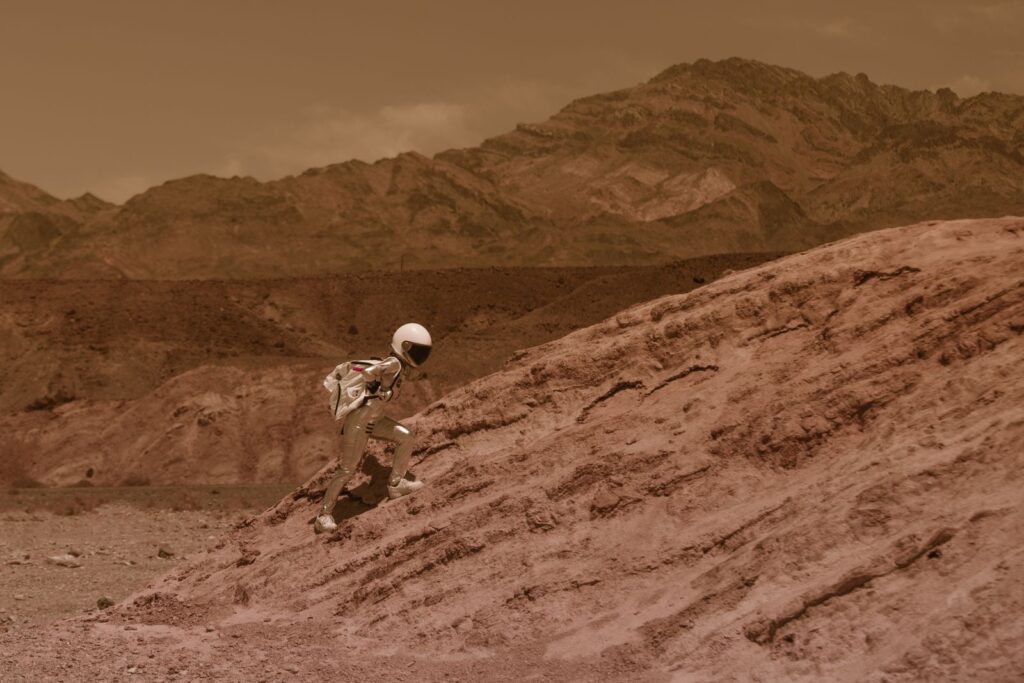
The 12-mile height makes the photographed dust devil look violent, but height alone does not determine force. Because the Martian atmosphere is so thin, the HiRISE team said even a fast-moving vortex would be unlikely to knock a person over. Dust and sand carried by the wind could still abrade equipment or scratch a spacesuit visor.
The experience would therefore be less like standing inside an Earth hurricane and more like entering a thin, dusty current. The strongest physical warning might come from grains striking exposed surfaces rather than from the pressure of the wind itself.
Twelve miles, put in scale
The highest detached dust reached roughly 20 kilometres, while the continuous column rose approximately 10 kilometres. Earth’s dust devils seldom extend more than a few hundred metres, making even the lower continuous portion of the Martian plume exceptional. Laid on its side, the full measured height would stretch almost the length of Manhattan.
The event itself was temporary, but it left evidence behind. HiRISE recorded the curling plume, its long shadow, and a bright track where the vortex disturbed the surface. By the time the image reached Earth, the dust was already returning to the Amazonis plain, leaving one orbital frame to preserve the shape of the wind.