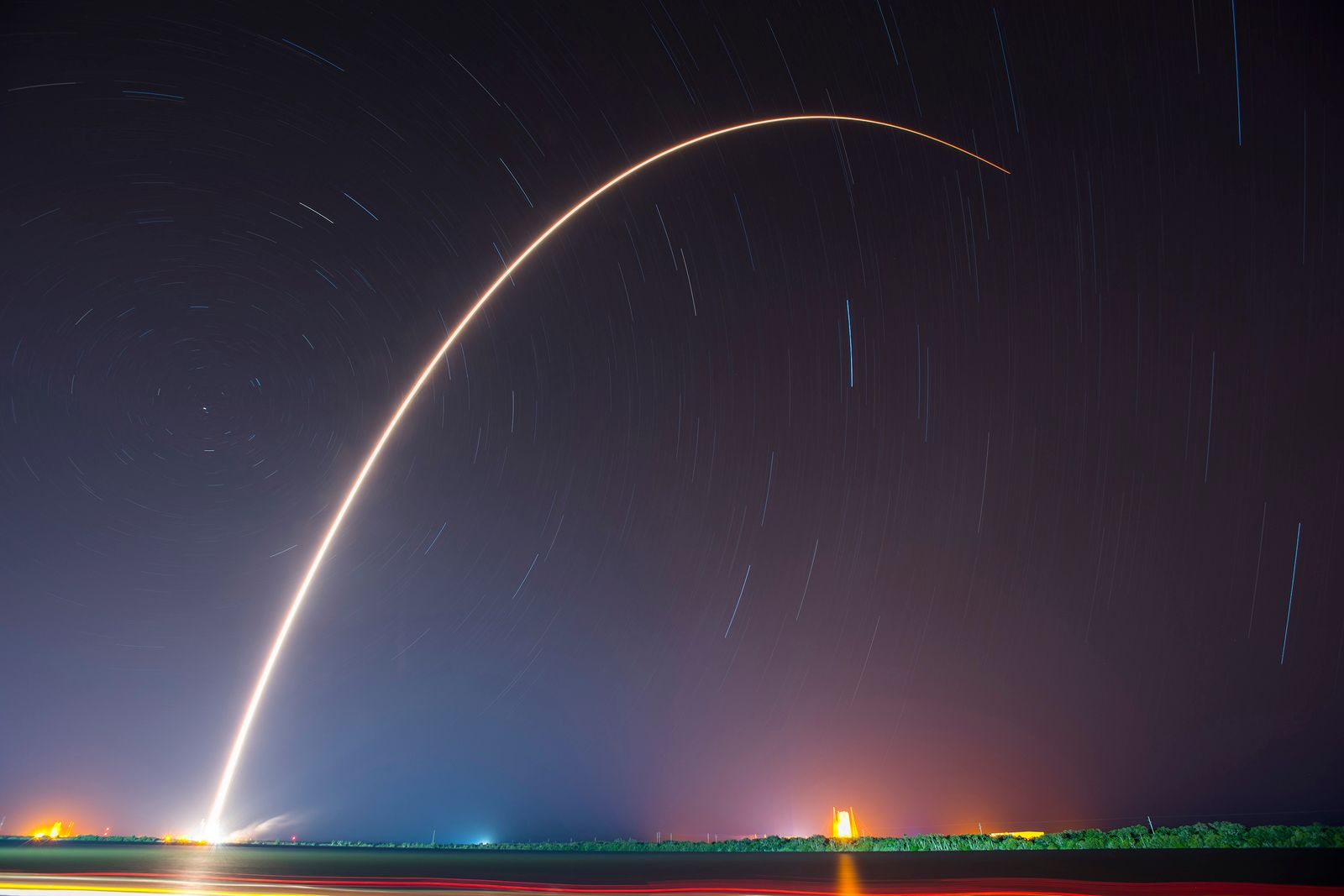
In the predawn hours of July 22, 1962, an Atlas-Agena rocket lifted off from Launch Complex 12 at Cape Canaveral carrying Mariner 1, the United States’ first attempt to send a spacecraft past Venus. Roughly 294 seconds later, after the rocket began fishtailing and drifting from its planned path, the Range Safety Officer sent the destruct command.
The failure was not caused by one typo acting alone. NASA’s history of the mission identifies two interacting problems: an Atlas guidance antenna lost lock with the ground, and a missing overbar in a data-editing equation prevented the ground-guidance program from handling the resulting information correctly. The Atlas was destroyed, while the Mariner spacecraft continued transmitting for more than a minute as it fell toward the Atlantic.
Arthur C. Clarke later helped immortalise the incident by calling the omitted mark “the most expensive hyphen in history.” It was not technically a hyphen. It was an overbar, a piece of mathematical notation whose absence became dangerous only when a hardware fault exposed the flawed guidance logic.
What Mariner 1 was supposed to do
Mariner 1 was designed to fly past Venus and return the first close-range American measurements of another planet. It carried no camera. Its scientific package included microwave and infrared radiometers, a magnetometer, charged-particle detectors, a cosmic-dust experiment, and instruments for studying the solar wind.
The radiometers were intended to help settle a question that had divided planetary scientists. Venus was hidden beneath permanent cloud, and observations from Earth had produced competing ideas about whether its concealed surface was relatively temperate or intensely hot.
The spacecraft was adapted from the Ranger lunar-probe design. NASA and the Jet Propulsion Laboratory had originally planned a larger Venus spacecraft launched by a Centaur upper stage, but delays forced engineers to produce a lighter vehicle that could fly on an Atlas-Agena rocket.
The resulting mission depended on several systems working together. The spacecraft had to survive the journey to Venus, but it first had to be placed on an exceptionally precise departure path by its launch vehicle.
A hardware fault met a software flaw
The Atlas did not rely solely on an autonomous computer aboard the rocket. During powered flight, tracking information was processed by a computer on the ground, which calculated steering corrections and transmitted commands back to the launch vehicle.
An airborne beacon on the Atlas supplied rate information to that guidance system. Losing contact with the beacon was a known problem and was not normally catastrophic. The rocket could continue along a pre-programmed path while the system attempted to recover reliable guidance data.
A data-editing equation was supposed to prevent faulty information from being accepted as the basis for steering commands. In the intended mathematical notation, an overbar above the symbol R represented a processed or smoothed value. That overbar was absent from the coded version of the equation.
The distinction mattered when the Atlas guidance antenna lost lock. Instead of handling the disrupted information as intended, the program accepted misleading values and generated incorrect corrections.
The failure needed two things to go wrong
The missing overbar had existed in the guidance logic before the Mariner 1 launch without producing the same result. As long as the rate-beacon system supplied acceptable information, the faulty equation did not necessarily reveal itself.
The antenna problem was also considered recoverable on its own. The rocket was meant to maintain its programmed course until reliable guidance contact returned.
Together, however, the two faults defeated those safeguards. The ground computer began issuing improper steering instructions, and the Atlas responded by moving farther away from its intended trajectory.
Controllers watched the rocket begin to fishtail. Its projected path raised the possibility that it could fall near populated areas or Atlantic shipping lanes.
The last six seconds
At roughly T+294 seconds, the Range Safety Officer sent the command that destroyed the Atlas. The decision came only about six seconds before the planned separation of the Agena upper stage and Mariner spacecraft.
That timing mattered because the Agena did not have an independent flight-termination system. Once it had separated from the Atlas, range safety would no longer have had the same ability to destroy the complete vehicle. Silicon Republic’s reconstruction of the launch also notes how close the destruct command came to that separation point.
The Atlas broke apart, ending the mission before Mariner 1 could leave Earth. NASA’s later account says the spacecraft continued sending data for more than a minute while falling toward the sea.
The most expensive hyphen in history
Clarke’s phrase endured because it captured the extraordinary difference in scale. A mark small enough to disappear from an equation had contributed to the loss of an interplanetary mission.
Calling it a hyphen blurred the technical detail, but it made the story memorable. The missing character was an overbar used in mathematical notation, and the affected program controlled the Atlas launch vehicle through a ground-based guidance system.
The fuller lesson is less tidy than the famous phrase. The hardware failure exposed the software flaw, while the software flaw turned a recoverable loss of guidance data into dangerous steering commands. Neither problem can accurately be treated as the entire cause by itself.
Before the next launch, engineers corrected the data-editing equation and applied more rigorous checks to the Atlas rate-beacon system.
Mariner 2 followed 36 days later
NASA had built the Venus spacecraft as a pair. Mariner 2, based on the same design, launched from Cape Canaveral on August 27, 1962, only 36 days after Mariner 1 was lost.
On December 14, Mariner 2 flew past Venus and became the world’s first successful interplanetary spacecraft. It also made the first direct measurements of the solar wind in interplanetary space.
Its microwave and infrared radiometers found a hostile planet beneath the clouds. Wired’s account of the encounter reports that the clouds were relatively cool while the surface temperature was around 900 degrees Fahrenheit.
The findings helped resolve the argument Mariner 1 had been built to investigate. Venus was not hiding a mild, Earthlike surface beneath its clouds. It was an intensely hot world with conditions hostile to life as scientists knew it.
Why the missing notation still matters
The vulnerable point was the handoff between several different systems: a mathematical specification, coded computer instructions, radar-derived information, and physical steering commands sent to a rocket.
The post-flight record establishes that the intended equation contained an overbar that the operational instructions did not. It is less useful to imagine one careless person destroying a spacecraft than to recognise that the wider system allowed a specification error and a hardware fault to combine without being caught in time.
Mariner 1 became an enduring engineering case study because every component appeared manageable in isolation. The mission was lost when the assumptions connecting those components failed together.
The Mariner series carried on
NASA launched ten Mariner spacecraft between 1962 and 1973. Mariner 1, Mariner 3, and Mariner 8 were lost during launch, while the seven others completed missions to Venus, Mars, or Mercury.
Mariner 4 returned the first close-up images of another planet in 1965. Mariner 9 became the first spacecraft to orbit another planet in 1971. Mariner 10 became the first mission to explore two planets and the first to use a planetary gravity assist to change its flight path.
NASA describes the Mariner program as the foundation for the deep-space exploration missions that followed. Its spacecraft demonstrated that relatively small robotic probes could cross interplanetary space, operate far from Earth, and return scientifically valuable information.
A small mark and two connected failures
What survives from the Mariner 1 accident is a documented chain of events: an Atlas guidance antenna lost lock, an equation lacked its intended overbar, the ground computer issued improper steering commands, and range safety destroyed the rocket before it could threaten people or shipping.
Thirty-six days later, Mariner 2 climbed away from the same launch complex with the guidance problem corrected. By December, it was transmitting data from Venus and opening the era of successful planetary exploration.
The overbar mattered. So did the failing antenna, the design of the guidance system, and the way the two faults were allowed to meet. That more complicated account is also the more useful one.