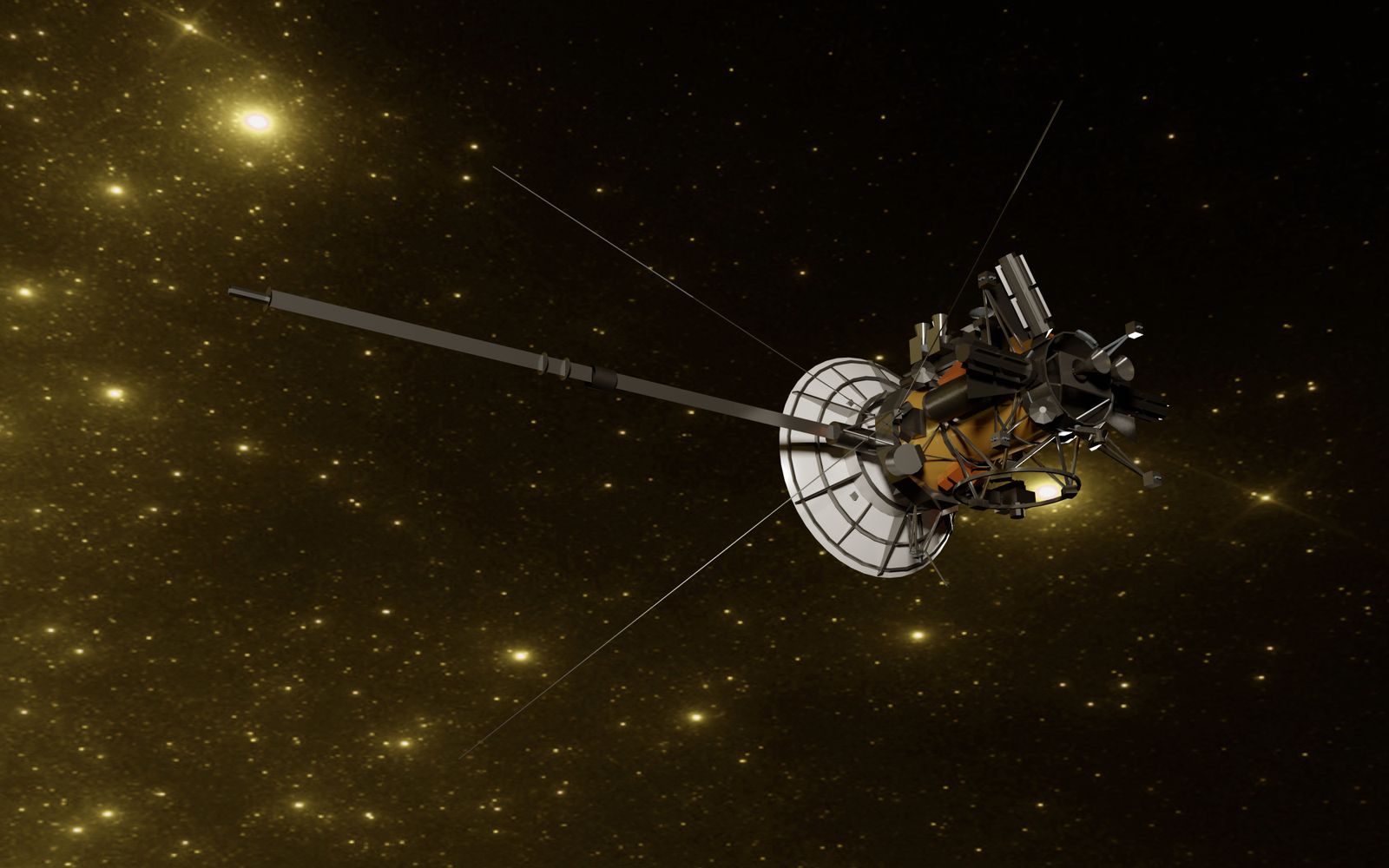
Voyager 1 is running today on roughly 225 watts of electrical power — less than a small refrigerator — and the transmitter that beams its data across 15 billion miles of interstellar space draws only about 22 watts, comparable to a dim hallway bulb. The spacecraft launched on September 5, 1977, the same year Elvis Presley died and the first Star Wars film opened in cinemas. Nearly forty-nine years later, it is still calling home.
The answer to how it manages this trick sits in three places: a plutonium-238 power source that decays predictably, a Deep Space Network of 70-meter dishes on Earth sensitive enough to detect a signal a billion times fainter than a digital watch battery, and a Jet Propulsion Laboratory engineering team that has spent decades turning off heaters, swapping thrusters, and rationing watts the way a submarine crew rations air. In 2024, that team pulled off a thruster branch swap that would have been routine in 1980 and is now considered one of the most delicate operations in the history of spaceflight.
The plutonium heart
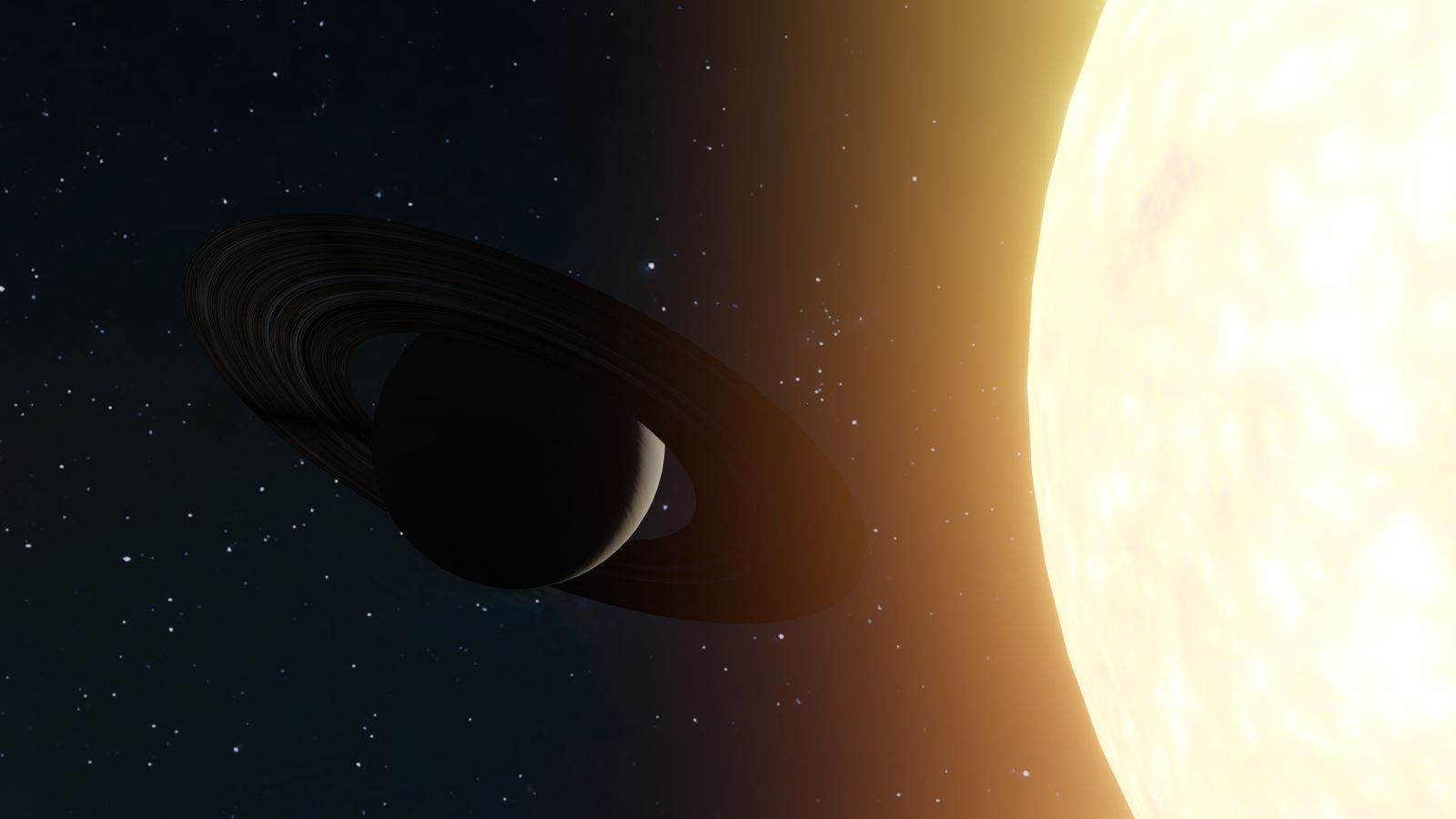
Voyager 1 does not run on solar panels. At its current distance — more than 15 billion miles from the Sun — sunlight is far too weak to power the spacecraft. Panels would be useless.
Instead, the spacecraft carries three radioisotope thermoelectric generators, or RTGs. Each contains pellets of plutonium-238 dioxide. As the plutonium decays, it releases heat. Thermocouples turn that heat difference into electricity. There are no moving parts. Nothing to break. The physics simply grinds forward at the pace set by plutonium-238’s 87.7-year half-life.
At launch in 1977, the three RTGs together produced about 470 watts. The generators lose power steadily — partly because the plutonium decays, and partly because the thermocouples themselves degrade. That slow bleed is why Voyager 1 today runs on less than half the power it had when it flew past Jupiter.
What 22 watts actually buys you
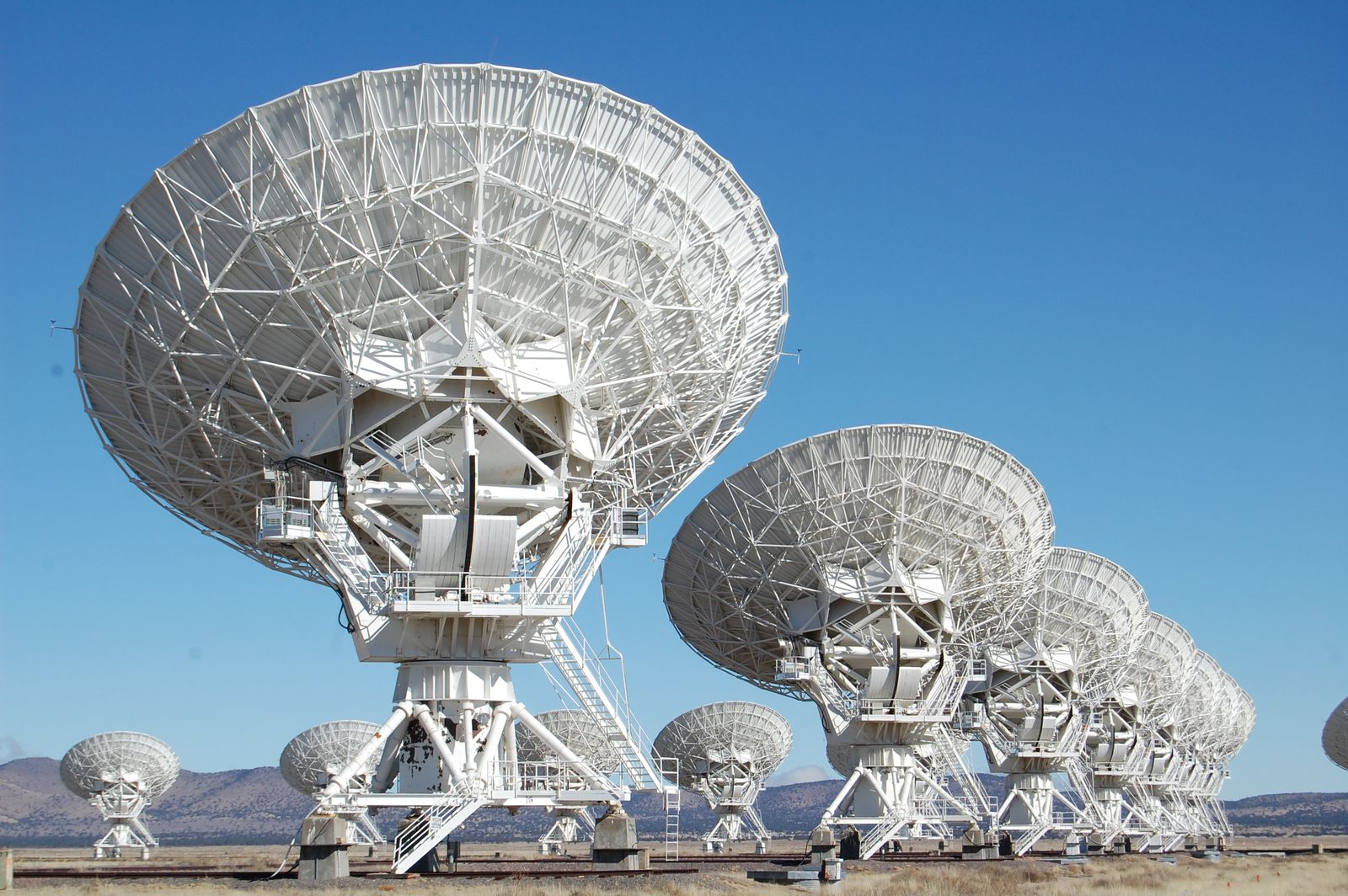
The signal Voyager 1 sends back reaches Earth extremely faint. Catching it requires the giant dishes of NASA’s Deep Space Network at Goldstone in California, Madrid, and Canberra. The round-trip light time is now more than 45 hours. A command sent Monday morning gets a reply late Wednesday.
That signal travels on a transmitter running at roughly 22 watts. For comparison, the portable power stations CNET lab-tested in 2025 can push out 2,000 watts continuously — nearly a hundred Voyager transmitters at once. A single LED bulb in a reading lamp typically draws 9 watts. A microwave draws 1,000. A hair dryer, 1,800. Voyager 1’s entire communication with humanity fits inside the power budget of a bright refrigerator light.
Why the spacecraft keeps getting colder
The Voyager team has spent the last decade turning things off. First the cameras, shut down after the 1990 “Pale Blue Dot” image, because there was nothing left to photograph. Then the scan platform heaters. Then the ultraviolet spectrometer. Then, in 2024 and 2025, several more science instruments.
Each shutdown saves a few watts. Each shutdown also removes a small source of waste heat. The spacecraft, drifting through interstellar space where the ambient temperature is about 3 kelvin above absolute zero, gets steadily colder inside. Hydrazine fuel lines that were designed to sit in a warm spacecraft now hover near their freezing point. Thruster catalyst beds, which need to be warm to work, sometimes are not.
This is the paradox at the center of the mission. Saving power to keep the radio alive means removing the heat that keeps the plumbing alive. Every choice trades one lifeline for another.
The thruster problem
Voyager 1 has to keep its high-gain antenna pointed directly at Earth. If it drifts even slightly, the signal misses. To stay aimed, it fires tiny thrusters — puffs of hydrazine gas lasting tens of milliseconds.
After 47 years, the fuel tubes inside those thrusters have been clogging with silicon dioxide, a byproduct of a rubber diaphragm in the fuel tank slowly breaking down. The opening inside each tube had narrowed significantly. The thrusters were still working, but barely.
Voyager 1 carries three branches of thrusters: two attitude propulsion sets and one trajectory correction maneuver set. The JPL engineering team switched off the first attitude branch when it clogged. Years later, they moved to the trajectory correction thrusters when the second attitude branch started to fail. By 2024, those trajectory thrusters were more clogged than either of the previous branches had been.
The team needed to switch back to one of the older attitude branches. In 1980, this would have been a few lines of code. In 2024, it was almost impossible.
The heater puzzle
The old attitude thrusters had been sitting cold for years. Firing them cold could crack them. To warm them, the team needed to turn on heaters that had been switched off years earlier to save power. But every watt of heater power had to come from somewhere. Every currently operating system on Voyager 1 was already classified as essential.
Turning off a science instrument was ruled out — there was a real risk it would not come back. Instead, engineers found they could switch off one of the spacecraft’s main heaters for up to an hour, redirecting that electricity to warm the dormant thruster branch just long enough to fire it safely.
In 2024, they did it. The old attitude thrusters came back to life. The spacecraft pointed itself at Earth again.
According to NASA, Suzanne Dodd, Voyager’s project manager at JPL, has noted that managing the aging spacecraft requires increasingly careful analysis as power resources dwindle. Dodd’s team has been managing the probes’ slow descent into power scarcity for more than a decade.
Where Voyager 1 actually is
The heliosphere is the bubble of charged particles and magnetic field blown outward by the Sun. It ends where that solar wind is stopped by the pressure of the interstellar medium — the thin, ionized gas that fills the space between stars.
Voyager 1 crossed that boundary, called the heliopause, on August 25, 2012. The confirmation took nearly two years of argument among plasma physicists, because the spacecraft’s plasma science instrument had failed back in 1980 and the team had to infer the crossing from indirect measurements of plasma oscillations. In July 2014, NASA formally announced that Voyager 1 had definitively entered interstellar space.
That announcement, reported at the time by The Christian Science Monitor, made Voyager 1 the first human-built object to leave the Sun’s sphere of magnetic influence. Its twin, Voyager 2, crossed the heliopause in November 2018 on a different trajectory.
The longest phone call in history
The Los Angeles Times, writing about the mission in 2022, described the ongoing contact with Voyager 1 as the world’s longest phone call. The metaphor is exact. A carrier signal has been open between JPL and Voyager 1 for 48 years. It has never been hung up.
What comes down that line now is thin. With most instruments off, Voyager 1 mainly returns magnetic field data and cosmic ray counts. Each measurement is a first — no other spacecraft has ever taken data from this region. The Pioneer 10 and 11 probes, launched earlier, went silent decades ago. New Horizons, on its way out through the Kuiper Belt, will not reach interstellar space for several more decades.
For now, Voyager 1 is the only human instrument reporting back from between the stars. The data arrives slowly — far slower than even a 1980s dial-up modem.
How long can it last
The plutonium keeps decaying. The RTGs keep losing power. Somewhere around 2030, give or take a year or two, Voyager 1’s output will drop below the level needed to run even its most essential systems. The last science instrument will be turned off. Then the transmitter itself.
After that, the spacecraft will keep going. It will not fall. It will not slow. Interstellar space contains nothing dense enough to friction it into stopping. In roughly 40,000 years, Voyager 1 will pass within about 1.6 light years of a small star in the constellation Camelopardalis called Gliese 445 — a closer approach to another sun than it will ever have to our own again.
It will still be carrying its gold-plated copper phonograph record, the Golden Record, with greetings in 55 languages, whale song, Chuck Berry’s “Johnny B. Goode,” and a diagram showing where in the galaxy it came from. The record is designed to last a billion years. The plutonium will be gone in a century. The transmitter will be silent in less than a decade. But the object itself — a 722-kilogram assembly of aluminum, titanium, and gold, launched the year the first commercial consumer electronics revolutions were still decades away — will keep drifting outward long after everyone who built it, and everyone who now listens to it, is gone.
The hallway bulb, in other words, will go dark. The traveler carrying it will not stop.