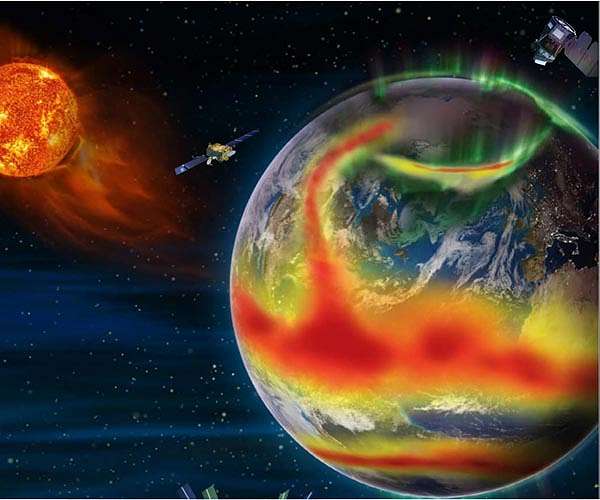
Research published in Earth and Planetary Physics by a team led by postdoctoral researcher Wenbo Li and researcher Libo Liu from the Key Laboratory of Earth and Planetary Physics, Institute of Geology and Geophysics, Chinese Academy of Sciences, provides new insights into the behavior of Earth's upper atmosphere during the May 2024 superstorm. Using a combination of ground-based and satellite observational tools, the researchers explored the complex variability and driving physical mechanisms in the upper atmosphere across hemispheres and longitudinal regions.
The study focused on the thermosphere, the neutral layer of the upper atmosphere, which serves as the backdrop to the ionosphere, its partially ionized counterpart. The team found that thermospheric conditions – composition, density, temperature, and dynamics – played a critical role in shaping ionospheric responses during the superstorm. These variations led to starkly different features between the northern and southern hemispheres and across the American and Asian longitudinal sectors.
The research underscores the importance of thermospheric observations for a deeper understanding of upper atmospheric responses. Compared to the wealth of ionospheric data, thermospheric observations remain insufficient, hindering comprehensive global analyses. Expanding and integrating diverse sources of thermospheric data is vital for improving our knowledge of the thermosphere's role in space environment variations and their effects on Earth.
Such advancements will not only enhance the field of space science but also provide critical insights for ensuring the safety of human spaceflight missions.
Research Report:Interhemispheric and longitudinal differences in the ionosphere – thermosphere coupling process during the May 2024 superstorm