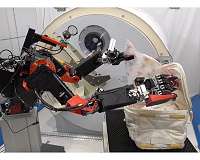
GITAI (Head Office: San Francisco, US; Japanese Branch: Meguro, Tokyo) has signed a joint research agreement with JAXA (the Japanese Aerospace Exploration Agency).
Experiments in using GITAI's robot as a substitute for astronauts in performing work have been conducted in a mock-up version of JAXA's Japanese Experiment Module for the International Space Station, "Kibo."
The Japanese Aerospace Exploration Agency (JAXA) is engaged in the active promotion of the introduction of robotics technology, aiming to make the low-Earth orbit an area of sustained human economic activity. As part of those efforts, aiming to dedicate astronauts to higher-level work and optimize results, the agency is considering using Kibo, the Japanese Experiment Module for the International Space Station (ISS) as a technological demonstration platform.
Aiming the reduce the cost of space work to 10%, GITAI aims to produce a robot capable of carrying out work within a space station in place of an astronaut.
With the latest GITAI robot (model 6), GITAI have succeeded in creating a robot which, given the presence of a limited networking environment within the space station, is capable of, as a single robot, accomplishing general tasks (switch operation, using tools, flexible object manipulation, heavy load work) which have been difficult with prior robots.
From December 25-27, 2018, in JAXA's mock-up of Kibo, the International Space Station's Japanese Experiment Module, GITAI conducted an experiment into using the GITAI robot as a substitute for an astronaut, based on a list of astronaut tasks provided by JAXA. The GITAI robot was found to succeed in completing 72% (13/18) of the tasks.
Aiming to use robot technology to carry out work in the place of astronauts on Kibo, the Japanese Experiment Module for the International Spae Station (ISS), GITAI and JAXA have entered into a joint research agreement (limited to the current fiscal year) in order to evaluate the applicability of GITAI's technology.
Both companies will continue to collaborate to investigate technologies and conduct proof-of-concept experiments in future.
Along with the intensification of competition in space development in the world in recent years, the demand for work in space is rapidly increasing. In particular, for the low Earth orbit space stations, represented by ISS, demand for work is rapidly increasing with matters such as the consideration of the Commercialization of ISS, and the ongoing construction of several commercial space stations, such as space hotels and space stations for scientific experiments, carried out mainly by private companies in the US.
GITAI aims to reduce the burden on astronauts, shorten the period of work in space, and reduce costs by enabling robots, who are able to work long-term on site, to do the work within private space stations instead of astronauts.
GITAI believes that the prevailing human transportation methods of the past hundred years, such as cars, trains, and airplanes, are no longer the optimum method of transporting people from a time, cost, or safety perspective.
Most technology businesses are trying to make existing methods of transportation faster and more effective, but GITAI believes that this is like trying to create faster, more effective horse-drawn carriages in the era of the carriage, while GITAI is trying to build the engine.
Believing that augmenting the human body, making effective teleportation a reality and obviating the need for transportation itself is an approach ten times more valuable, GITAI aims to produce humanoid robots that can act as stand-ins for humans.