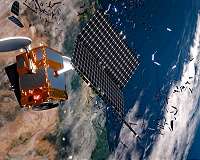
A new satellite developed by a group of students at the Moscow State University of Mechanical Engineering has been fitted with metallic reflectors and will be able to remove space junk circling the Earth. Radio Sputnik talked to the head of high technology developing at 12-Digital, Nikita Yershov.
The probe is part of a flotilla of 73 artificial orbital bodies aboard the Soyuz rocket, which was launched last Friday.
When asked about the functions the new satellite, dubbed Mayak, and about the hopes and expectations regarding its launch and deployment, Nikita Yershov said there were some scientific goals and utilitarian ones too.
"The satellite will test aero-braking techniques that could be used in removing space junk from our planet's orbit," Yershov explained.
The space probe, whose name translates as "beacon," is expected to be one of the brightest objects in the sky. One downside of this could be the so-called "light pollution" of the sky though.
Yershov allayed these fears saying that the Mayak will certainly not be as bright as the sun or the moon – rather like stars, artificial satellites or other man-made objects circling our planet.
Speaking about the future projects they have in mind, Nikita Yershov said that, apart from the aero-braking tests they are going to perform in orbit, they were now thinking about other useful things the Mayak could do in the future.
"Of course, we'll do something bigger, more exciting and more important things as we go," Yershov said.
Stanford engineers design a robotic gripper for cleaning up space debris
Right now, about 500,000 pieces of human-made debris are whizzing around space, orbiting our planet at speeds up to 17,500 miles per hour. This debris poses a threat to satellites, space vehicles and astronauts aboard those vehicles.
What makes tidying up especially challenging is that the debris exists in space. Suction cups don't work in a vacuum. Traditional sticky substances, like tape … read more