
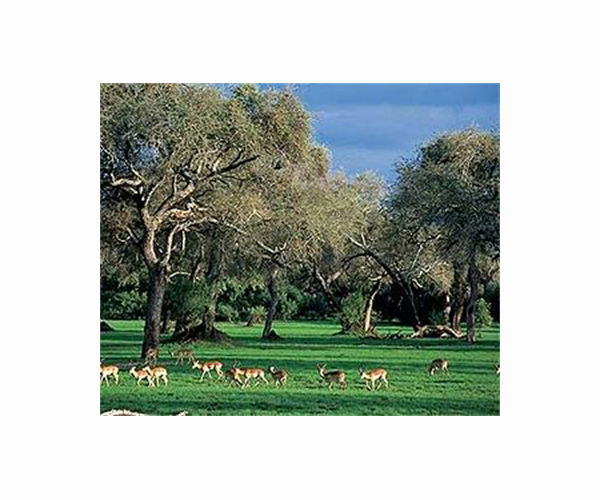
One of Zimbabwe's biggest wildlife reserves is to receive US$1 million annually from a brand-new fund to help sustain its operations and fight poaching, German conservationists said on Wednesday.
The money, which will extend for at least 15 years, will help pay for ranger patrols, equipment maintenance and other everyday needs, the park's partner, the Frankfurt Zoological Society (FZS), told AFP by email.
Zimbabwe's second largest reserve, the Gonarezhou National Park covers 5,000 square kilometres (2,000 square miles) in the country's remote southeast.
It is home to at least 11,000 elephants — its name means "the place of the elephant" in the local ChiShona language — as well as to black rhinos, whose numbers are kept secret for security reasons.
The money will come from the Legacy Landscapes Fund (LLF), a brand-new international initiative that provides funds to help wildlife havens in poor countries.
"The idea of the Legacy Landscapes Fund is to provide a reliable funding for basic operations in a protected area," said the FZS's head of communications, Dagmar Andres-Bruemmer.
The donation to Gonarezhou is "funding 'to keep the lights on' in difficult times, so to say," she said in response to questions emailed by AFP.
National parks that depend on tourism income have suffered during the coronavirus pandemic, she noted.
"In some parks in Africa, even basic work such as ranger patrols could not be done due to budget cuts. So poaching picked up significantly."
The LLF, set up in 2021, is a public-private fund established as a charity under German law to help close the funding gap for biodiversity conservation.
Participants include the French and German governments, Germany's KfW Development Bank, France's Agence Francaise de Developpement (AFD), the International Union for Conservation of Nature (IUCN) and the World Wide Fund for Nature (WWF).
"Protected and wild areas remain the mainstay of biodiversity conservation and our best tool at mitigating climate change across the globe," said Hugo Van der Westhuizen, director of Gonarezhou Conservation Trust.
"Managing these areas effectively requires long-term commitment in funding."
Ecuador, Colombia slam use of wild animal species after MasterChef episode
Quito (AFP) Jan 5, 2022 –
Ecuador on Tuesday warned would-be wild animal eaters of possible prison time and Colombia launched an investigation after a competitive cooking TV show featured shark, alligator and capybara as ingredients.
In the offending episode, contestants of MasterChef Ecuador cooked up tollo, a small shark, as well as a type of wild deer and a capybara, a large rodent that can weigh up to 80 kilograms (175 lbs).
The National Animal Movement of Ecuador warned that the use of such ingredients on TV would "normalize the consumption of protected animals, whose ownership contributes to the trafficking of wild animals and the destruction of ecosystems."
Neither the channel nor the producers of the program responded to the charges leveled against them, though the show's chef and judge, Carolina Sanchez, claimed the meat was "from a farm."
In response to the program, which was filmed in Colombia, Ecuador's environment ministry said it "rejects the promotion and dissemination of graphic or audiovisual content that encourages the purchase and consumption of wild species or their constituent elements."
It also warned that crimes against wild flora and fauna can be punished with prison sentences of up to three years.
In Colombia, Environment Minister Carlos Eduardo Correa announced an investigation.
He said authorities "are verifying information circulating on social networks about the use of wildlife by-products in television programs.
"Trafficking and marketing of wildlife is a crime in Colombia," he wrote on Twitter.
MasterChef Ecuador, which is in its third season, is recorded in Colombia and broadcast on the privately owned national channel Teleamazonas.
