
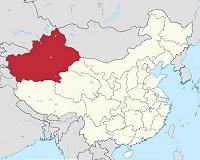
Chinese authorities are using a mobile app designed for mass surveillance to profile, investigate and detain Muslims in Xinjiang by labelling "completely lawful" behaviour as suspicious, a Human Rights Watch report said Thursday.
Beijing has come under international criticism over its policies in the northwest region of Xinjiang, where as many as one million Uighurs and other mostly Muslim minorities are being held in internment camps, according to a group of experts cited by the UN.
Human Rights Watch has previously reported that Xinjiang authorities use a mass surveillance system called the Integrated Joint Operations Platform (IJOP) to gather information from multiple sources, such as facial-recognition cameras, wifi sniffers, police checkpoints, banking records and home visits.
But the new study, entitled "China's Algorithms of Repression", worked with a Berlin-based security company to analyse an app connected to the IJOP, showing specific acts targeted by the system.
Xinjiang authorities closely watch 36 categories of behaviour, including those who do not socialise with neighbours, often avoid using the front door, don't use a smartphone, donate to mosques "enthusiastically", and use an "abnormal" amount of electricity, the group found.
The app also instructs officers to investigate those related to someone who got a new phone number, or related to others who left the country and have not returned after 30 days.
"Our research shows, for the first time, that Xinjiang police are using illegally gathered information about people's completely lawful behavior — and using it against them," said Maya Wang, senior China researcher at Human Rights Watch.
"The Chinese government is monitoring every aspect of people's lives in Xinjiang, picking out those it mistrusts, and subjecting them to extra scrutiny."
– "Moving red-line" –
The rights group obtained a copy of the app and enlisted cybersecurity firm Cure53 to "reverse-engineer" it — to disassemble it and look at its design and data — and examined its source code.
Along with collecting personal information the app prompts officials to file reports about people, vehicles and events they find suspect — and sends out "investigative missions" for police to follow up.
Officers are also asked to check whether suspects use any of the 51 internet tools that are deemed suspicious, including foreign messaging platforms popular outside China like WhatsApp, LINE and Telegram.
A number of people said they or their family members have been detained for having software such as WhatsApp or a Virtual Private Network (VPN) installed on their phones during checks by authorities, according to the report.
The rights group said its findings suggest the IJOP system tracks data of everyone in Xinjiang by monitoring location data from their phones, ID cards and vehicles, plus electricity and gas station usage.
"Psychologically, the more people are sure that their actions are monitored and that they, at anytime, can be judged for moving outside of a safe grey-space, the more likely they are to do everything to avoid coming close to crossing a moving red- line," Samantha Hoffman, an analyst at the Australian Strategic Policy Institute's International Cyber Policy Centre, told AFP.
"There is no rule of law in China, the Party ultimately decides what is legal and illegal behaviour, and it doesn't have to be written down."
The IJOP app was developed by Hebei Far East Communication System Engineering Company (HBFEC), which at the time of the app's development was fully-owned by China Electronics Technology Group Corporation, a state-owned technology giant (CETC), said Human Rights Watch.
CETC could not be reached and HBFEC did not respond to requests for comment.
Washington last year imposed export controls on key Chinese companies including HBFEC and other institutions under CETC, citing risks to US national security and foreign policy interests.
Greg Walton, an independent cybersecurity expert who advised on the report, said while the system is a "blunt instrument that may be directly contributing to the massive numbers of people in internment camps", the data if stored could be used in the future for more advanced policing algorithms.
"This means that data collected through the app today may well be analysed in a few years' time by far more sophisticated logic," he said.
Pompeo asks US business to think twice in China's Xinjiang
Washington (AFP) May 1, 2019 –
Secretary of State Mike Pompeo asked corporate America on Tuesday to think twice when doing business in China's Xinjiang region, where he appeared to liken the scale of mass incarceration of Muslims to Nazi abuses.
Speaking to a business group, Pompeo stopped short of asking firms not to work with China but said he hoped to spark further discussion on the "enormous risk" of doing business in the country.
"We watch the massive human rights violations in Xinjiang where over a million people are being held in a humanitarian crisis that is the scale of what took place in the 1930s," Pompeo said.
"And we see American businesses and their technology being used to help facilitate that activity from the Chinese government. It's something worthy of thinking about," the diplomatic chief said as he received an award from Business Executives for National Security.
Pompeo added that "I don't know the answer," recalling that as a business owner and a conservative Republican he opposes government interference in commerce.
Pompeo's remarks come as US software titan Microsoft faces scrutiny over its joint research with Chinese government-linked scholars on artificial intelligence, with Beijing said to be using facial recognition technology in its crackdown in Xinjiang.
In February, US biotechnology manufacturer Thermo Fisher announced it would stop selling equipment used to create a DNA database of the Uighur minority.
A United Nations panel has cited estimates that China has rounded up some one million Uighurs and other mostly Muslim Turkic-speaking minorities, with activists accusing Beijing of curbing the practice of Islam.
China says the camps are "vocational training centers" to steer people away from extremism and reintegrate them, in a region plagued by violence blamed on Uighur separatists or Islamists.
