
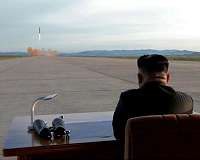
North Korea has made a very public statement on the test of a new form of "tactical guided" weapon, which was conducted recently under the watchful eye of leader Kim Jong-Un.
Exactly how the world will react to this is unclear at the time of writing, and the North Koreans themselves could have more than one objective. A test like this could have been conducted discreetly, but North Korea does not want to hide it. Clearly, international communications is a major objective.
This could be a gentle form of sabre-rattling, designed to catch the attention of the world at a time when negotiations have stalled. The test will probably have more impact in South Korea (and possibly Japan) than in the White House.
That could be the desired effect, prompting regional leaders to get in touch with Mr Trump and remind them of the situation. It could also be an attempt to strengthen moves to get South Korea to forge its own diplomatic path with North Korea, independent of the US negotiations.
The test is not a long-range missile or a nuclear device, which puts it well outside any violations of the test moratorium of these systems. Donald Trump may disapprove of this test, but he can still take pride in the fact that a major weapons system was not tested.
Short-range systems are also less of a threat to the USA, but they could potentially be used against US forces in the region.
But what exactly did the North Koreans test? Despite the publicity, there has been no imagery of the new weapon, nor has there been any precise description. Some pundits are suggesting it could be some form of multiple rocket launcher, similar in range to artillery.
That's certainly possible, but this analyst will suggest another option. The new weapon could be an unpiloted aircraft, or drone. It would be destroyed when its warhead explodes as it hits its target. The drone is more likely to be a sort of winged aircraft than a helicopter-style vehicle.
North Korea stated that the weapon has a "special flight guidance method", a vague statement that's consistent with the drone theory, but does not rule out other options. It could be some sort of short-range missile with autonomous navigation or heat-seeking capabilities. Without more data, it's hard to rule out any theory.
It's possible that international intelligence services know a lot more about this weapon than they are disclosing, and they may plan to keep quiet about how much they really know. The North Koreans would certainly gain technical data from testing the weapon, and that needs to be done before it can be declared operational. But the publicity is a strong indication that diplomacy is also a major goal of the test.
