
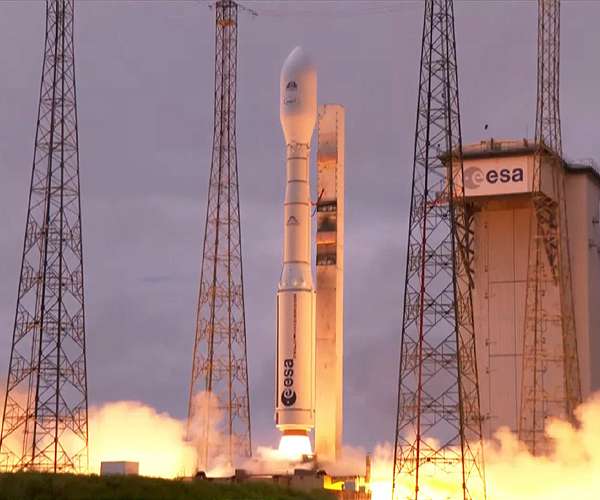
ESA has signed a series of contracts with Avio to enhance the operational capacity of the Vega-C rocket and push forward the development of its successor, Vega-E. These agreements aim to increase the annual launch frequency and advance next-generation rocket technologies.
The contracts cover three key areas: upgrading Vega-C ground systems to support a higher launch cadence, advancing the development of the Vega-E system, and securing the launch of ESA's FORUM Earth observation mission on Vega-C with Avio as the service provider.
Enhancing Vega-C Operations
Vega-C resumed commercial operations last month, successfully delivering Sentinel-1C to orbit. Four launches are scheduled for 2025, increasing to five in 2026. The new contracts will streamline ground operations, enabling shorter intervals between consecutive launches and an overall higher frequency.
A significant aspect of the upgrades involves adapting the former Ariane 5 integration building at Europe's Spaceport in French Guiana to support Vega-C. This facility will allow for simultaneous assembly of two rockets – one on the launch pad and one in the integration building – enabling parallel launch campaigns. These improvements will not only reduce the time between launches but also provide greater flexibility for Vega-E development activities.
Advancing Vega-E Development
The second contract focuses on the development of Vega-E, a successor to Vega-C, targeting its ground qualification stage – the final step before a maiden launch. Vega-E will feature a three-stage design, as opposed to Vega-C's four, and use a liquid-fueled methane-oxygen stage that will be fueled shortly before liftoff.
This agreement covers critical components, including rocket stages, the adaptation of the former Ariane 5 launch pad, and the logistics and systems needed for fueling. It also includes comprehensive testing of the integrated Vega-E system, paving the way for its future role in European space transportation.
FORUM Earth Observation Mission
The third contract is dedicated to launching ESA's FORUM mission – Far-infrared Outgoing Radiation Understanding and Monitoring – on a Vega-C rocket in 2027. This mission, part of ESA's Earth Explorer program, is vital for climate science, providing unprecedented data on Earth's outgoing longwave radiation in the far-infrared spectrum.
The FORUM mission exemplifies the Vega rocket family's suitability for Earth observation, with 2024 already marked by successful launches of Copernicus Sentinel satellites. This contract also inaugurates a new procurement framework between ESA and Avio for launch services.
