
UK astrophysicists are gearing up to resume the search for gravitational waves, the ripples in spacetime caused by some of the universe's most spectacular events, after substantial upgrades to the three global detectors mean that they will be able to survey an even larger volume of space than ever before for powerful, wave-making events, such as the collisions of black holes.
Over the last year upgrades have been put in place to the mirrors, lasers and other components of the US based LIGO detectors that that will increase the detector sensitivity by 40 percent. Meanwhile Virgo, the European-based gravitational-wave detector, has almost doubled its sensitivity since the last run.
The National Science Foundation's LIGO (Laser Interferometer Gravitational-Wave Observatory) will resume its hunt for gravitational waves on April 1, after receiving a series of upgrades to its lasers, mirrors, and other components at the twin detectors located in Washington and Louisiana.
Joining the search will be Virgo, the European-based gravitational-wave detector, located at the European Gravitational Observatory (EGO) in Italy, which has almost doubled its sensitivity since its last run and is also starting up April 1.
Professor Sheila Rowan is Director of the University of Glasgow's Institute for Gravitational Research and said: "This third run of observations marks an important step forward for the new field of gravitational wave astronomy.
"The upgraded LIGO-Virgo detectors will allow us to detect signals from further out in the universe, pushing back the boundaries of our understanding and delivering a wealth of new findings which are only possible by listening out for the sounds of those ripples in spacetime."
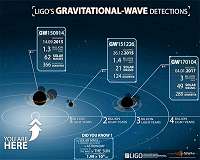
In 2015, after LIGO began observing for the first time in an upgraded program called Advanced LIGO, it soon made history by making the first direct detection of gravitational waves. The ripples traveled to Earth from a pair of colliding black holes located 1.3 billion light-years away.
Since then, the LIGO-Virgo detector network has uncovered nine additional black hole mergers and one explosive smashup of two neutron stars. That event, dubbed GW170817, generated not just gravitational waves but light, which was observed by dozens of telescopes in space and on the ground.
Professor Alberto Vecchio, Director of the Institute of Gravitational Wave Astronomy, University of Birmingham said: "The LIGO and Virgo instruments at this improved sensitivity will survey a volume of the universe about three times as large as the one that has been covered so far. We are going to observe many new cosmic collisions of black holes which will surely give us new information about the properties of these mysterious objects. But what I am really looking forward to is to be surprised: maybe we'll detect some completely unexpected sources."
In this next run, LIGO will be able to see those events out to an average of 550 million light-years away, or more than 190 million light-years farther out than before.
Prof. Mark Hannam, Director of Cardiff University's Gravity Exploration Institute believes that : "By the end of this year it's likely that we will have observed over 100 black holes with the LIGO and Virgo detectors, which is an amazing treasure trove of scientific information."
