
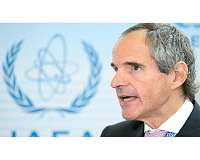
The head of the UN's nuclear watchdog on Monday called on Iran to allow "prompt access" to two sites where past nuclear activity may have occurred.
"I hope we can do better," Rafael Grossi, director general of the Vienna-based International Atomic Energy Agency (IAEA), told reporters when asked about the agency's current relationship with Iran.
Grossi was speaking at the start of a meeting of the agency's Board of Governors which is expected to discuss a report earlier this month in which the IAEA expressed "serious concern" that Iran has been blocking inspections at two sites.
"There are areas where our cooperation is ongoing and there is this issue where quite clearly we are in disagreement," he said.
Grossi repeated an appeal to Iran to "cooperate immediately and fully" with the agency.
If the Board of Governors pass a resolution critical of Iran, it would be the first of its kind since 2012.
Even though the two sites in question are not thought to be directly relavent to Iran's current activities, the agency says it needs to know if activities going back almost two decades have been properly declared and all materials accounted for.
The report detailed efforts by the agency's officials to get access to the locations.
Iran told the agency the report was a source of "deep regret and disappointment" and hinted the queries were based on "fabricated information" from "intelligence services".
Israel has previously claimed its intelligence services unearthed information on an alleged previous nuclear weapons programme in Iran.
Grossi said that there were "no legal ambiguities" around the requests for access.
"The agency works on the basis of a very rigorous, dogged, meticulous technical and scientific analysis of information," he said, insisting: "Nothing is taken at face value."
Western states have voiced concern over Iran's denial of access to the sites concerned, with the United States being particularly vocal.
– Brink of collapse –
The latest row over access comes as a landmark deal between Iran and world powers in 2015 continues to unravel.
Under the deal, known as the Joint Comprehensive Plan of Action (JCPOA), Iran committed to curtailing its nuclear activities for sanctions relief and other benefits.
But the Islamic republic has slowly abandoned its commitments after US President Donald Trump's decision two years ago to renounce the deal and reimpose swingeing sanctions.
Iran's stockpile of enriched uranium is now almost eight times the limit fixed in the accord, according to an IAEA assessment published earlier this month.
However, the level of enrichment is still far below what would be needed for a nuclear weapon.
The IAEA says it continues to have access to all the facilities needed to monitor Iran's current nuclear activity.
The latest tension will further complicate efforts by the deal's EU signatories — the so-called E3 of France, Germany and Britain — to keep the deal from collapsing.
Trump has called for the E3 to follow his lead and leave the deal.
Last month, the US said it was ending sanctions waivers for nations that remain in the Iran nuclear accord — a move likely to have most impact on Russian firms working on Iran's nuclear programme.
The American move brought condemnation from the E3 and was branded "unlawful" by Tehran.
Iran is also concerned that the US is pushing for an extension to an international arms embargo against Tehran which is set to be progressively eased from October.
Last week Iranian President Hassan Rouhani urged other UN Security Council members, especially veto-wielding China and Russia, to stand against the American "conspiracy".
The hard-won 2015 Iran nuclear deal
Tehran (AFP) June 15, 2020 –
Iran agreed with major world powers in 2015 to freeze its nuclear programme in return for the lifting of punishing international sanctions.
But in 2018, US President Donald Trump pulled the United States out of the agreement and reimposed sanctions, prompting Iran to roll back its own commitments.
Despite consistent denials from Tehran, the US and Israel continue to accuse Iran of seeking a nuclear weapon.
Here is a look back at the deal:
– Tough negotiations –
Negotiations start in June 2013 between Iran and the five permanent members of the UN Security Council (Britain, China, France, Russia and the United States) plus Germany.
The final deal is reached in July 2015, seemingly ending a 12-year dispute over the Iran nuclear issue.
– The aim –
The accord's goal is to make it practically impossible for Iran to build an atomic bomb, while allowing it to pursue a civilian nuclear programme.
Tehran pledges to reduce its nuclear capacities for several years, capping its enrichment of uranium at 3.67 percent — sufficient for power generation, but far below the more than 90 percent required for a nuclear weapon.
Iran agrees to slash the number of its enrichment centrifuges from more than 19,000 to 5,060, for a decade.
It also agrees to modify its heavy water reactor in Arak to prevent it using plutonium for military use.
The deal comes into effect in January 2016.
– Inspectors, sanctions relief –
The International Atomic Energy Agency is charged with carrying out inspections to ensure Iran is keeping to its side of the bargain.
The accord paves the way for a partial lifting of international sanctions on Tehran, opening the door to foreign investors.
However, UN embargoes on the sale of conventional arms and on ballistic missiles to Iran are maintained up to 2020 and 2023 respectively.
Washington is currently pressuring the three European signatories to the accord to extend the conventional weapons embargo, which should be gradually lifted from October 2020.
– US exit –
Investment starts to flow into Iran. But in May 2018, Trump pulls the US out of the agreement, calling it "rotten".
In August and November, Washington reimposes sanctions, particularly targeting Iran's oil and finance sectors.
– Iran rolls back –
Iran in May 2019 announces a first step back from the accord.
It says the European Union must help it circumvent US sanctions and sell oil or it will abandon more terms.
After exceeding the deal's uranium enrichment cap and the allowed quantity of heavy water, it says in January 2020 it will ignore the limit on its number of centrifuges.
