
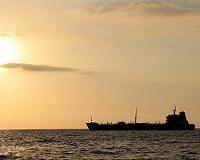
President Donald Trump downplayed recent attacks on oil tankers in the Gulf of Oman that Washington blames on Iran and noted that the United States is less dependent on energy supplies from the region.
"So far, it's been very minor," Trump told Time magazine in an interview released Monday.
However, Trump said he accepts the US intelligence assessment that Iran is behind the explosions that damaged the hulls of Norwegian and Japanese tankers.
"I don't think too many people don't believe it," he said.
Iran denies responsibility for the incidents, which come as tensions spiral between Washington and Tehran over what the United States says is Iran's secret push to develop nuclear weapons technology. Iran also denies having such a policy.
Trump told Time he would order a US military response if Iran had to be stopped getting nuclear arms, but he was not eager for war otherwise.
"I would certainly go over nuclear weapons," he said, "and I would keep the other a question mark."
"Other places get such vast amounts of oil there," Trump said. "We get very little. We have made tremendous progress in the last two and a half years in energy. And when the pipelines get built, we're now an exporter of energy. So we're not in the position that we used to be in in the Middle East."
Strait of Hormuz: imbalance of forces and guerilla warfare
Dubai (AFP) June 18, 2019 – The deployment of 1,000 more US troops to the Middle East highlights the imbalance of forces in the region between Washington and Tehran, which is experienced in maritime guerilla warfare and likely to avoid full-scale battles, experts say.
Washington has not specified when and where the new contingent will be deployed, but it comes less than three weeks after the US announced it was sending 1,500 soldiers, along with a squadron of fighter jets, to the region in response to alleged threats from the Islamic republic.
Any open confrontation between Washington and Tehran would therefore pit the US superpower — including its Bahrain-based Fifth Fleet and aircraft carriers — and its allies Saudi Arabia and Israel against an isolated Iran, whose economy has been crippled by years of sanctions and its military resources limited.
Saudi Arabia on Tuesday urged world powers to take "decisive action to ensure the safety of navigation in the waterways of the region", after twin attacks on tankers in the Gulf of Oman last week escalated US-Iran tensions.
– 'Guerrilla warfare' –
"A US-Iran war wouldn't be a naval war at all in the strict sense of the term," wrote James Holmes, from the US Naval War College, in The National Interest.
"Guerrilla warfare, not the traditional sea fight, makes a better analogy for Iranian maritime strategy," he added.
Jean-Sylvestre Mongrenier, researcher at the Franco-Belgian think-tank Institut Thomas More, said Iran is well aware it is no match for the aircraft carriers of the United States.
In waters they are familiar with, Iranians could pose problems for the US fleet, although they know they cannot compete head-on, analysts said.
Such actions could include placing mines in the Strait of Hormuz, harassing US navy craft with smaller warships and also using anti-ship missiles, Mongrenier said.
"The United States must also take into account the consequences of a possible direct confrontation with Iran on the overall balance of forces with China and Russia," Mongrenier told AFP.
"Iran's modes of action include the laying of mines in the Strait of Hormuz — Russian, Chinese and North Korean-made mines, but also Iranian-made mines — harassing US naval units by speedboats (armies of rocket launchers and short-range missiles) and the use of anti-ship missiles on land and sea," said Mongrenier.
The narrow and shallow nature of the Strait of Hormuz is likely to play a major role.
– 'Enemy's passage' –
In 1988, Operation Praying Mantis launched by the US Navy against Iranian oil platforms and facilities illustrated an imbalance of power.
In the midst of the 1980-88 Iran-Iraq war, Tehran had mined areas in the strategic navigation passage of the Strait of Hormuz, which the United States had vowed, as it has today, to keep open.
On April 14, 1988, the frigate USS Samuel B. Roberts hit a mine and almost sank, but there were no casualties.
In retaliation, the US military undertook a major offensive that included commando operations, launching missiles and aerial bombardments against two oil platforms Washington claimed were used as launching pads by Iranian speedboats and frigates.
In this naval battle, nearly 90 Iranian soldiers were killed and some 300 wounded, while two American pilots lost their lives when their helicopters crashed.
Any escalation between the United States and Iran would likely be played out at sea and have immediate global implications for energy markets if it affected shipping in the key transit point of the Strait of Hormuz.
Iranian forces "will concentrate asymmetric firepower and effort at the narrowest and most convoluted points in the strait, where an enemy's whereabouts are known in advance, targeting is easy, and escape it heard," said Holmes.
"So, don't make the mistake of comparing force structures and concluding that the US Navy would steamroller the Iranian armed forces by dint of its total number of warships, aircraft, and armaments."
