
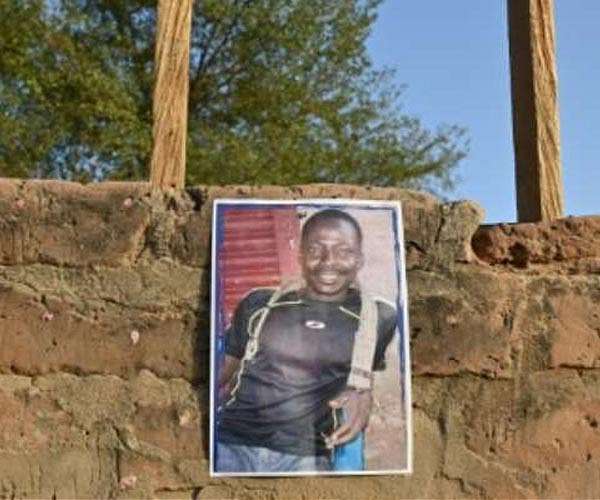
A printed sheet of paper bearing a photo of Adoussouma hung on the crumbling wall at the Komeissou family home in Chad's capital N'Djamena, marking his death Tuesday in protests against the new military junta.
The young man's broad smile in the picture was the only cheery face seen Thursday around the large house, where about 40 relatives and friends came to grieve with the family.
Adoussouma, 27, decided with friends to go out on Tuesday morning and demonstrate "for change" in the large, impoverished central African nation, his uncle Joslin said.
He planned only to go a few dozen metres (yards), up to the main asphalt road that borders his working-class district of Walia, a hotbed of protest in southern N'Djamena.
But a bullet pierced both Adoussouma's legs, and he died in hospital a few hours later.
A big man of 1.80 metres (almost six feet), Joslin wept as he described the circumstances of the death to the morgue official for the municipal register.
A few minutes later, he told AFP that he did not understand why his nephew had been shot.
– 'Dynastic succession' –
Adoussouma was among at least six demonstrators who died during protests called for by the opposition and civil society, many banned by the regime and put down by security forces.
Organizers wanted to denounce Mahamat Idriss Deby's "dynastic succession" to power on April 20 after the sudden death of his father, Idriss Deby Itno, who was mortally wounded fighting rebels.
In power for three decades, news of Deby's death came hard on the heels of an announcement that he had won a sixth presidential term.
A junta dubbed the Transitional Military Council (CMT) was quickly formed, chaired by Mahamat Idriss Deby and made up of generals close to his late father.
Assuming the title of president, the younger Deby dissolved the National Assembly and vowed to hold "free and democratic" elections in 18 months.
Opposition and civil society groups denounced an "institutional coup" as well as blasting the new regime's supporters across the region and from further afield — particularly France.
Paris has long been concerned about the stability of this pivotal nation between Libya, the Sahel and central Africa, seen as a bulwark in fighting the region's jihadists.
But Tuesday's demonstrations were cut short.
After barely a few hours, the few groups of young people who went to march were dispersed by the security forces in their ubiquitous pick-up trucks.
The uniformed men, mostly turbaned or wearing hoods, fired tear gas and live ammunition.
– 'He should have been useful' –
Dozens of people were injured and admitted to city hospitals. The authorities said that six people were killed in N'Djamena and in the south of the country, while local non-governmental organisations said that a dozen people lost their lives.
More than 650 others were detained by the security forces, although civil society groups say many have since been released.
The UN on Friday condemned "apparently disproportionate use of force, including live rounds" against the demonstrators.
Days later, wearing a black head scarf, Adoussouma's mother Yvonne Ponga grieved for her son.
"He was my first son, he was the one who was supposed to help me," she breathed, holding back tears.
"I did nothing, I have already suffered a lot," Ponga repeated over and over, recalling how Adoussouma's father had abandoned her on discovering that she was pregnant.
"I don't want to live anymore," she said.
"He was a good lad, he should have been useful to the family, he should have been useful to Chad, and suddenly he's gone. It's a shock," added Balo Lama Komeissou, 69, the head of the household.
"The government ignores its people and does not know the poverty in which we live," he said. "Even the students are unemployed."
In one of the world's poorest countries, joining the army or artisanal gold mining in the Sahara are the main ways off the bread line.
Among the young, a "fed up" outlook has become a "danger", said Remadji Hoinathy, a researcher at the Institute for Security Studies (ISS) in N'Djamena.
"In view of the current situation, those born in the early 1990s tell themselves that there is not much left to lose," Hoinathy said.
Adoussouma was one of those disabused and poorly educated young people. At 27, he was only just completing high school.
"He wanted Chad to change, for everyone here to prosper (without) inequality and nepotism," said Joslin.
He still hopes that his nephew "will be a martyr" and that "the blood that has been spilled is not for nothing".
Chad's new junta names transition government
N'Djamena (AFP) May 2, 2021 –
The military junta that took power in Chad last month after the shock death of veteran leader Idriss Deby Itno named a transition government on Sunday, the army spokesman said.
The so-called Transitional Military Council (CMT) had pledged to restore democracy to the poor Sahel country within 18 months after what the opposition condemned as an "institutional coup".
Deby's 37-year-old son Mahamat, the country's new strongman, named a government comprising 40 ministers and deputy ministers, junta spokesman Azem Bermandoa Agouna said in a televised statement.
Deby also created a new national reconciliation ministry to be headed by Acheick Ibn Oumar, a former rebel chief who became a diplomatic adviser to the presidency in 2019.
Longtime opposition politician Saleh Kebzabo was not named to the transition government, but he issued a statement saying he "recognised" it.
Two members of his party were given portfolios.
Another opposition figure, Mahamat Ahmat Alhabo, will be justice minister in the country of around 16 million.
Chad was thrown into turmoil by Deby's death, announced just the day after he was declared the winner of an April 11 election — giving him a sixth mandate after 30 years at the helm.
Earlier Sunday, the junta announced the lifting of an overnight curfew introduced after Deby's death.
The army said Deby died from wounds sustained in fighting with rebel forces in the north of the poor Sahel country last month.
Tensions are high in the country, with the military saying that six people were killed last week during demonstrations in the capital N'Djamena and the south against the formation of the junta.
A local aid group has put the death toll at nine. More than 650 people were arrested during the protests, which had been banned by the authorities.
The military has said that Deby died during fighting with rebels from the Libya-based Front for Change and Concord in Chad (FACT), who had launched an election day offensive on April 11.
The announcement of Deby's death aged 68 came only a day after he was proclaimed winner of the presidential election, handing him a sixth term in office after three decades of iron-fisted rule in the former French colony.
The election held no suspense, as his top threats had been sidelined.
– Landslide re-election –
Deby died on April 19 from wounds he suffered fighting the Libya-based rebels, according to the authorities.
A career soldier who seized power in 1990 and exercised it ruthlessly, Deby died on the day that the electoral commission confirmed that he had won a landslide victory, the authorities say.
The rebels have threatened to march on N'Djamena, where a team from the African Union arrived last week to assess ways to accelerate a return to democratic rule.
Chad, with a well respected fighting force, is central to the West's fight against jihadists in the Sahel, where myriad Islamist extremist groups operate.
France's 5,100-strong Barkhane anti-jihadist force is headquartered in N'Djamena.
