
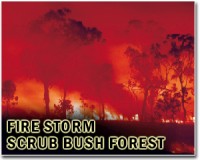
Smoke haze from bushfires raging in Australia spread to the capital Sunday, as firefighters raced to contain more than 140 blazes ahead of a heatwave forecast early this week.
Australia is experiencing a horrific start to its fire season, which scientists say began earlier and is more extreme this year due to a prolonged drought and the effects of climate change.
Residents of Canberra in the country's southeast woke up to see the capital shrouded in haze Sunday, joining those in Sydney who have endured weeks of toxic air pollution caused by bushfire smoke.
Officials said favourable weather conditions had given them a chance to bring several blazes under control before the forecast return of strong winds and high temperatures Tuesday.
Among those is a "mega fire" burning across 250,000 hectares within an hour's drive of Sydney, Australia's largest city, where ash from the fires has occasionally fallen.
Firefighters are now bracing for Tuesday, when temperatures are expected to reach above 40 Celsius in parts of New South Wales state — worst-hit by the bushfires — and gusting westerly winds are likely to fan the flames.
"Today (fire) crews will be doing what they can to consolidate and strengthen containment lines, which in some areas will include backburning," NSW Rural Fire Service spokesman Greg Allan told AFP.
But the state's Bureau of Meteorology warned that the massive fires are "in some cases just too big to put out at the moment".
"They're pumping out vast amounts of smoke which is filling the air, turning the sky orange & even appearing like significant rain on our radars," the department tweeted.
Nearly 50 reinforcements from the United States and Canada have been flown in to support fatigued firefighters in recent days, with the international contingent tasked with providing logistical assistance.
In neighbouring Queensland, the focus was also on managing fatigue among frontline firefighters — who in both states are almost all volunteers — as weather there provided a brief reprieve from weeks of battling blazes.
"We're just looking to wind down and recover and prepare for the next round, whenever that may be," a Queensland Fire and Emergency Service spokesman told AFP.
Since the crisis began in September, six people have been killed, more than 700 homes destroyed and an estimated two million hectares (almost five million acres) scorched.
Though the human toll has been far lower than the deadliest fire season in 2009 — when almost 200 people died — the scale of this year's devastation has been widely described as unprecedented, as Australians grapple with the impacts of a changing climate.
Official data shows 2019 is on track to be one of the hottest and driest years on record in Australia.
'Mega fire' forms north of Sydney
Sydney (AFP) Dec 6, 2019 –
Several Australian bushfires have combined to form a "mega fire" that is burning out of control across a swathe of land north of Sydney, authorities said Friday, warning they cannot contain the blaze.
New South Wales Rural Fire Service deputy commissioner, Rob Rogers said "there are probably more than eight fires in all" that have merged to form what has been dubbed a "mega fire" in an area of national park forest.
The blaze was burning across 300,000 hectares — an area roughly 60 kilometres (37 miles) across — within an hour's drive of Australia's largest city, which was again subsumed in a soup of toxic smoke.
"There is just fire that whole way" said Rogers, who added that firefighters could do little more than get any residents out, protect property and hope for an end to fire-friendly dry and windy conditions.
We "cannot stop these fires, they will just keep burning until conditions ease, and then we'll try to do what we can to contain them," he told public broadcaster ABC.
"The best thing we can do is try to protect property and people as much as we can."
Prolonged drought has left much of eastern Australia tinder-dry and spot fires have raged every day for the past three months.
Bushfires are common in Australia but scientists say this year's season has come earlier and with more intensity due to a prolonged drought and climatic conditions fuelled by global warming.
Dramatic footage of firefighters running from a wall of fire ripping through the tree canopy above them was captured overnight in Orangeville, less than 100 kilometres west of Sydney.
The local fire and rescue team that shot the images said no one was injured and the vehicles surrounded by the swirling embers also survived the blaze.
"The video was put up to demonstrate why you need to listen to the fire advisory system," the team from Ingleburn fire station said on Facebook.
"If your property is not prepared for the bushfire season and your (sic) not sure you are able or capable of defending your property if a fire approaches you need to leave straight away," they warned.
At a wildlife park in the area, 300 animals were evacuated.
Walkabout Wildlife Park said it had shipped out lizards, dingoes, peacocks and marsupials, as firefighters battled more than 100 fires up and down the eastern seaboard.
"This fire has been doing some crazy things, so we have to be prepared," general manager Tassin Barnard told AFP.
New South Wales rural fire chief Shane Fitzsimmons said some US and Canadian firefighters had arrived to help out.
The specialists are expected to supervise waterbombing planes and heavy equipment used in creating fire containment lines.
"We are not only appreciative of their presence here today, but of their sacrifice," said Fitzsimmons — who has become a fixture on Australian television screens for weeks, updating the public on blazes in towns, national parks and backwaters.
"They are volunteering to sacrifice time from loved ones, from families, to give up that special time of the year around Christmas and New Year to come down here and lend us a hand," he said.
More than 600 homes have been destroyed and six people have died since the crisis began in September.
That is many fewer than Australia's deadliest recent fire season in 2009 when almost 200 people died, but 2019's toll so far belies the scale of devastation.
An estimated two million hectares have burned — the size of some small countries — across a region spanning hundreds of kilometres (miles).
The fires have taken a toll in Sydney and other major cities, which have been blanketed in toxic smoke for weeks and occasionally sprinkled with snow-like embers.
Fitzsimmons said he could not "overstate the effect that this profound drought is having" as he warned of a long, painful summer ahead.
"There is an absolute lack of moisture in the soil, a lack of moisture in the vegetation… you are seeing fires started very easily and they are spreading extremely quickly, and they are burning ridiculously intensely."
