
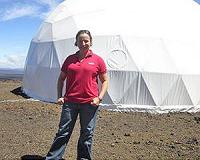
The crew that will spend 365 days in isolation in the next Hawai?i Space Exploration Analog and Simulation (HI-SEAS) mission has been selected. The six scientists will begin their yearlong stay in the solar powered dome atop Mauna Loa on August 28. It will be the fourth and longest HI-SEAS mission yet in the University of Hawaii at Manoa research project that simulates long duration space exploration.
As with the previous two HI-SEAS missions in the NASA funded study, this mission will focus on crewmember cohesion and performance. HI-SEAS researchers are working to develop effective team composition and support strategies to allow crews to successfully travel to Mars and back, an estimated three-year journey.
The crew will be monitored using cameras, body movement trackers, electronic surveys, and other methods. UH Manoa researchers and their collaborators will be studying the group's cohesion over time, gathering data on a wide range of cognitive, social and emotional factors that may impact team performance.
"The longer each mission becomes, the better we can understand the risks of space travel," said Kim Binsted, HI-SEAS principal investigator and UH Manoa professor from the Department of Information and Computer Sciences.
"We hope that this upcoming mission will build on our current understanding of the social and psychological factors involved in long duration space exploration and give NASA solid data on how best to select and support a flight crew that will work cohesively as a team while in space."
