
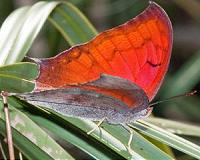
Butterfly wings aren't simply lifeless canvasses for color signalling. New research has revealed a network of living cells within butterfly wings that helps the insects maintain performance by preventing overheating and rapid cooling.
When scientists from Columbia and Harvard peeled back the scales of butterfly wings, they found a network of mechanical and temperature sensors, as well as a supportive circulatory and tracheal systems.
"Most of the research on butterfly wings has focused on colors used in signaling between individuals," Naomi E. Pierce, professor of evolutionary biology at Harvard, said in a news release. "This work shows that we should reconceptualize the butterfly wing as a dynamic, living structure rather than as a relatively inert membrane."
The delicate wings of a butterfly can quickly overheat in the sun. They can also cool down too quickly in cold environs. According to the new study, published Tuesday in the journal Nature Communications, the living cells in butterfly wings help the insects regulate their temperature.
"Butterfly wings are essentially vector light-detecting panels by which butterflies can accurately determine the intensity and direction of sunlight, and do this swiftly without using their eyes," said Nanfang Yu, associate professor of applied physics at Columbia.
In lab tests, scientists used a technology called infrared hyperspectral imaging to measure the heat distribution across butterfly wings.
"We discovered that diverse scale nanostructures and non-uniform cuticle thicknesses create a heterogeneous distribution of radiative cooling — heat dissipation through thermal radiation — that selectively reduces the temperature of living structures such as wing veins and scent pads," Yu said.
Though scientists studied the wings of several different butterflies, each with unique visible colors and patterns, the infrared hyperspectral imaging revealed the living portion of each butterfly wing remained cooler than the rest of the wing under a variety of environmental conditions.
"The nanostructures found in the wing scales could inspire the design of radiative-cooling materials to cope with excessive heat conditions," said lead study author Cheng-Chia Tsai, a doctoral student in Yu's group.
In behavioral tests, scientists found the butterflies regularly responded to simulated sunlight in ways that suggest the butterfly's living wings help the insect sense the direction and intensity of sunlight. Using a small light spot to precisely warm the butterflies, scientists found the insects were most sensitive to a threshold of 104 degrees Fahrenheit.
Scientists are now working to study the mechanical sensors found in living wings, with hopes of deciphering the ways different sensor networks enable unique flying patterns.
Scientists track flower preferences of bumble bees
Washington DC (UPI) Jan 28, 2020 –
To figure out what kinds of plants bumble bees like best, scientists surveyed bee-plant interactions in 400 sample plots in Plumas National Forest, located in California's Sierra Nevada.
"We spent 16 minutes searching for bumble bees within a 20 meter radius plot," lead study author Jerry Cole, a biologist with the Institute for Bird Populations, told UPI in an email. "Any time we saw a bumble bee using a plant we captured it in a net and then identified the plant to species."
The researcher observed 13 different bumble bee species visiting more than 100 different species of flower. However, scientists determined the bees only preferentially selected 14 of the plant species.
Cole and his research partners, including scientists from the University of Connecticut and the USDA Forest Service, used statistical models to account for the abundance of flowers in each plot. If a flower is particularly abundant, it can make it appear as though bees have a preference for the flower when no preference exists. The flower, in other words, is simply available in great numbers, not preferred.
"The kinds of models that incorporate availability have been around and used for decades to answer questions about what habitat is most selected by a given organism," Cole said.
All of the bee species showed a preference for many of the same species, but each species was found on flower species that others ignored. The list of flowers that bees preferred — including species like Agastache urticifolia, called nettleleaf giant hyssop or horse mint, and Lupinus polyphyllus, or large-leaved lupine — could be used to inform habitat restoration.
The findings, published Tuesday in the journal Environmental Entomology, don't suggest there is a handful of flower species that are key to bee health. Instead, the results echo those of other studies that showed plant diversity is essential to bee health. The largest bee populations are found in habitats with a variety of flowers.
"Having plants with staggered blooming periods can be beneficial to a large group of bumble bee species," Cole said. "So when restoring or enhancing habitat for bumble bees it's important to have plant species with blooming periods across an entire season and provide relatively consistent food for bumble bees."
