
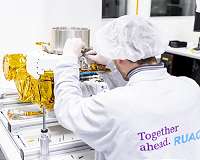
On 7th/8th February a United Launch Alliance (ULA) Atlas V rocket with Sun Explorer Solar Orbiter will launch from Cape Canaveral, Florida. RUAG Space supplied the thermal insulation, the structure of the satellite and the on-board computer, the so-called brain.
The Solar Orbiter is a joint ESA/NASA collaboration and is scheduled for launch for 7th/8th February on a ULA Atlas V launch vehicle. The satellite will get very close to the Sun. It will be the first satellite to provide close-up images of the Sun's polar regions. It will study the solar wind, the so-called space weather, as well as all layers of the Sun, except its core.
RUAG Space on board
RUAG Space has various parts on board of Solar Orbiter. "We have delivered key components, which enable this important science mission. Our computer controls the satellite, stores all scientific data, and communicates with Earth, our thermal insulation keeps it at the right temperature and our structures hold it stable," says Peter Guggenbach, Executive Vice President, RUAG Space.
Due to its extreme proximity to the Sun, Solar Orbiter's heat shield will be exposed to 13 times more solar radiation than on Earth.
Some parts of the spacecraft will reach extremely high temperatures up to several hundred degrees Celsius. RUAG Space has developed a special thermal insulation for these conditions, meeting exactly the requirements for Solar Orbiter.
This means extremely high temperatures up to several hundred degrees Celsius. RUAG Space has supplied the spacecraft structure. It is made of a carbon fiber backbone in cylinder form, and a number of aluminum sandwich panels to which all the subsystems are mounted.
