
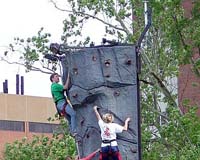
What do wakeboarding, horseback riding, archery, rock climbing, whitewater rafting and mountain biking have to do with middle school math? These six pastimes are the basis of Camp MMU, a new program on Raytheon's MathMovesU Web site that uses popular "tween" activities to help take the monotony out of studying math during the summer break. Participants log on and choose from up to six themed "cabins" each week.
A student who answers the questions in any two cabins is entered in a random drawing to win that week's featured prize. Prizes include Nintendo Wii, a karaoke machine, and a portable DVD player. Camp MMU runs through August 24.
The idea for a virtual summer math camp grew out of a recent survey for Raytheon. In the survey parents and middle school aged children were polled about student study habits. One of the main findings highlighted a significant disconnect between how often parents and students felt math should be studied over the summer and how often students actually plan to study it during their break.
While a majority of both parents and "tweens" felt that studying math at least once a week was something students should do, two-thirds (68 percent) of middle schoolers expected to study math once a month or less. In addition, just eight percent of 11-13 year olds surveyed are required to study math during the summer – well shy of the 39 percent who are required to study English/reading during the same timeframe.
Although 76 percent of students told researchers that math is important to them, when they were given a choice of ways to keep their skills sharp over the summer, the vast majority (83 percent) not surprisingly opted for Internet-based or educational math games over textbooks, tutoring or summer school.
"We know kids would rather spend their holidays at the beach or the amusement park," said Kristin Hilf, Raytheon vice president of community relations. "Camp MMU pairs that love of outdoor activities with the attraction of the Internet. By appealing to students' imaginations and by taking the monotony out of studying math, the goal is to offset the loss of math skills that occurs during the summer."
