
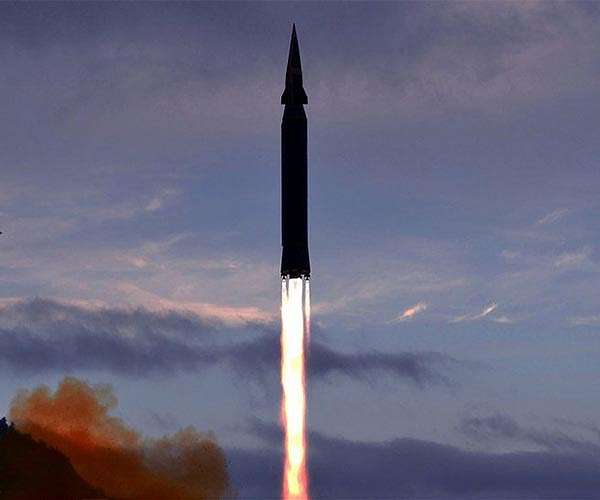
North Korea's leader Kim Jong Un personally oversaw the successful test of a hypersonic missile, state media reported Wednesday, the second such launch by the nuclear-armed nation in less than a week.
The missile carrying a "hypersonic gliding vehicle" hit "the set target in waters 1,000 km off," the official Korea Central News Agency (KCNA) said.
Photographs posted on the website of Rodong Sinmun, the official newspaper of the ruling Workers' Party, showed Kim Jong Un wearing a long black leather coat and using binoculars to watch the missile blast off from his mobile viewing platform.
"The superior maneuverability of the hypersonic glide vehicle was more strikingly verified through the final test-fire," the KCNA report said.
Other images in Rodong Sinmun showed the missile blasting off from land at dawn in a blaze of fire and smoke, and Kim discussing charts with uniformed officials.
This is the third reported North Korean test of a hypersonic gliding missile to date, following one in September 2021 and one last week, as the country looks to add the sophisticated weapon to its arsenal.
South Korea's military said the Tuesday launch had reached hypersonic speeds and showed clear signs of "progress" from last week's test.
The KCNA report said that the hypersonic glide vehicle "made glide jump flight from 600 km area before making a 240 km corkscrew."
Hypersonic missiles travel at speeds of Mach 5 and higher and can manoeuvre mid-flight, making them harder to track and intercept.
Russia, the United States and China have all said they have successfully tested hypersonic glide vehicles, with Russia generally seen as the world leader in the technology so far.
In the decade since Kim took power, North Korea has seen rapid advances in its military technology at the cost of international sanctions.
Hypersonic missiles were listed among the "top priority" tasks for strategic weapons in its current five-year plan, and it announced its first test — of the Hwasong-8 — in September last year.
"Kim Jong Un's attendance at the missile test suggests that the level of completion of the hypersonic missile has reached a satisfactory level," said Lim Eul-chul, a professor of North Korean studies at Kyungnam University in Seoul.
– Stalled talks –
The Tuesday test came as the UN Security Council met in New York to discuss Pyongyang's weapons programs.
US State Department spokesman Ned Price said the launch "violates multiple UN Security Council resolutions."
The hypersonic tests come as North Korea has refused to respond to US appeals for talks.
At a key meeting of North Korea's ruling party last month, Kim vowed to continue building up the country's defence capabilities, without mentioning the United States.
Dialogue between Washington and Pyongyang remains stalled and the country is under multiple sets of international sanctions over its nuclear and ballistic missile programmes.
The impoverished nation has also been under a rigid self-imposed coronavirus blockade that has hammered its economy.
US briefly halted west coast flights after NKorea missile test: FAA
Washington (AFP) Jan 11, 2022 –
Takeoffs at some western US airports were temporarily halted after North Korea test-launched a ballistic missile, the Federal Aviation Administration said Tuesday.
"As a matter of precaution, the FAA temporarily paused departures at some airports along the West Coast on Monday evening," the FAA said in a statement about the rare action.
"Full operations resumed in less than 15 minutes. The FAA regularly takes precautionary measures," it said.
The agency, which governs commercial and private aviation, did not directly link the shutdown to the North Korean missile, and the US military said it had not ordered the action.
But when asked about the North Korean launch and the airports, White House Spokesperson Jen Psaki replied: "I believe it was a 15 minute groundstop and they did it out of an abundance of caution."
The FAA is "going to be assessing their approach moving forward," she said.
The shutdown appeared to have been ordered just minutes after the launch, which took place at around 2227 GMT Monday, or 2:27 pm on the west coast Pacific Standard Time.
The second test launch in a week by nuclear-armed North Korea is believed to have been a short-range ballistic missile that plunged into the sea east of the Korean peninsula after flying 700 kilometers (435 miles), according to South Korea's Joint Chiefs of Staff.
The missile reached an altitude of 60 kilometers (37 miles) and a speed of Mach 10, or ten times the speed of sound.
Public reports on social media showed that planes preparing for takeoff were told to halt in place at several western US airports before the order was rescinded.
In a recording posted online, a Burbank air traffic controller is heard telling a pilot to land because "some sort of national security stuff is going on."
Washington Times reporter Bill Gertz said in a tweet that his flight in Reno, Nevada, just east of the border of northern California, was also held on the ground for about 20 minutes.
It is not clear exactly how the alert was triggered. A spokesman for the Pentagon's North American Aerospace Defense Command (Norad) said it did not issue an alert after the launch. US intelligence can detect such events immediately with satellites monitoring the region.
"Certainly from our part, the missile launch would have been detected and assessed as no threat to Canada or the United States, and therefore no warning was issued," the Norad spokesman said.
The United States has elevated its defense readiness ever since Pyongyang demonstrated in tests in 2017 that it had potentially intercontinental ballistic missiles capable of hitting the continental United States.
On January 13, 2018, Hawaii went on full alert for a possible nuclear ballistic missile attack, with residents told to seek immediate shelter, after an erroneous emergency warning went out and sparked panic across the state.
