
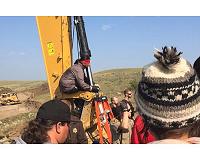
Police in the US state of North Dakota engaged in a tense standoff with oil-pipeline protesters Thursday, attempting to clear them from a public road and off private property.
Police used a sound cannon to disperse protesters, some of whom had moved closer to the construction area of the Dakota Access Pipeline, the subject of a months-long protest by Native Americans and their supporters.
"There have been arrests made," said Dallas Goldtooth, a protester at the scene of the standoff, said in a Facebook post.
The protesters created a barricade with tires and wooden poles — briefly lighting it on fire — as police in riot helmets moved slowly toward them in a long line and told them to disperse via loudspeaker.
The protesters were attempting to stop Energy Transfer Partners's construction of the pipeline, Goldtooth said, after it resumed following courts' refusals to halt the project.
"We all are aware that this is an arrestable situation for everybody in this space. That's what we've been told. So we're just doing our best to hold the line," Goldtooth posted.
The Standing Rock Sioux Tribe, whose reservation is close to the pipeline's route, has objected to the project, saying it would damage its water supply by crossing the nearby Missouri River and would destroy sacred Native American sites.
The standoff has grown into a larger protest movement in the United States, drawing in Indian tribes, environmentalists and advocates for Native Americans.
The tribe criticized the sheriff's actions Thursday. Spokeswoman Sue Evans told AFP that law enforcement was employing "militarized vehicles and equipment."
The tribe has asked the Obama administration to intervene to stop the pipeline construction and for the Department of Justice to investigate "law enforcement abuses at the site," Evans said.
Morton County Sheriff Kyle Kirchmeier, who has spearheaded the law-enforcement response, said he had visited the protesters Wednesday and asked them to voluntarily clear the road and remove teepees and tents from private land, but they declined.
"We cannot have protesters blocking county roads, blocking state highways, or trespassing on private property," Kirchmeier said in a statement, adding that the protesters had "escalated unlawful behavior," forcing law enforcement to respond.
The US federal government has twice asked the pipeline operators to voluntarily pause construction near the tribe's reservation while the authorities reconsider the project's route.
But courts have refused to compel a halt. Energy Transfer Partners has insisted that the pipeline complies with the law. It resumed construction of the pipeline on October 11.
