
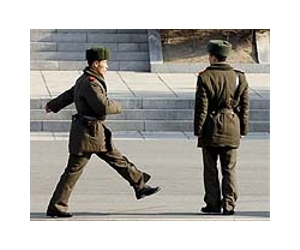
North Korea's military Thursday accused South Korean and US troops of planning a surprise attack, and said it could respond with atomic weapons, as diplomatic efforts intensified to revive nuclear disarmament talks.
Pyongyang's military described upcoming US-South Korean manoeuvres as "pilot operations and nuclear war exercises" aimed at mounting a surprise preemptive attack on it.
The military said it would retaliate for any attack "with our powerful military counteraction, and if necessary, mercilessly destroy the bulwark of aggression by mobilising all the offensive and defensive means including nuclear deterrent".
The statement from the General Staff was carried on the communist state's official news agency.
The North routinely criticises war games staged in South Korea as a rehearsal for invasion, while Seoul and its ally Washington say they are purely defensive.
The Key Resolve/Foal Eagle exercise from March 8-18 will draw 10,000 US troops stationed in South Korea plus 8,000 from abroad, and an undisclosed number of South Korean troops.
On the diplomatic front, a US envoy trying to restart six-nation nuclear disarmament talks said they could resume very soon if North Korea called off its boycott.
"We are prepared to resume six-party talks in the very near future," Stephen Bosworth told reporters on arrival in South Korea, his second stop in a three-country mission.
But the envoy, who earlier held talks in China which hosts the six-party forum, said he did not know whether the North would rejoin the talks.
China said it was closely consulting other parties to try to reopen talks soon.
"At present the six-party talks is certainly facing an important opportunity to work out of the current dilemma and move forward," said foreign ministry spokesman Qin Gang.
The talks grouping the two Koreas, Japan, China, Russia and the United States were last held in December 2008 before getting bogged down in disputes over verifying disarmament.
In April last year the North declared the forum "dead". It staged its second atomic weapons test and ballistic missile launches before indicating readiness in principle to return to dialogue.
Estimates vary but the North is thought to have enough plutonium to make around eight atomic weapons. It is not known whether it could deliver them by missile.
Bosworth, the US special envoy on North Korea, met his Chinese counterpart Wu Dawei in Beijing Wednesday to assess prospects of resuming negotiations.
South Korea's chief nuclear negotiator Wi Sung-Lac also met Wu during a two-day visit to Beijing that began Tuesday.
Wi, quoted by South Korea's Yonhap news agency, said Wednesday the future was unclear.
"We will have to wait and see because it is still not clear how the consultations (on the resumption of the talks) will go," he added.
The North has two conditions for returning to dialogue: the lifting of UN sanctions and a US commitment to discuss a formal peace treaty on the Korean peninsula.
"We could not see any significant changes (to North Korea's demands)," a South Korean official told Yonhap after the Wi-Wu meeting.
Some analysts believe Pyongyang is raising tensions on the peninsula to make its point that a formal peace pact is needed. The 1950-1953 war ended only with an armistice.
The United States, South Korea and Japan, where Bosworth will travel Friday, say Pyongyang must return to dialogue and show seriousness about denuclearisation before other issues are discussed.
earlier related report
US envoy says nuke talks could resume soon if N.Korea moves
Seoul (AFP) Feb 25, 2010 –
Six-nation nuclear disarmament talks could resume very soon if North Korea ends its boycott of the negotiations, a US envoy said Thursday, as China urged the parties to seize an "important opportunity".
"We are prepared to resume six-party talks in the very near future," Stephen Bosworth told reporters on arrival in South Korea, his second stop in a three-country mission to revive the nuclear dialogue.
But the envoy, who earlier held talks in China which hosts the six-party forum, said he did not know whether the North would rejoin the talks.
Bosworth said such a return would be "in everyone's interests".
China said it is closely consulting other parties to try to reopen the talks soon .
"At present the six-party talks is certainly facing an important opportunity to work out of the current dilemma and move forward," foreign ministry spokesman Qin Gang told reporters.
The talks grouping the two Koreas, Japan, China, Russia and the United States were last held in December 2008 before getting bogged down in disputes over verifying disarmament.
In April last year the North declared the forum "dead". It staged its second atomic weapons test and ballistic missile launches before indicating readiness in principle to return to dialogue.
Bosworth, the US special envoy on North Korea, met his Chinese counterpart Wu Dawei in Beijing Wednesday to assess prospects for resuming negotiations.
South Korea's chief nuclear negotiator Wi Sung-Lac also met Wu as part of a two-day visit to Beijing that began on Tuesday.
Wi, quoted by South Korea's Yonhap news agency, said Wednesday the future was unclear.
"We will have to wait and see because it is still not clear how the consultations (on the resumption of the six-party talks) will go," he added.
The North has two conditions for returning to dialogue: the lifting of UN sanctions and a US commitment to discuss a formal peace treaty on the Korean peninsula.
"We could not see any significant changes (to North Korea's demands)," a South Korean official told Yonhap news agency after the Wi-Wu meeting.
The United States, South Korea and Japan, where Bosworth will travel Friday, say Pyongyang must return to dialogue and show seriousness about denuclearisation before other issues are discussed.
China, the North's only major ally, has said the future of the on-off negotiations depends on the willingness of Washington and Pyongyang to work together.
Share This Article With Planet Earth
