
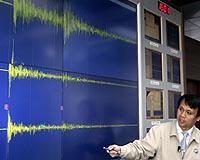
The atomic bomb which North Korea tested Monday was probably less powerful than hoped because it was detonated incorrectly, according to one expert citing seismic data.
The explosive, while larger than the first test in October 2006, was still far short of the expected yield of a crude Hiroshima-type bomb, according to Jeffrey Park, director of the Yale Institute for Biospheric Studies.
"More than likely this means North Korea tried and failed to get a simple plutonium bomb to detonate correctly," Park wrote in an article on the website of the Bulletin of the Atomic Scientists.
Park said most estimates of the Richter magnitude were in the low half of the 4.5-5 range "so it seems likely that the yield was four kilotons or smaller."
While that was much larger than the 2006 test, it still fell far short of an expected 12-20 kiloton yield of a crude Hiroshima-style device, Park wrote.
"For comparison's sake, the first nuclear tests of all other nations that are self-announced members of the nuclear club had larger yields than this latest North Korean test."
Park said that compared to bomb technology based on uranium 235, "building a plutonium-based bomb represents a technical challenge because the critical mass can blow apart in a split second before the detonation reaches max efficiency."
Even an inefficient nuclear weapon is "nothing to dismiss," Park said.
"But one should be mindful of the technical challenges North Korea still faces in carrying out the threats implied by its deliberate pairing of its explosive test with test missile launches."
Other experts have also estimated the power of Monday's underground blast at around four kilotons, or 4,000 tons of TNT, compared to less than one kiloton for the first test.
Share This Article With Planet Earth
