
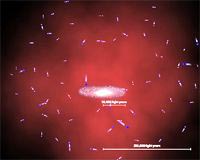
It wasn't a Galactic diet that accounted for the recent slimming, but a more accurate scale. This weighty discovery from the Sloan Digital Sky Survey (SDSS-II) has broad implications for our understanding of the Milky Way.
"The Galaxy is slimmer than we thought," said Xiangxiang Xue of the National Astronomical Observatories of China, who led an international team of researchers. "That means it has less dark matter than previously believed, but also that it was more efficient in converting its original supply of hydrogen and helium into stars." Xue is presently pursuing a doctoral thesis at the Max Planck Institute for Astronomy (MPIA) in Heidelberg, Germany.
The discovery, accepted for publication in The Astrophysical Journal, is based on data from SEGUE, an enormous survey of stars in the Milky Way — one of the three programs that comprise SDSS-II. Using SEGUE measurements of stellar velocities in the outer Milky Way, a region known as the stellar halo, the researchers determined the mass of the Galaxy by inferring the amount of gravity required to keep the stars in orbit. Some of that gravity comes from the Milky Way stars themselves, but most of it comes from an extended distribution of invisible dark matter, whose nature is still not fully understood.
To trace the mass distribution of the Galaxy, the SEGUE team used a carefully constructed sample of 2,400 "blue horizontal branch" stars whose distances can be determined from their measured brightness. Blue horizontal branch stars can be seen to large distances, Xue explained, enabling the team to measure velocities of stars all the way out to distances of 180,000 light years from the sun.
The most recent previous studies of the mass of the Milky Way used mixed samples of 50 to 500 objects, noted team member Hans-Walter Rix, director of MPIA. They implied masses up to two trillion times the mass of the sun for the total mass of the Galaxy. By contrast, when the SDSS-II measurement within 180,000 light years is corrected to a total mass measurement, it yields a value slightly under one trillion times the mass of the sun.
"The enormous size of SEGUE gives us a huge statistical advantage," said Rix. "We can select a uniform set of tracers, and the large sample of stars allows us to calibrate our method against realistic computer simulations of the Galaxy."
"The total mass of the Galaxy is hard to measure because we're stuck in the middle of it," explained collaborator Timothy Beers of Michigan State University. "But it is the single most fundamental number we have to know if we want to understand how the Milky Way formed or compare it to distant galaxies that we see from the outside."
All SDSS-II observations are made from the 2.5-meter telescope at Apache Point Observatory in New Mexico. It uses a mosaic digital camera to image large areas of sky and spectrographs fed by 640 optical fibers to measure light from individual stars, galaxies, and quasars. SEGUE's stellar spectra turn flat sky maps into multi-dimensional views of the Milky Way, Beers said, by providing distances, velocities, and chemical compositions of hundreds of thousands of stars.
The Sloan Digital Sky Survey
The Sloan Digital Sky Survey is the most ambitious survey of the sky ever undertaken, involving more than 300 astronomers and engineers at 25 institutions around the world. SDSS-II, which runs from 2005-2008, is comprised of three complementary projects. The Legacy Survey is completing the original SDSS map of half the northern sky, determining the positions, brightness, and colors of hundreds of millions of celestial objects and measuring distances to more than a million galaxies and quasars. SEGUE (Sloan Extension for Galactic Understanding and Exploration) is mapping the structure and stellar makeup of the Milky Way Galaxy. The Supernova Survey repeatedly scans a stripe along the celestial equator to discover and measure supernovae and other variable objects, probing the accelerating expansion of the cosmos. All three surveys are carried out with special purpose instruments on the 2.5-meter telescope at Apache Point Observatory, in New Mexico.
