
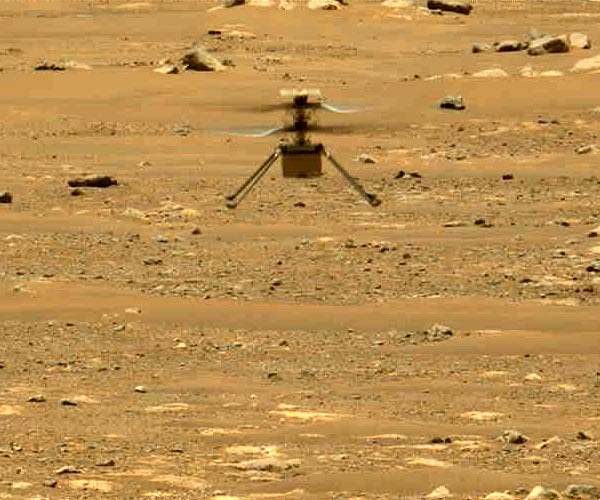
NASA officials have changed the agency's plans for its daring and complicated effort to bring actual samples of Mars back to Earth by adding two helicopters and ditching the idea of landing a "fetch rover."
In a joint project with the European Space Agency, NASA has a goal of returning Martian samples back to Earth by 2033. The rover Perseverance is already on the Red Planet with the charge of collecting the samples.
Scientists have been encouraged by the performance of the rover and the current Martian helicopter Ingenuity, which arrived with Perseverance last year.
Perseverance will be tasked with bringing the samples to a Mars ascent vehicle with the two helicopters, modeled after Ingenuity, serving as a Plan B.
"The conceptual design phase is when every facet of a mission plan gets put under a microscope," said Thomas Zurbuchen, associate administrator for science at NASA headquarters in Washington, said Wednesday in a statement.
"There are some significant and advantageous changes to the plan, which can be directly attributed to Perseverance's recent successes at Jezero [Crater on Mars] and the amazing performance of our Mars helicopter."
If Perseverance fails to retrieve the samples, the helicopter will be sent out to capture the sample and place them within reach of the ESA's ascent vehicle, eliminating the need for a second rover.
"ESA is continuing at full speed the development of both the Earth Return Orbiter that will make the historic round-trip from Earth to Mars and back again; and the Sample Transfer Arm that will robotically place sample tubes aboard the Orbiting Sample Container before its launch from the surface of the Red Planet," said David Parker, ESA's director of human and robotic exploration.
