
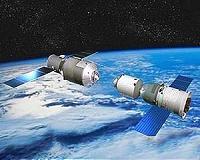
China recently announced that the crew of Shenzhou 11, bound for the Tiangong 2 space laboratory, will only consist of two astronauts. That's a big step back from recent trends in Chinese spaceflight, which has favoured three-person crews for recent missions.
Two crews were launched to the Tiangong 1 space laboratory, and they both contained three people. So did the Shenzhou 7 mission, which carried out China's first spacewalk. There was one exception to this trend. Shenzhou 8 carried no crew at all, but this was not an operational human space mission.
The Shenzhou spacecraft can easily accommodate three people. It's even larger than Russia's Soyuz spacecraft. Furthermore, the crew of Shenzhou 11 will spend most of their time aboard the Tiangong 2 laboratory, which has yet to be launched. So why the cutback?
This analyst proposes a simple explanation: Logistics. The more crew you have, the more consumables you need. Cut out one astronaut, and your logistics can be stretched for a longer mission.
This could be critical on a small space laboratory. China's expeditions to Tiangong 1 were roughly two weeks long. This time, China could be planning a longer stay. Dropping one astronaut is the price that must be paid for keeping the other two in space for longer.
So, how long will they stay? This analyst previously speculated that a mission of one month could be feasible. That was based on rough logistics calculations, assuming a single crew of three astronauts would occupy the lab. If we assume a single crew will fly, that could still be done, but China could extend the occupation even longer.
The decision could also be tied into the new regenerative life-support system on Tiangong 2. This could possibly manage the waste products of two astronauts with ease, but could be challenged by three. This theory is speculation, but it could also help to explain the decision, and the fact that it's such an unexpected change from previous trends.
China could also be testing a two-person crew from a task management perspective. The Soviet Union experimented with different sizes of crews for its Salyut space stations. China could be following the same path.
The use of a two-person crew will also prompt more speculation on the crewmembers themselves. There will be a commander and a second astronaut who could be dubbed "pilot" or "flight engineer" or both.
The commander will probably be a veteran and the second astronaut will probably be a rookie. But how will China reshuffle its crew rosters? China's launch rate is notoriously slow. Flight opportunities are rare. With smaller crews, China's astronauts will have to wait even longer for their missions.
In a recent article in China's state-run media, China has spoken of Shenzhou 11 (with two crew) and the first Tianzhou cargo spacecraft as missions bound for Tiangong 2. There is no mention of a Shenzhou 12 mission to Tiangong 2.
As previously suspected the order of missions is Shenzhou 11 followed by Tianzhou. This analyst thus suggests that a second crew expedition to Tiangong 2 (which would launch on Shenzhou 12) is questionable.
China would presumably wait until human occupation of Tiangong 2 was complete before it experimented with the untested Tianzhou spacecraft. But this is not exactly set in stone.
China has a habit of surprising us with unexpected announcements and reshuffles. The conservation of logistics with a two-person crew on Shenzhou 11 could be one way of ensuring that there's something left for a second crew. Waiting for more developments is always entertaining.
