
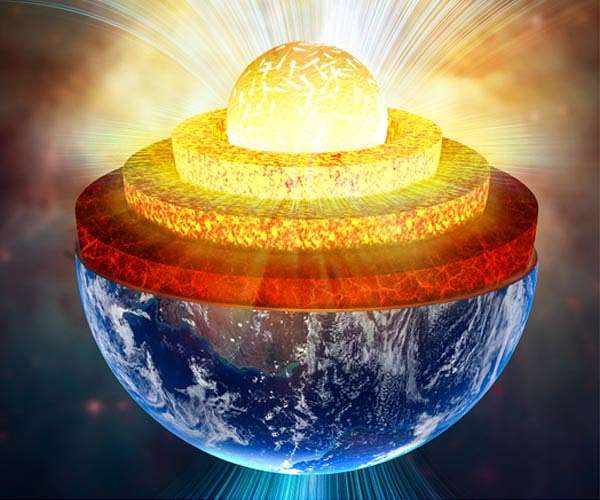
A new study reveals that the solid inner core at the center of Earth behaves in a way that defies traditional understanding of solid matter, existing instead as a superionic structure. This research, led by Professor Youjun Zhang and Dr. Yuqian Huang of Sichuan University, along with Professor Yu He from the Institute of Geochemistry, CAS, uncovers how light elements move fluidly through the dense, solid iron framework that makes up the inner core.
Earth's inner core is a sphere of iron alloy subjected to staggering pressures above 3.3 million atmospheres and temperatures near 6000 kelvin. Despite being solid, seismic data have long shown it is unexpectedly "soft," slowing seismic shear waves and displaying a Poisson's ratio more similar to soft metals than to rigid iron. Scientists have now proved that, under these extreme conditions, the iron – carbon alloy transforms into a superionic phase. In this state, carbon atoms diffuse rapidly within a solid iron lattice, imparting fluid-like properties while keeping the underlying crystal structure intact.
"Under inner-core conditions, carbon atoms are highly mobile yet the iron remains stable," said Professor Zhang. "This superionic phase can explain why shear waves slow down and why the core appears soft rather than rigid."
To achieve these results, the team used a dynamic shock compression platform, accelerating iron – carbon samples to 7 km/s, generating conditions similar to Earth's inner core. By taking real-time sound velocity measurements and using molecular dynamics simulations, they observed a dramatic drop in shear wave velocity, aligned with geophysical observations. These measurements confirm that atomic-level diffusion of light elements is responsible for the unique seismic properties detected in the core.
This discovery fundamentally changes our view of Earth's deepest interior. The inner core's superionic properties help explain not just low rigidity but also seismic anisotropy – the phenomenon where seismic waves travel at different speeds in different directions through the core. Additionally, this atomic movement could play a critical role in powering the geodynamo, Earth's self-sustaining magnetic engine. Dr. Huang noted, "Atomic diffusion inside the inner core may contribute energy for the geodynamo, alongside heat and convection."
These results also resolve longstanding debates about which physical models best describe the inner core's composition, favoring the importance of interstitial solid solutions and highlighting the role of carbon as a mobile element. According to Professor Zhang, viewing the inner core as dynamic and ever-changing, rather than as a static, solid sphere, opens new avenues for understanding the evolution of Earth and other planetary bodies.
This research, published in National Science Review, underscores the importance of studying the exact combination of temperature, pressure, and composition to unravel the mysteries of planetary interiors and their magnetic fields. Such insights may ultimately help scientists interpret seismic and magnetic variations not just on Earth, but on rocky planets elsewhere in the solar system and beyond.
Research Report:Experimental evidence for superionic Fe-C alloy revealed by shear softening in Earth's inner core
