
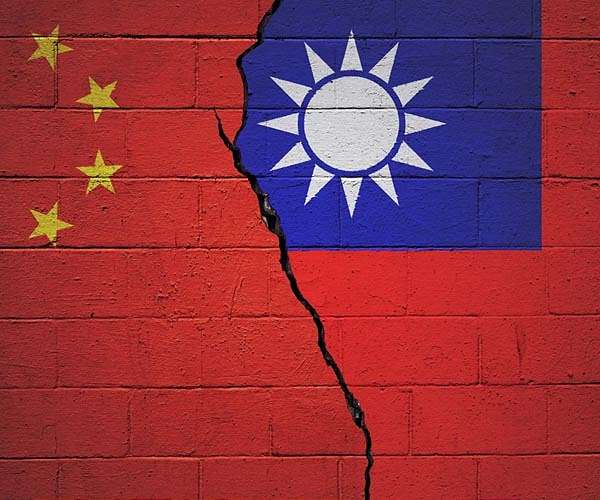
China has launched a volley of trade curbs against Taiwan in addition to live-fire military drills, as US House Speaker Nancy Pelosi visited the island despite Beijing's warnings.
China considers Taiwan its territory and tries to keep it isolated internationally, opposing countries from maintaining official contacts with the self-ruled democratic island.
After Pelosi became the highest-profile elected US official to visit Taiwan in 25 years, Chinese foreign ministry spokeswoman Hua Chunying said Wednesday the response will be "resolute, forceful and effective".
Here are the measures China has announced so far:
– Military exercises –
The first response was announced swiftly: live-fire military drills in zones encircling Taiwan — at some points, within just 20 kilometres (12 miles) of the island's shore.
The drills will include "long-range live ammunition shooting" in the Taiwan Strait, which separates the island from mainland China and straddles vital shipping lanes.
Taiwan's defence ministry described the drills as "an irrational move to challenge the international order".
And the island's Mainland Affairs Council, which sets the government's China policies, accused Beijing of "vicious intimidation".
Beijing cannot afford to be seen as toothless after ramping up the rhetoric ahead of Pelosi's arrival, analysts said.
"It will be imperative for the Chinese regime to underline its nationalist credentials to its domestic audience," said James Char, an associate research fellow at Singapore's S. Rajaratnam School of International Studies.
"Beijing cannot be seen as weak by its own people."
– Trade curbs –
China on Wednesday also imposed curbs on the import of fruit and fish from Taiwan.
Its customs authorities said it would suspend some citrus fruit imports over alleged "repeated" detection of excessive pesticide residue.
It also banned the import of certain fish from the island, pointing to the discovery of the coronavirus on packages.
These bans came a day after Taipei's Council of Agriculture said China had cited regulatory breaches in suspending the import of Taiwanese goods including fishery products, tea and honey.
It is not the first time Beijing has aimed at Taiwan's agricultural products — it banned pineapple imports in March 2021, citing the discovery of pests. However, the move was widely seen as politically driven.
The moves are part of a "common pattern for Beijing", said Even Pay, an agriculture analyst at consultancy Trivium China.
More disruptions of agricultural and food trade can be expected in the coming days, she added.
"When diplomatic or trade tensions are running high, Chinese regulators typically take an extremely strict approach to compliance… looking for any issues that can be used to justify a trade ban," she told AFP.
The Chinese commerce ministry said in a separate notice that it would "suspend the export of natural sand to Taiwan" from Wednesday, without providing details.
Natural sand is generally used for producing concrete and asphalt, and most of Taiwan's imported sand and gravel comes from China.
– Bans on 'secessionists' –
Beijing has ramped up pressure on Taiwan since President Tsai Ing-wen took office in 2016, as she views the island as a de facto sovereign nation and not part of "one China".
The Chinese State Council's Taiwan Affairs Office said Wednesday that it will punish two Taiwan organisations with close links to "die-hard" secessionists — the Taiwan Foundation for Democracy and International Cooperation and Development Fund.
Enterprises that have donated to the groups, such as Speedtech Energy and Hyweb Technology, will also be prohibited from working with Chinese firms.
The Taiwan Strait — a history of crises
Taipei (AFP) Aug 3, 2022 –
Ever since Communist China and Taiwan broke away from each other at the end of the Chinese Civil War in 1949 the waterway separating them has been a tense geopolitical flashpoint.
Just 130 kilometres (81 miles) wide at its narrowest point, the Taiwan Strait is a major international shipping channel and all that lies between now democratic, self-ruled Taiwan and its giant authoritarian neighbour.
Beijing has responded furiously to this week's visit to Taiwan by US House Speaker Nancy Pelosi, issuing increasingly bellicose threats and announcing a series of military drills in the waters surrounding the island.
Historians pinpoint three previous moments when tensions within the Taiwan Strait boiled over into an acute crisis.
– First Taiwan Strait Crisis –
At the end of the Chinese Civil War, Mao Zedong's communist forces had successfully pushed out Chiang Kai-shek's Nationalists, who relocated to Taiwan.
Two rivals stood on each side of the strait — the People's Republic of China (PRC) on the mainland and the Republic of China (ROC) in Taiwan.
The First Taiwan Strait Crisis broke out in August 1954 when the Nationalists placed thousands of troops on Taiwan-ruled Kinmen and Matsu, two small islands just a few miles from the mainland.
Communist China responded with artillery bombardments of the islands and the successful capture of the Yijiangshan Islands, about 400 kilometres north of Taipei.
The crisis was eventually defused but nearly brought China and the United States to the brink of direct conflict.
– Second Taiwan Strait Crisis –
Fighting broke out again in 1958 as Mao's forces conducted an intense bombardment of Kinmen and Matsu in a bid to once again dislodge Nationalist troops there.
Concerned that the loss of those islands might lead to the collapse of the Nationalists and Beijing's eventual takeover of Taiwan, US President Dwight D Eisenhower ordered his military to escort and resupply their Taiwanese allies.
At one point, the US even briefly considered deploying nuclear weapons against China.
Unable to take the offshore islands or bombard the Nationalists into submission, Beijing announced a ceasefire.
Mao's forces would still intermittently shell Kinmen up to 1979 but an otherwise tense stalemate set in.
– Third Taiwan Strait Crisis –
It would be another 37 years before the next crisis.
In those intervening decades, both China and Taiwan changed considerably.
Following the death of Mao, China remained Communist Party-controlled but began a period of reform and opening up to the world.
Taiwan, meanwhile, began shaking off the authoritarian years of Chiang Kai-shek and evolving into a progressive democracy, with many embracing a distinctly Taiwanese — and not Chinese — identity.
Tensions exploded again in 1995 when China began test-firing missiles in the waters around Taiwan to protest a visit by Taiwanese President Lee Teng-hui to his alma mater university in the United States.
Beijing particularly loathed Lee because he favoured Taiwan declaring itself an independent state.
Further missile tests were carried out a year later as Taiwan held its first direct presidential election.
The display backfired.
The US dispatched two aircraft carrier groups to push China into backing down and Lee won the election by a large margin.
A year later, Newt Gingrich became the first US House Speaker to visit Taiwan, a precedent Pelosi is now following 25 years later.
