
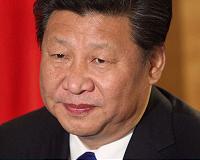
Chinese President Xi Jinping Thursday lambasted "protectionism, isolationism and populism" and again vowed to open up Asia's largest economy, as Beijing faces an escalating trade dispute with the United States.
Xi told a gathering of foreign business executives that after "signs of stability and improvement in the world economy" last year, "we must also stay vigilant because … we have seen a surge of trade protectionism, isolationism and populism".
The leaders of mining giant BHP Billiton, German carmaker Volkswagen and British conglomerate Swire were seen at the meeting according to images from Chinese state television.
Trade relations between Beijing and Washington risk descending into all-out conflict, with US President Donald Trump having threatened to impose tariffs on almost all of Chinese exports to the United States.
Without mentioning the Trump administration, the Chinese president condemned "Cold War mentalities and zero sum games" where exporting countries are seen as the only winners of trade exchanges.
"The peace and development of the world faces more and more severe challenges," Xi cautioned.
China's head of state also reiterated his promises of economic openness made in April at the Boao Forum for Asia, the "Chinese Davos", where he promised to accelerate the opening up of the Chinese financial sector.
In spite of Beijing's conciliatory tone, Western companies complain about unfulfilled pledges and a tough business climate in the country due to factors such as internet censorship and unfavourable regulations.
In a survey released Wednesday by the European Union Chamber of Commerce in China, nearly half of European firms said it had become "more difficult" to do business in the past 12 months.
And a fifth said they have been victims of forced technology transfers, a practice denounced fiercely by Washington as it carries out a probe on the issue while threatening tariffs in retaliation.
Trump's many trade wars: a summary
Paris (AFP) June 21, 2018 –
The European Union on Friday joined an emerging global trade war with the United States, hitting emblematic American exports in response to new US metals tariffs.
The tensions add to those between Washington and China, the world's two largest economies, as Trump, pursuing his "America First" agenda, also wages trade offensives against other key trading partners.
Together the trade battles have raised the spectre of a global trade war, spooking financial markets that fear major consequences to the world economy.
Here is a summary of Trump's trade conflicts:
– China –
After last week announcing new tariffs of 25 percent against $50 billion in Chinese imports, Trump on June 19 ordered his foreign trade chief to identify another $200 billion worth of imports for a 10 percent levy, citing China's "unacceptable" move to raise its own tariffs.
And if China makes good on its pledge to up its own retaliation, Trump said he would hit a further $200 billion of Chinese imports.
China, also affected by US steel tariffs, denounced Trump's approach of "extreme pressure and blackmail" and warned it would "take strong, powerful countermeasures" if the president enacts his threats.
Tensions were also stoked by the US Senate's decision to reimpose a seven-year ban on sales of US high-tech chips to Chinese telecom firm ZTE, which had narrowly escaped collapse under a compromise deal announced by the Trump administration.
– European Union –
A raft of EU retaliatory tariffs came into effect on June 22.
From blue jeans to motorbikes and whiskey, the EU's hit-list of products targeted for tariffs with the US reads like a long list of emblematic American exports.
The reprisal came after Trump on June 1 followed through on his threat to impose 25 percent tariffs on steel imports and 10 percent on aluminium imports from the EU.
Europe is also worried that Washington will follow up on a threat to impose punitive levies on imported cars, something particularly feared by the powerful German car industry.
– Canada and Mexico –
Canada and Mexico, both members with Washington of the North American Free Trade Agreement (NAFTA), have not been spared the US offensive on steel and aluminium and are threatening their own reprisals.
Trump and Canadian Prime Minister Justin Trudeau traded barbs over the steel tariffs at a farcical summit of the G7 richest countries that ended on June 9.
Meanwhile talks among the three NAFTA signatories, launched after Trump demanded an overhaul of the "terrible deal", have snagged notably owing to US demands to increase American content installed in duty-free NAFTA vehicles.
– Japan –
Japan is another target of Trump's steel tariffs, which Tokyo calls "extremely deplorable".
It has informed the World Trade Organization (WTO) that it plans to impose retaliatory measures on US goods to the tune of 50 billion yen (395 million euros, $455 million), after failing to persuade Washington to exempt it from the tariffs.
– South Korea –
In March Washington and Seoul announced agreement on a renegotiated free trade accord, giving US carmakers greater access to the South Korean market.
Trump argued the original deal from 2012 was lopsided in Seoul's favour, but has also clouded the issue by appearing to link trade concessions to progress in his separate track of talks with nuclear-armed North Korea.
– Russia –
Russia, also hit by the US steel tariffs, has informed the WTO that it is planning its own retaliation.
Trade relations were already strained by US sanctions targeting oligarchs and businesses accused of supporting President Vladimir Putin's alleged efforts to undermine Western democracies.
– Iran –
Trump announced in May he was abandoning the 2015 nuclear deal with Iran — which will mean new sanctions on the Islamic republic and punitive measures for those who trade with it.
Several companies — including Total and Peugeot of France, and Russia's Lukoil — have said they are preparing to exit Iran before US deadlines, the last of which is November 4.
