
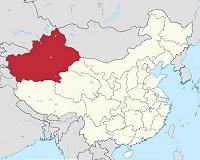
China on Thursday hit back at criticism from the United States' top diplomat who called its treatment of Muslims "shameful hypocrisy" after speaking with a former prisoner from a Chinese detention camp.
US Secretary of State Mike Pompeo made the comment after meeting with Mihrigul Tursun, a member of the Uighur ethnic group who has spoken publicly in the US about what she said was widespread torture in China's prisons for the minority group.
Beijing claims the camps are "vocational training centres" that provide language classes and employment, steering locals away from extremism.
Pompeo's comments are "extremely absurd and grossly interfere in China's internal affairs", said Chinese foreign ministry spokesman Geng Shuang at a regular press briefing.
"Currently, the overall situation in Xinjiang society is stable … and all ethnic groups get along harmoniously," he said.
"We urge the US to respect the facts … and stop the malicious smearing and groundless accusations against the Chinese side," Geng added.
As many as one million Uighurs and other mostly Muslim minorities are being held in internment camps in Xinjiang, according to a group of experts cited last year by the United Nations.
Former detainees say they were detained for simply following Islamic traditions, such as having a long beard or wearing a veil.
"China must release all those arbitrarily detained and end its repression," tweeted Pompeo, who had also met with relatives of those detained in Xinjiang.
After months denying the existence of the internment camps, Beijing last year launched a public relations campaign to defend its "training centres", organising visits for diplomats and media from friendly countries.
However, a delegation of three EU officials who visited Xinjiang in January as part of a carefully organised visit said they had the impression that the people they had spoken to in a "training centre" were reciting a dictated speech.
On Wednesday, Pompeo also criticised Beijing's trillion-dollar Belt and Road project after Italy decided to join China's "Silk Road" infrastructure initiative.
He accused China of practising "debt-trap diplomacy" with its state-owned or state-controlled enterprises only looking after their own interests.
"The US side's statement is inconsistent with the facts," dismissed Geng. "No country sinks into a so-called debt trap because of their co-operation with China."
Pakistan says it found no links to Kashmir suicide blast
Islamabad (AFP) March 28, 2019 –
Pakistan Thursday said it had found no links between militants swept up in a recent dragnet and a suicide attack in Indian-administered Kashmir last month that brought the nuclear-armed rivals to the brink of war.
The announcement by Pakistan's foreign office comes after India provided Pakistani officials with a list of 90 suspected militants and 22 locations of alleged training camps.
"While 54 detained individuals are being investigated, no details linking them to Pulwama have been found so far," the foreign office said, referring to the area where the attack occurred in Kashmir in February.
"Similarly, the 22 pin locations shared by India have been examined. No such camps exist."
The statement said Pakistan was "willing to allow visits, on request, to these locations".
Tensions between old foes India and Pakistan soared after the suicide bombing, which killed 40 Indian security personnel and was later claimed by the Pakistan-based militant group Jaish-e-Mohammad (JeM).
Pakistan, long accused by India of using militant proxies in Kashmir, has denied it was involved in the attack.
Earlier this month Islamabad launched an apparent crackdown as it came under pressure to demonstrate its sincerity about eliminating militancy, rounding up alleged militants and shuttering mosques and clinics linked to banned groups.
But the crackdown is reminiscent of previous efforts which later saw militants released without charge, and Pakistan has yet to convince the international community that their latest thrust is sincere.
The US also appeared to increase pressure on Islamabad this week, circulating a draft resolution to the UN Security Council that would blacklist Masood Azhar, the Pakistan-based leader of JeM, as a terrorist.
Pakistan's ally China earlier this month blocked a request to blacklist Azhar, and the move by Washington sets up a potential clash with Beijing.
It comes as tensions between Indian and Pakistan were ratcheted-up again this week after Delhi announced it had destroyed a low-orbiting satellite in a missile test Wednesday.
Indian Prime Minister Narendra Modi said the anti-satellite missile test was peaceful and not designed to create "an atmosphere of war".
But analysts said it would not go unnoticed in China and Pakistan, and could be interpreted as a show of Delhi's advancing military capabilities.
