
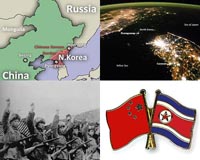
Beijing has protested against Washington's decision to impose sanctions against Chinese companies accused of conducting illicit economic deals with North Korea, the foreign ministry said.
US President Donald Trump on Friday announced measures targeting more than 50 North Korea-linked shipping companies, vessels and trade businesses, hailing the package as the "heaviest sanctions ever" levied on the nuclear-armed regime.
The measures, which the US says are aimed at forcing Pyongyang to roll back its banned nuclear and weapons programmes, apply to companies located or registered in North Korea, China, Singapore, Taiwan, Hong Kong, Marshall Islands, Tanzania, Panama and Comoros.
Washington has been locked in a nuclear standoff with Pyongyang, which is trying to develop missiles that could deliver an atomic weapon to major US cities, and the sanctions are designed to put the squeeze on North Korea's already precarious economy and fuel supply.
"China is strongly opposed to the United States' long-arm jurisdiction and unilateral sanctions on Chinese entities and individuals," foreign ministry spokesman Geng Shuang said on Saturday.
"We have lodged solemn representations to the United States and asked the U.S. to immediately cease the wrong practice so as to avoid undermining relevant cooperation between the two sides," he added.
China, North Korea's only major ally, has steadfastly rebuffed Washington's calls for a full oil embargo — fearing the chaotic collapse of the Pyongyang regime — but has accepted caps agreed at the United Nations.
"We will never allow Chinese citizens or companies to be engaged in activities that violate resolutions from the United Nations Security Council," Geng said.
But Washington says its latest measures target entities that have helped Pyongyang evade UN sanctions.
The North Korean military and broader economy depend heavily on imports of coal and oil from Russia and China, with the latter accounting for some 90 percent of the country's trade.
Last year, the Security Council adopted a series of resolutions to ban North Korean exports of commodities, including coal, iron and steel.
Trump announces 'heaviest ever' sanctions on North Korea
Washington (AFP) Feb 24, 2018 – US President Donald Trump has rolled out fresh sanctions against North Korea-linked shipping assets, hailing the package as the "heaviest sanctions ever" levied on the Pyongyang regime.
Trump used a speech to conservatives just outside Washington to step up his campaign of "maximum pressure" designed to force North Korea to roll back its weapons programs.
"We imposed today the heaviest sanctions ever imposed on a country before," Trump claimed at the end of a lengthy campaign-style address Friday.
In light of past US embargoes, that is likely an overstatement, but Treasury Secretary Steve Mnuchin confirmed the sanctions covered "virtually all the ships" North Korea is "using at this moment in time."
Speaking to reporters in Pyeongchang Saturday on a visit to the Winter Olympics, White House spokeswoman Sarah Sanders said: "Hopefully we'll see a change on the part of the North Koreans to start to denuclearise the peninsula, that's what our focus is."
She added: "I can tell you the president won't make the mistakes the previous administration has and be soft or weak."
Trump's administration is locked in a nuclear standoff with Pyongyang, which is trying to develop missiles that could deliver an atomic weapon to major US cities.
The latest sanctions are designed to put the squeeze on North Korea's already precarious economy and fuel supply.
In his speech Friday Trump had been expected to provide details of measures that target "56 vessels, shipping companies, and trade businesses," but skipped that part of his prepared remarks.
"Frankly hopefully something positive can happen," he said instead.
During a joint press conference with Australian Prime Minister Malcolm Turnbull, Trump said sanctions were only the first step.
"If the sanctions don't work, we'll have to go to phase two. Phase two may be a very rough thing," he said, without elaborating.
Mnuchin said there were signs the punitive measures were starting to have an impact, but did not elaborate.
The North Korean military and broader economy depend heavily on imports of coal and oil from China and Russia.
China, Pyongyang's only major ally, has steadfastly rebuffed Washington's calls for a full oil embargo — fearing the chaotic collapse of the Pyongyang regime — but has accepted caps agreed at the United Nations.
– Reaffirming ties with Seoul –
The timing of the new measures coincides with the arrival in South Korea of Trump's daughter Ivanka.
She is attending the closing ceremony of the Winter Olympics, which have taken place against the backdrop of the crisis.
The 36-year-old businesswoman and now top aide to her father has been tasked with reaffirming US ties with South Korea, which have been strained over how to deal with the North.
She was hosted in Seoul by President Moon Jae-in, who has long advocated talks rather than confrontation with North Korea.
"Mrs. Trump delivered a personal message to President Moon from President Trump about today's North Korea related sanctions announcement at a small meeting at the Blue House," the White House said.
"They also discussed the continued effort on the joint maximum pressure campaign against North Korea."
South Korean officials, who sit in a capital well within range of conventional North Korea artillery, have been spooked by Trump's talk of military confrontation.
US officials worry meanwhile that North Korea is luring Moon into talks that are designed to go nowhere.
North Korea's delegation at the closing ceremony will be headed by top general Kim Yong Chol, who is widely blamed for a series of attacks against the South including the 2010 sinking of a warship, with the loss of 46 lives.
The White House spokeswoman said Ivanka would probably sit apart from the North Korean delegation at Sunday's closing ceremony.
