
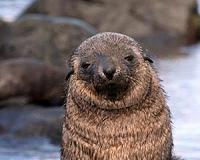
Veterinary surgeons at Tufts University have completed a first-of-its-kind brain surgery to treat hydrocephalus in a Northern fur seal.
The seal, named Ziggy Star, had exhibited worsening neurological symptoms over several years, moving caretakers to proceed with the risky surgery. Ziggy is now recovering at the Mystic Aquarium in Connecticut.
"The ability to successfully complete this procedure with many unknown factors is due in large part to the collaboration among colleagues at Cummings and Mystic," Ane Uriarte, lead neurosurgeon at the Cummings School of Veterinary Medicine at Tufts, said in a news release. "The combined expertise and skills from all our areas of specialty — from neurosurgery to anesthesia and zoological medicine — was critical to this success."
Ziggy, an adult female, first came to the Mystic Aquarium after she was found stranded in Northern California four years ago. She was deemed unfit for release back into the wild. An MRI revealed neurologic abnormalities, and her treatment failed to reverse worsening neurological symptoms.
Most recently, Ziggy began suffering seizures. Another MRI revealed a buildup of cerebral spinal fluid in her brain.
"The MRI taken recently by our team showed that the brain was disappearing due to the excess fluid, and it was significantly worse than the last study four years ago," Uriarte said. "After discussion with Mystic's veterinary team, we determined the best option to prevent further deterioration of the brain and to improve Ziggy's symptoms was to surgically place a shunt to drain the excess fluid, relieving some of the pressure on the brain."
Researchers are hopeful that the procedure will stop the worsening of Ziggy's condition, boosting her quality of life by improving her mobility and responsiveness.
Hydrocephalus is relatively common among dogs and cats, but Ziggy's surgeons don't believe the condition has ever been documented and treated in seals, sea lions and walruses.
During the hour-long procedure, surgeons installed a shunt catheter in Ziggy's brain. The narrow tube funnels excess cerebral spinal fluid from her brain to her abdomen, where it is reabsorbed by the body.
After recovery, Ziggy was transferred back to the aquarium where she is in stable condition and undergoing rehabilitation.
"We continue to monitor Ziggy very closely," said Jen Flower, chief clinical veterinarian at Mystic. "She is showing marked progress daily, eating a full diet, moving well within her habitat and showing normal swim patterns. No additional seizures have been noted post-operatively."
Study: Golden-crowned manakins are 'exceedingly rare' hybrid
Scientists in Toronto determined the golden-crowned manakin, a bird found in the Amazon rainforest, is an "exceedingly rare" hybrid species.
The bird was first discovered in 1957 in Brazil and had gone unseen again until 2002.
Researchers determined the bird was a hybrid after examining the keratin structure of its feathers using an electron microscope. It has a mixture of kerati … read more
