
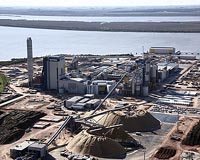
The UN's highest court will from Monday examine a dispute between Argentina and Uruguay centred round two paper mills on a river separating the Latin American neighbours.
Twelve hearings of three hours each have been scheduled before the International Court of Justice in The Hague until October 2.
Argentina filed an application with the court in May 2006, accusing Uruguay of having unilaterally authorised the construction of two mills on the River Uruguay, violating a 1975 treaty.
Argentina said the treaty granted each country the right "to use the waters of the river within its jurisdiction," but also upheld their duty to "preserve the aquatic environment and in particular to prevent its pollution".
It claimed Uruguay authorised the mills despite concerns they would jeopardise "conservation of the environment of the river and of the areas affected by it".
"It is a fragile and complex aquatic ecosystem the quality of whose waters needs to be protected and preserved, in order to protect not only the river but also water consumption (by approximately 1 million riparians) and fishing and recreational activities," Argentina argued.
Plans by Spanish paper company Ence and Finnish Botnia to construct the mills caused "serious concern" among some 300,000 people residing in the affected area on the river, the Argentinian court papers said.
"The concerns of the riparian population relate to the major risks of pollution of the river, deterioration in biodiversity, harmful effects on health and damage to fish stocks, as well as to the extremely serious consequences for tourism and other economic interests."
Botnia's paper mill, representing an investment of some 688 million euros (one billion dollars), started operating in November 2007 and has an annual capacity of one million tons.
Ence, however, has changed its plans and sold its project, not yet constructed, to Finald's Stora Enso and Chile's Arauca, who want to build a mill further south, a few dozen kilometres from the Argentinian border.
"We think that the request will be rejected; we are confident," former Uruguayan foreign minister Gonzalo Fernandez, now defence minister, said recently.
In July 2006, the ICJ had dismissed a separate bid by Argentina for an interim order suspending construction of the mills.
In January 2007, it also rejected an application by Uruguay for an order ending a blockade by Argentinian environmentalists of a bridge across the river that has been place since 2006.
Share This Article With Planet Earth
