
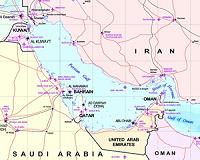
The United States is weighing sending up to 14,000 more troops to the Middle East in the face of a perceived threat from Iran, the Wall Street Journal reported Wednesday.
The mulled deployment would include "dozens" more ships and double the number of troops added to the US force in the region since the beginning of this year, the Journal said, citing unnamed US officials.
It said President Donald Trump could make a decision on the troop boost as early as this month.
A Pentagon spokesperson declined to comment on the report to AFP.
The move would come after a series of attacks on shipping vessels and a drone and missile attack on Saudi oil installations in September blamed on Iran.
Washington has already ratcheted up its military presence in the Gulf and expanded economic sanctions on the country, elevating tensions across the region.
In mid-November the US aircraft carrier Abraham Lincoln sailed through the Strait of Hormuz in a show of force aimed at reassuring allies worried about the Iran threat.
In October Defense Secretary Mark Esper announced that two fighter squadrons and additional missile defense batteries were being sent to Saudi Arabia, for a total of about 3,000 new troops.
Earlier Wednesday Iranian President Hassan Rouhani said the country was willing to return to the negotiating table over its nuclear program if the United States first drops sanctions, which have hampered the country's economy and may have contributed to recent domestic turmoil sparked by fuel price hikes.
Speaking at a defense conference in Manama, Bahrain on November 23, General Kenneth McKenzie, commander of US Central Command, said the US does not have all the resources it needs to cover the Middle East region.
"There is a lot of water to cover. Simply put, we don't have sufficient resources to be where we want to be in the right numbers all the time," he told the annual Manama Dialogue on regional security.
But McKenzie rebuffed criticism that Washington has been disengaging from the region.
"We have a carrier in the theatre, we've reinforced Saudi Arabia," he said.
"So I'm not sure I would agree with the narrative of abandonment or a narrative of walking away."
"Clearly the United States has different global priorities and this is probably not the highest global priority, but I think it remains a very important thing for the United States," he added.
Iran says still ready for talks if US lifts sanctions
Tehran (AFP) Dec 4, 2019 – Iran is willing to return to the negotiating table if the United States first drops sanctions, President Hassan Rouhani said Wednesday, after a fuel price hike sparked deadly violence ahead of elections.
European countries have been pushing for talks with Iran to salvage a 2015 nuclear deal that has all but collapsed since the United States withdrew and reimposed sanctions last year.
Rouhani has long demanded the lifting of US sanctions for Iran's return to talks under the auspices of the so-called P5+1 that reached the deal — the five veto-wielding permanent members of the UN Security Council plus Germany.
His latest statement comes after a shock announcement in mid-November that the price of petrol was going up by as much as 200 percent triggered demonstrations across Iran that turned deadly.
The decision came at a sensitive time ahead of a February parliamentary election.
It is a rise many Iranians can ill afford in a country whose sanctions-hit economy is expected to contract by 9.5 percent this year.
"If they are prepared to put aside the sanctions, we are ready to talk and negotiate, even at the level of heads of the 5+1 countries," Rouhani said in remarks aired live on state television.
"We are under sanctions. This situation… is (because of) incitement by the Zionists and the region's reactionary," he said, referring to Iran's regional rivals Israel and Saudi Arabia.
His remarks came after France and Germany raised the possibility of triggering a mechanism in the deal that could lead to the reimposition of UN sanctions.
– 'Cruel act' –
Rouhani described the sanctions as "a cruel act by the White House".
"We have no choice but to resist and persevere," he said. "At the same time, we have not closed the window for negotiations.
"I tell the nation of Iran that any time America is prepared to lift and put aside its wrong, cruel, unlawful, incorrect, terrorist sanctions, immediately the heads of 5+1 can meet and we have no problem."
The landmark 2015 deal gave Iran relief from economic sanctions in return for curbs on its nuclear programme.
It has been at risk of falling apart since US President Donald Trump unilaterally withdrew from it in May last year and reimposed sanctions.
Known formally as the Joint Comprehensive Plan of Action (JCPOA), it was agreed between Britain, China, France, Russia and the United States, plus Germany.
Twelve months on from the US pullout, Iran began reducing its commitments to the deal hoping to win concessions from those still party to the accord.
Its latest step back came last month, when engineers began feeding uranium hexafluoride gas into mothballed enrichment centrifuges at the underground Fordow plant south of Tehran.
In his remarks, Rouhani said his government strived to remain in the nuclear deal despite "pressures" that were on it.
– 'Utter lies' –
The statement comes after angry demonstrations erupted against a shock decision to raise petrol prices on November 15.
London-based human rights group Amnesty International said on Monday that at least 208 people were killed in a crackdown on the demonstrations, citing what it called credible reports.
Iran's judiciary spokesman Gholamhossein Esmaili on Tuesday rejected as "utter lies" unofficial casualty figures given by "hostile groups" based abroad.
On Monday night, state television charged that foreign media had been "hyping up" the death toll.
It said "the security forces had no choice but to resort to authoritative and tough confrontation… and a number of rioters were killed".
The unrest started hours after it was announced that the price of petrol would rise from 10,000 rials per litre to 15,000 (12 US cents) for the first 60 litres, and to 30,000 rials for any extra fuel bought after that each month.
Rouhani has said proceeds would go to the most needy.
State news agency IRNA said the payments had since been made in three instalments between November 18 and 23.
