
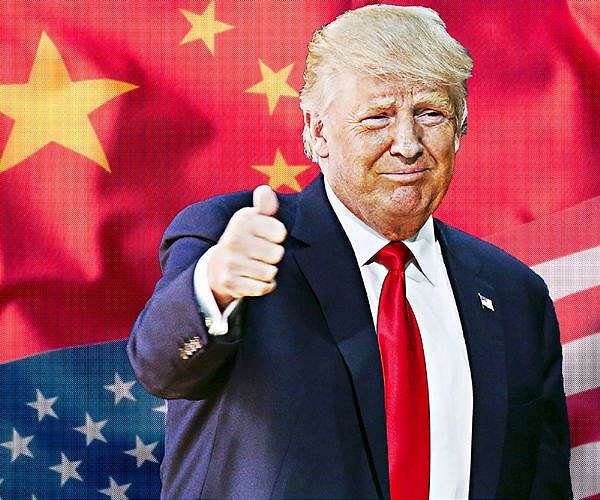
President Donald Trump's war on Chinese technology firms has changed the ground rules for global business, underscoring a new political reality that could have negative repercussions for American firms.
The White House moves against the popular Chinese-owned apps TikTok and WeChat and the tough sanctions on tech giant Huawei highlight the struggle for technology supremacy between the two economic giants, under the guise of national security.
The economic relationship has been roiled by an unprecedented campaign by Trump that has included tariffs, threats of bans and economic sanctions on Chinese tech firms.
"At the heart of it is a struggle to dominate emerging technologies," said Doug Barry of the US-China Business Council.
"The country that succeeds will realize huge economic and geopolitical benefits."
But many analysts argue that Trump's actions could backfire on the US tech sector and other American businesses by encouraging China and other countries to respond in kind.
Trump's moves on TikTok and other Chinese firms "are eroding confidence in US leadership," said Darrell West, who heads the Brookings Institution's Center for Technology Innovation.
"There was little process associated with his (TikTok) executive order and the company's forced sale to American investors sets a bad precedent for other countries. It likely will embolden them to retaliate against US companies and demand payments for the ability to operate within their own borders."
– Moving toward cronyism –
More ominously, Trump appears to be moving toward "crony capitalism" by brokering deals that benefit his friends and allies such as Oracle, whose founder Larry Ellison is major fundraiser for the president.
The Wall Street Journal, despite its support for the president on other issues, posted a scathing editorial this month of the proposed deal to transfer control of TikTok from its Chinese parent to Oracle and Walmart.
"Maybe the deal will protect national security as the Trump administration claims, but it reeks of corporate cronyism that will damage the US government's credibility and reputation for free-market rules," the business daily said.
Benedict Evans, a venture investor who blogs on the tech industry, said the complex TikTok deal being promoted by the Trump administration has pushed national security into the background, making the whole saga a "farce."
"Setting aside the chaos — what does this solve?" he wrote.
"This is a shakedown, but it's also a climbdown. (Russian President Vladimir) Putin does this in Russia all the time, but manages it much better."
– Businesses fret –
The new ground rules have sparked concerns among business leaders forced to adapt to a new political landscape.
"Once you start tossing this grenade about protectionism and once you start turning these things into political questions (the change) prevents natural commerce," Barry Diller, chairman of the tech holding firm IAC, told CNBC television.
Edward Alden, a senior fellow at the Council on Foreign Relations, said the drama could harm US interests by discouraging foreign investment.
"The deal for TikTok was done among friends of the president, and with none of usual transparency and regulatory consistency that historically characterized the US treatment of foreign investors," Alden said.
"That may also worry investors from other countries, who will fear they no longer know what the rules are in the US."
Roger Kay, analyst and consultant with Endpoint Technologies Associates, said American technology firms have long benefitted from free trade and global supply chains, and that these are being disrupted by the US-China battle.
"There are a lot of intertwined webs that have been disturbed by the war on China, which to me seems badly conceived," he said.
"My view is that free trade is the right trade and we've already lost a lot of that through tariffs and other matters, and this (action by the president) ultimately impoverishes everyone."
One consequence of the conflict: the US move to ban WeChat — the massively popular Chinese multipurpose app for messaging, shopping, payments and other services — could likely see a dent in iPhone sales in China if Apple is forced to remove it from its online marketplace.
Cornell University economist and trade policy specialist Eswar Prasad said the conflict appears likely to escalate, noting China's latest moves to restrict certain technology exports.
This suggests that "the two countries are going to use every available tool to advance their commercial and technological interests, and all companies operating in this space are at risk of getting caught up in these bilateral hostilities," Prasad said.
Automakers sue US government over tariffs on Chinese imports
New York (AFP) Sept 24, 2020 –
Major automakers Tesla, Volvo, Ford and Mercedes-Benz have sued the US government over tariffs on Chinese goods, demanding customs duties paid on imports be returned, with interest.
The lawsuits, which were filed in recent days in the New York-based Court of International Trade, concern tariffs imposed by the Office of the US Trade Representative (USTR) on imports from China, which Tesla in its filing called "arbitrary, capricious, and an abuse of discretion."
The duties came amid a wider trade dispute between Washington and Beijing, and the automakers are asking for the tariffs to be revoked and any money paid to import parts returned.
Mercedes-Benz in its filing accused Washington of "prosecution of an unprecedented, unbounded, and unlimited trade war impacting over $500 billion in imports from the People's Republic of China."
The German automaker argued that US law "did not confer authority on defendants to litigate a vast trade war for however long, and by whatever means, they choose."
Officials at the office of US Trade Representative Robert Lighthizer did not respond when contacted by AFP for comments on the lawsuits.
US President Donald Trump's administration engaged in months of trade conflicts with China, and imposed the levies as part of an effort to wean US manufacturers off Chinese technology.
China and the United States signed their "phase one" trade deal earlier this year that partially ended the dispute.
Under that agreement, Beijing promised to buy $200 billion in US goods and Washington backed down on tariffs on $160 billion in Chinese goods, particularly consumer electronics.
The US also slashed by half 15 percent tariffs on $120 billion in goods, but kept in place 25 percent duties on $250 billion in imports, which some of the automakers cited in their lawsuits.
Beijing has retaliated for these levies, while Washington is aiming both to reduce its trade deficit and reform Chinese business practices it considers unfair.
The Commerce Department reported the US trade deficit in July surged nearly 11 percent to $63.6 billion, with the deficit with China climbing to $28.3 billion.
China is the world's biggest auto market and the main growth driver for many car manufacturers — especially for electric car maker Tesla, which intends to benefit from the country's ambitious targets for reducing CO2 emissions.
