
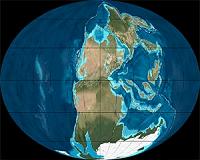
Scientists still aren't sure what exactly caused 70 percent of land species to disappear some 252 million years ago, but new research suggests the extinctions — part of what's called the Great Dying — had a measurable effect on the chemistry of Earth's ancient oceans.
The loss of plants and animals on land during the the Permian-Triassic extinction was followed by major die offs in Earth's oceans. Some 90 percent of all marine species disappeared. The Great Dying was also characterized by extreme soil erosion.
To better understand the link between die offs on the land and in the water, scientists developed models to analyze changes in the chemistry of Earth's oceans during the Great Dying. The models focused on the cycling of mercury, an element spewed by volcanoes and found in living organisms.
By plotting changes in mercury and carbon cycles during the Permian-Triassic extinction and comparing the simulation results with the chemistry of ancient rock samples, scientists were able to determine whether shifts in ocean chemistry were caused by volcanic and biological events.
The data, detailed Thursday in the journal Nature Communications, showed the collapse of terrestrial ecosystems led to the release of large amounts of organic matter, nutrients and other biological elements into Earth's oceans.
More research is needed to uncover the precise mechanisms by which ocean chemical changes snuffed out marine species, but scientists suspect the influx of sediment, nutrients and other chemicals had a significant effect on marine life.
"In this study we show that during the Permian-Triassic transition, roughly 252 million years ago, the widespread collapse of the terrestrial ecosystems caused sudden changes in marine chemistry," study co-author Jacopo Dal Corso, who worked on the research while at Leeds University, said in a news release.
"This likely played a central role in triggering the most severe known marine extinction in Earth's history," said Dal Corso, now a professor at the China University of Geoscience. "This deep-time example shows how important the terrestrial reservoir is in regulating global biogeochemical cycles and calls for the greater conservation of these ecosystems."
The link between terrestrial and marine die offs some 252 million years ago could have implications for the future of modern ecosystems.
"This is an uncomfortable parallel with our own human-driven land use change, and we too are transferring large quantities of nutrients and other chemicals to the oceans," said study co-author Benjamin Mills, an assistant professor and a biogeochemical modeller at Leeds. "As we look to re-start the world's economies in the wake of the current pandemic, protecting our life-sustaining ecosystems should be a priority."
Ancient footprints in South Korea made by crocodiles that walked on two legs
Washington DC (UPI) Jun 11, 2020 –
Crocodiles once walked on two legs, just like dinosaurs, according to new analysis of a unique collection of footprints discovered in South Korea.
Scientists dated the footprints to between 110 and 120 million years ago, according to the study, published Thursday in the journal Scientific Reports.
At first, researchers thought they happened upon the tracks of giant bipedal pterosaurs, but after closer examination, they determined the tracks were left by crocodiles measuring some 10 feet in length.
"One of the methods we use to identify potential track-makers is similar to Cinderella — basically we look for a foot that fits," University of Queensland paleontologist Anthony Romilio told UPI in an email. "In the case with extinct animals, this involves comparing any with fossilized bones, but since we find more fossil tracks than fossil skeletons we have to use other approaches."
Inside dinosaur prints, the deepest portions are found in the toes. Dinosaurs walked on their toes. The tracks left among the ancient mudflats featured distinct heel prints. Primitive bipedal crocodiles walked flat-footed, making them a match for the unusual tracks.
The narrow path of the tracks made it appear as if the ancient crocodiles were walking on tightropes. This pattern, combined with the lack of tail marks, confirmed the tracks were left by crocodiles walking on their hind two legs.
"Bipedalism happened early in the crocodile evolution, even before dinosaurs, and there were many different species," Romilio said. "We had thought crocs of this type were all extinct by the end of the Triassic, and so to have evidence of this type of croc behavior [approximately] 80 million years after they were supposed to be extinct was a big surprise."
It's possible the bipedal crocodiles of the Triassic did go extinct, and the crocodiles of the Cretaceous evolved bipedalism independently.
"We don't know," said Romilio. "What we do know is that these unusual tracks are all of the same types, and so are likely from the same type of animal. But keep in mind that all of these tracks come from a very localized area."
The fossilized tracks and trackways were remarkably well-preserved, revealing details of the toe-pads and scales on their soles, researchers said.
Scientists suggest the bipedal crocodiles of the Cretaceous were part of a diverse lakeside ecosystem.
"From this one track site alone, we also have pterosaurs, turtles, birds, meat-eating dinosaurs (theropods) and long-necked dinosaurs (sauropods)," Romilio said.
"And there are many track sites within that particular area that increases the faunal diversity — frogs, baby dinosaurs, velociraptors and other types of theropods, two-legged planter dinosaurs, birds that were like spoonbills, other like ducks, and so much more, all based on the footprints they left behind in the fine muddy sediment of ancient shallow lakes," he said.
