
Have a good-sized telescope with a digital camera? Then you can team up with NASA's New Horizons mission this spring on a really cool – and record-setting – deep-space experiment.
In April, New Horizons, which by then will be more than 46 times farther from the Sun than Earth, nearing 5 billion miles (8 billion kilometers) from home, will be used to detect "shifts" in the relative positions of nearby stars as compared with the way they appear to observers on Earth.
The technique is called parallax, and it has been used by astronomers for nearly two centuries to measure the distances of faraway stars; see the accompanying sidebar article for more detail.
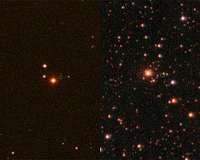
On April 22 and 23, New Horizons will take images of two of the very nearest stars, Proxima Centauri and Wolf 359. When combined with Earth-based images made on the same dates, the result will be a record-setting parallax measurement yielding 3D images of these stars popping out of their background star fields that NASA's New Horizons project will share with the public.
The mission team is coordinating the use of astronomical observatories and a public observing campaign to image the same stars on the same day to demonstrate the "parallax" effect.
"These exciting 3D images, which we'll release in May, will be as if you had eyes as wide as the solar system and could detect the distance of these stars yourself," said New Horizons Principal Investigator Alan Stern, of the Southwest Research Institute, Boulder, Colorado.
"It'll be a truly vivid demonstration of the immense distance New Horizons has traveled, and a cool way to take advantage of the spacecraft's unique vantage point out on the very frontier of our solar system!"
New Horizons' two target stars can be observed by anyone with a camera-equipped, 6-inch or larger telescope. Once New Horizons sends its images to Earth, the mission team will provide them for comparison to images obtained with amateur telescopes. Wolf 359 and Proxima Centauri will appear to shift in position between the Earth-based and space-based images.
In addition, working with New Horizons participating scientist and Queen guitarist Brian May – an astrophysicist himself – the New Horizons team will create and release 3D images showing these two stars.
"For all of history, the fixed stars in the night sky have served as navigation markers," said Tod Lauer, a New Horizons science team member from the National Science Foundation's
National Optical-Infrared Astronomy Research Laboratory.
"As we voyage out of the solar system and into interstellar space, how the nearer stars shift can serve as a new way to navigate. We will see this for the first time with New Horizons."
