
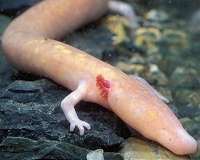
Scientists have for the first time sequenced the entire genome of the Iberian ribbed newt. Their efforts revealed a unique family of genes important to the salamander's impressive regenerative abilities.
The Iberian ribbed newt, Pleurodeles waltl, maxes out at a foot in length, but the amphibian boasts a massive genome — six times larger than the human genome.
The sequencing of the giant genome by scientists at the Karolinska Institutet in Sweden revealed numerous copies of a microRNA group typically found in mammalian stem cells and tumor cells. Researchers believe this unique group is key to the salamander's ability to regenerate brain neurons and other parts of its body.
"It will be exciting to figure out how regeneration in the adult organism re-activates embryonic genes," András Simon, a professor of cell and molecular biology at Karolinska, said in a news release. "What's needed now are functional studies of these microRNA molecules to understand their function in regeneration. The link to cancer cells is also very interesting, especially bearing in mind newts' marked resistance to tumour formation."
While researchers believe the stem cell microRNA genes are important, they alone can't explain the newt's regenerative qualities. It's likely to genes interact with other more common genes to control regeneration.
The sequencing of the newt's genome was made possible by technological advances. Until recently, sequencing such a massive genome would have proved a near impossible task.
"It's only now that the technology is available to handle such a large genome," said Simon. "The sequencing per se doesn't take that long — it's recreating the genome from the sequences that's so time consuming."
Researchers described their sequencing feat this week in the journal Nature Communications. The scientists are now working with the researchers to glean insights from the genomic data. Scientists can test hypotheses about the role various genes play by comparing the salamander's genome with those of well-studies mammals.
Their investigations could yield insights useful to the treatment of neurodegenerative disorders and other human diseases.
"We showed ten years ago that salamanders can recreate all the cells that die in Parkinson's disease in the space of four weeks," said Simon. "We can now delve deeply into the molecular processes underlying this ability. Although we're doing basic research, our findings can hopefully lead to the development of new regenerative strategies for humans."
Oh, how cute: Tokyo crowds flock to see baby panda on first day
Hundreds of fans flocked to a Tokyo zoo Tuesday for the first public viewing of baby panda Xiang Xiang, after winning a lucky lottery ticket that a quarter of a million applied for.
Long queues formed outside the zoo as fans – many wearing panda cub hats or gloves – waited patiently for a brief glimpse of Xiang Xiang, whose name is derived from the Chinese character for "fragrance."
Su … read more
