
The Kremlin doesn't expect the global economic crisis to damp down international demand for its weapons exports. Alexander Brindikov, who chairs an advisory panel for the giant Russian arms-exporting monopoly and coordinating corporation Rosoboronexport, said last month that the company projected arms sales in 2009 to remain at their 2008 levels of around $7 billion, RIA Novosti reported April 22.
"Our situation is stable. We have reached a high level (of arms sales), and we are expecting this year roughly the same amount as in 2008," said Brindikov, who the news agency described as "a defense industry official."
However, as the international economic crisis hits Russia, it will also have an impact on smaller, more vulnerable defense companies and could cause production bottlenecks leading to unanticipated delays and even full-scale defaults on contracts, Brindikov said.
"Today in the marketplace, in our estimation, defense enterprises with the lowest levels of cooperation suffer the most, and this could lead to defaults on contracts," he warned.
RIA Novosti said Rosoboronexport currently has $27 billion worth of export orders to countries around the world on its books.
The Russian arms industry currently sells its weapons to no fewer than 80 nations. India is believed to be the largest single customer, and U.S. defense contractors remain almost totally frozen out of the rapidly growing Indian demand for advanced industrialized weapons systems.
RIA Novosti noted that the Kremlin has also been working hard to increase its arms exports to nations throughout Latin America, Southeast Asia, the Middle East and Africa.
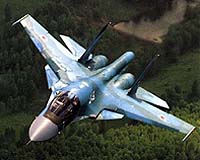
RIA Novosti said the most popular weapons other nations wanted to buy from Russia included Sukhoi and Mikoyan-Gurevich MiG air-superiority combat fighters, helicopters, battle tanks, armored personnel carriers and infantry fighting vehicles. Sales were also healthy in the areas of small-arms, anti-tank and air-defense missile systems, it said.
In the days when global oil and gas prices were soaring, the Kremlin virtually gave away its weapons systems for free by arranging loans and exceptionally long and easy credit agreements for favored customers. But even with Russia being rocked by the current economic crisis and seeing a collapse in prices for its oil and gas exports, the Russian government remains committed to expanding its influence by selling weapons on more easy terms.
RIA Novosti said Rosoboronexport intended to attract further major arms contracts by coupling them with big loans and debt write-offs.
At the insistence of Russian Prime Minister Vladimir Putin, Rosoboronexport has also been seeking to improve the reliability and efficiency of Russian arms manufacturers in the long-neglected areas of providing maintenance programs, upgrades, spare parts and other support programs for weapons systems ranging from combat aircraft to main battle tanks.
Air Defense Systems And Helicopters Showcased In Istanbul
Russia put its air defense systems and helicopter capabilities on display last week in Istanbul in the hope of landing major orders from Turkey, a traditional enemy of the Kremlin and a member of the U.S.-led North Atlantic Treaty Organization for more than half a century.
RIA Novosti reported April 27 that Russia was putting more than 120 different kinds of weapons on show at the IDEF 2009 arms show in Istanbul on April 27-30. The high-profile arms bazaar has been conducted in Turkey's largest city every two years since 1993.
"Turkey is mostly interested in buying (Russian) short- and medium-range air-defense systems and combat helicopters," Anatoly Aksenov, a senior adviser to the general director of Russian arms-export monopoly Rosoboronexport, told the news agency. He expressed the hope some agreements in military-technical cooperation between Turkey and Russia could be concluded soon after the IDEF show.
Russia's traditionally close ties with the United States became increasingly strained during the eight-year presidency of George W. Bush. The Turks were furious that the United States strongly supported a virtually independent Kurdish enclave in oil-rich northern Iraq, from which fiercely anti-Turkish guerrilla groups operated.
In 2008, as reported in these columns, there were unsubstantiated claims in the Turkish media that Turkey's Islamic fundamentalist government was considering purchasing as many as 32 old Mi-28 Havoc helicopters from Russia worth $1 billion. The helicopters would be of exceptional value to the Turkish armed forces in maintaining security in the mountainous southeastern regions of the country with a large Kurdish population where the guerrilla groups had operated.
Military cooperation between Russia and Turkey took another significant step forward in February when the defense ministers of both nations held talks and made a joint commitment to significantly increase their levels of military-technical cooperation.
Share This Article With Planet Earth
