
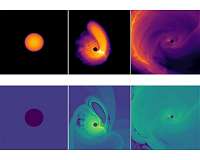
Occasionally a star or other celestial object may have the misfortune of passing too close to a neighboring black hole, resulting in the object being ripped apart by the black hole's extreme tidal forces.
During such violent "tidal disruption events" (TDEs), the object being disrupted is simultaneously stretched and compressed in opposing directions. If the object happens to be a white dwarf, which is the dead core of a Sun-like star, the compression may be sufficient to briefly reignite nuclear fusion, in a sense bringing the white dwarf back to life, if only for a few seconds.
For this to happen, the white dwarf must pass relatively close (inside the "tidal radius") to an intermediate-mass black hole (IMBH), one about 1,000 to 10,000 times the mass of the Sun. This is because the size of a black hole (and its tidal radius) correlates with its mass; larger mass black holes are bigger.
If the black hole has too little mass, its tidal radius is smaller than the size of the white dwarf, so the black hole is initially swallowed by the white dwarf. If the black hole has too much mass, it will be so large that the white dwarf will pass inside before the tidal forces become strong enough to disrupt it.
While large numbers of "stellar-mass" and "supermassive" black holes have been discovered, there is currently scant evidence for their intermediate-mass cousins. It is important, though, to know how many intermediate-mass black holes exist, as this will help answer the question of where supermassive black holes come from. Finding intermediate-mass black holes through tidal disruption events would be a tremendous advancement.
Tidal disruption events are sometimes capable of producing huge electromagnetic outbursts and potentially detectable gravitational-wave signals. Thus far, only a dozen or so discoveries have shown the signatures of a tidal disruption event, and none of those seem to be the disruption of a white dwarf. Nevertheless, these events are a primary target of many current and future missions, including the All Sky Automated Survey for SuperNovae (ASASSN), the Intermediate Palomar Transient Factory, and the Large Synoptic Survey Telescope (LSST).
While some of the material ripped from the disrupted object will ultimately be swallowed ("accreted") by the black hole, a significant fraction will be flung away into surrounding space as unbound debris. This debris can eventually be assimilated into future generations of stars and planets, so its chemical make-up can have important consequences.
The nuclear burning that takes place during the tidal disruption of a white dwarf causes significant changes to its chemical composition, converting the mostly helium, carbon, and oxygen of a typical white dwarf into elements closer to iron on the periodic table. In some rare instances, white dwarf tidal disruption events may produce elements closer to calcium, possibly explaining some strange, calcium-rich systems.
Tidal disruptions of white dwarfs by intermediate-mass black holes are now being studied with the aid of computer simulations. One such set of simulations, recently reported in a paper and soon to appear in the Astrophysical Journal, have confirmed that nuclear burning is a common outcome, with mass conversion efficiencies up to 60%.
The efficiency and elements produced both depend sensitively on how close the white dwarf comes to the black hole, with more distant approaches preferentially producing calcium and closer approaches producing iron. The simulated disruptions also generate short bursts of gravitational waves, of a frequency and amplitude that may be detectable with future instruments.
As of now, these are the highest resolution three-dimensional simulations of tidal disruption events. This research will be helpful in characterizing future tidal disruption events and placing constraints on the prevalence of intermediate-mass black holes.
Authors of this work include Drs. Peter Anninos and Robert Hoffman of Lawrence Livermore National Laboratory; Prof. Chris Fragile of the College of Charleston; Samuel Olivier of University of California, Berkeley; Dr. Bhupendra Mishra of the University of Colorado; and Prof. Karen Camarda of Washburn University.
