
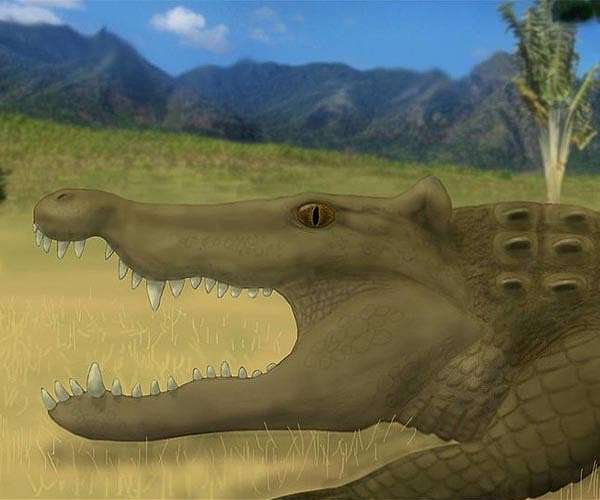
Scientists have finally figured out the horned crocodile's proper place on the tree of life, thanks to ancient DNA extracted from fossils housed at the American Museum of Natural History.
New genomic analysis — detailed Tuesday in the journal Communications Biology — suggests the horned crocodile was closely related to "true" crocodiles, including the Nile crocodile, however scientists determined the extinct species warrants a new branch on the family tree.
Horned crocodiles lived on the islands of Madagascar for hundreds of thousands of years.
But like so many of the island's largest animals, or megafauna, like giant tortoises and dwarf hippos, the novel croc species disappeared not long after humans arrived on the island.
"This crocodile was hiding out on the island of Madagascar during the time when people were building the pyramids and was probably still there when pirates were getting stranded on the island," lead study author Evon Hekkala said in a press release.
"They blinked out just before we had the modern genomic tools available to make sense of the relationships of living things. And yet, they were the key to understanding the story of all the crocodiles alive today," Hekkala, an assistant professor at Fordham University and a research assistant at AMNH.
The horned crocodile's evolutionary relationships has been source of uncertainty for decades.
At the end of the 19th century, scientists determined the horned crocodile was a true crocodile, the group featuring Nile, Asian and American crocodiles. Decades later, scientists decided horned crocodiles were in fact primitive Nile crocs.
Then, in 2007, evolutionary biologists conducted an anatomical survey of horned crocodile remains and decided the species belonged in the group that includes all dwarf crocodiles.
Early European explorers noted that the islands' Malagasy peoples referred to two different types of crocodiles, a larger, more robust croc and another more slender croc.
The slender version turned out to be an isolated population of Nile crocodiles, which are still found on the islands. The robust form was the horned crocodile.
Using ancient DNA, extracted and sequenced using the latest genomic technologies, researchers determined that the horned crocodile was a unique species.
"This is a project we've tried to do on and off for many years, but the technology just hadn't advanced enough, so it always failed," said co-author George Amato, emeritus director of the Museum's Institute for Comparative Genomics.
"But in time, we had both the computational setup and the paleogenomic protocols that could actually fish out this DNA from the fossil and finally find a home for this species," Amato said.
The genomic data showed the horned crocodile was closely related to the Nile crocodile, but was distinct enough to warrant a separate branch on the tree of life.
Scientists determined the horned crocodile was the closest known relative to the common ancestor of all modern crocodiles.
The findings suggest the evolutionary origins of modern crocs can be traced to the African continent.
"This finding was surprising and also very informative to how we think about the origin of the true crocodiles found around the tropics today," Amato said.
"The placement of this individual suggests that true crocodiles originated in Africa and from there, some went to Asia and some went to the Caribbean and the New World. We really needed the DNA to get the correct answer to this question," Amato said.
