
Andrea Kunder, Ph.D., assistant professor of physics, Stephen Parker, Ph.D., associate professor of physics, Gordon Bellevue, physics instructor, and Saint Martin's students Arthur Mills, Joseph Edgecomb, Mathew Thomas, Levi Schilter, and Craig Boyle collaborated on research that resulted in the publication of a paper, "Radial Velocities of RR Lyrae Stars in and Around NGC 6441, in The Astronomical Journal, volume 155, number 4.
As context for the research the team did, Kunder explained that the Milky Way galaxy hosts around 150 globular clusters – spherical collections of stars bound together by gravity that harbor some of the first stars to be produced in the universe.
Curiously, the most massive globular clusters have complicated stellar populations that are not able to be explained in any kind of globular cluster formation scenario. One way to explain the properties of these massive globular clusters is that they are cores of once larger galaxies that have been accreted by the Milky Way galaxy and that are being tidally stripped of stars.
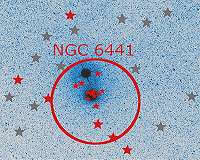
NGC 6441 is the fifth most massive globular cluster in the Milky Way and is well-known for having bizarre stellar populations. Using proper motions from Gaia DR2 and radial velocities calculated by Saint Martin's University professor Andrea Kunder, Ph.D., and team, stars that have been stripped from NGC 6441 have been found for the first time.
"We were intrigued by our radial velocity calculations of RR Lyrae stars in NGC 6441, because it did look likely this globular cluster had extra-tidal stars," Kunder said.
"As soon as the Gaia DR2 space observations were released in April I went to check their proper motions, and my jaw dropped when I saw that almost half of our extra-tidal stars had proper motions exactly what you would expect for a NGC 6441 cluster star. And two of our extra-tidal stars are a quarter degree from the cluster center!"
Kunder provided more detail about the results that are outlined in the paper. "We found a large number of stars that are outside the extent of the cluster but still moving along its orbit, which suggests that this globular cluster was once part of a larger system that is being slowly ripped apart by the tidal forces of the Milky Way galaxy."
The Gaia space observatory's new map of Milky Way stars and their motions allow for measurement details that have either previously been completely unknown or imprecise. Kunder and her team have combined their radial velocities with Gaia measurements to confirm that there are stars surrounding NGC 6441, quite distant from the nominal extent of the cluster, that are co-moving with the cluster through space.
This is what is predicted if NGC 6441 was once more massive in the past and is slowly losing stars as it moves through the Milky Way. The possible link between globular clusters and the dwarf galaxies is still controversial, but observations such as these are allowing for this bridge to be explored.
