
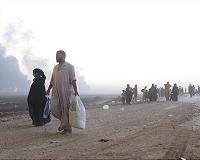
Iraq is denying relatives of suspected Islamic State group jihadists security clearance to obtain identity cards, in what amounts to a form of "collective punishment", Human Rights Watch said Sunday.
"Iraqi security officers are routinely denying relatives of suspected Islamic State (IS) members the security clearance needed to obtain identity cards and other documents, " HRW said.
"Denying government benefits because of perceived family relationships instead of individual security determinations is a form of collective punishment prohibited under international human rights law."
The New York-based rights watchdog said in a statement that without proper documentation these individuals cannot move freely in fear of arrest, nor can they apply for jobs or welfare benefits.
Children denied birth certificates "may be considered stateless and may not be allowed to enrol in school", while widows who fail to get death certificates for their husbands cannot inherit or remarry, it said.
"Iraq's security forces are marginalising thousands of families of (IS) suspects by depriving them of the basic documents they need to rebuild their lives," said HRW's deputy Middle East director Lama Fakih.
"Unless this collective punishment stops, the authorities will be further destabilising the situation in Mosul and other former ISIS-held cities," she said using another acronym for IS.
HRW said it had interviewed 18 people in Mosul, including lawyers, aid workers and security officials, for its report since late January.
"The Iraqi government has valid security concerns that ISIS members sought for serious crimes should not be able to get fake identity documents," Fakih said.
"But keeping women and children who did nothing wrong beyond having a relative join ISIS out of work, out of school, and in fear of arrest every day will do nothing to foster reconciliation in Iraq.".
Iraqi forces announced the total defeat of IS in the country in December after a punishing campaign to oust the group from territory it seized in 2014, including Iraq's second city Mosul.
Iraq condemns 15 Turkish women to death for belonging to IS
Baghdad (AFP) Feb 25, 2018 – An Iraqi criminal court on Sunday sentenced to death 15 Turkish women after finding them guilty of belonging to the Islamic State group, a judicial official said.
Another Turkish woman accused of joining the jihadist group was given a life sentence, the official said, adding they had all acknowledged the charges against them.
Four of the women, all of whom were dressed in black, were accompanied by young children, he said.
Aged between 20 and 50, the women said they had entered Iraq illegally to join their husbands who were heading to fight for the self-proclaimed "caliphate" straddling vast areas of Iraq and Syria, the official added.
One of them told the judge she had taken part in fighting against Iraqi forces alongside the jihadists, he said.
Supreme Judicial Council spokesman Abdel Sattar Bayraqdar told AFP the women had a month to appeal.
Last week, another group of foreign widows of IS fighters told a court hearing attended by an AFP journalist that they had been fooled or threatened by their husbands to head to Iraq.
Iraq, which has detained at least 560 women, as well as 600 children, identified as jihadist or relatives of suspected IS fighters, is wasting no time in putting them on trial.
In January, a court sentenced a German woman to death on charges of providing logistical support to IS, and a Turkish woman was earlier this month also handed the death penalty.
Human Rights Watch denounced the rulings as "unfair".
Earlier this week, a Baghdad court sentenced a French woman, Melina Boughedir, to seven months in jail for entering Iraq illegally but ordered her release on time already served.
Baghdad declared military victory over IS in December, after having expelled the jihadists from all urban centres they had held in northern and western Iraq since 2014.
Experts estimate that 20,000 people are being held in jail in Iraq for alleged membership of IS. There is no official figure.
Separately, authorities in Iraqi Kurdistan said in early February they had detained some 4,000 suspected IS members, including foreigners.
Iraq's anti-terrorism law empowers courts to convict people who are believed to have helped IS even if they are not accused of carrying out attacks.
It also allows for the death penalty to be issued against anyone — including non-combatants — found guilty of belonging to IS.
